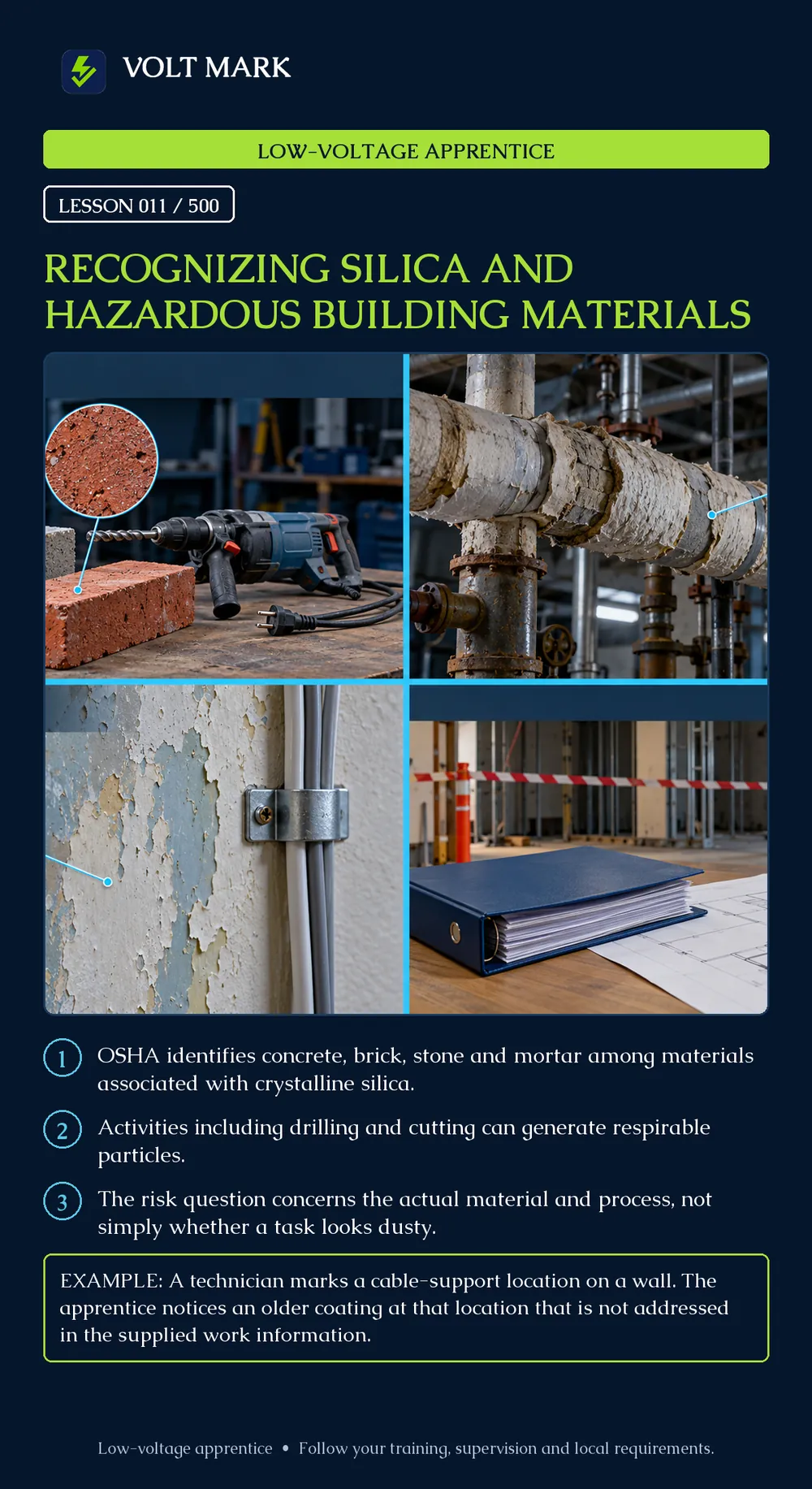
A small low-voltage installation can disturb building material. Before drilling, cutting or scraping, establish what material the task involves and what controls the approved plan requires.
OSHA identifies concrete, brick, stone and mortar among materials associated with crystalline silica. Activities including drilling and cutting can generate respirable particles. The risk question concerns the actual material and process, not simply whether a task looks dusty. [1]
Insulation and coatings raise different questions. OSHA identifies asbestos in historical uses including pipe insulation and building products, and lead in paints and other materials. These are examples of potential sources, not a visual identification guide. [2,3] EPA explains that appearance generally cannot establish whether material contains asbestos and discourages untrained sampling. The cited EPA page concerns homes; workplace assessment and applicable requirements must be determined for the actual site. [4]
For construction work, OSHA has material-specific standards that may apply when work can create exposure to hazardous building materials. OSHA 1926.1153 addresses respirable crystalline silica and includes requirements for covered construction activities involving materials containing crystalline silica. OSHA 1926.1101 addresses occupational exposure to asbestos in construction, including asbestos-containing material (ACM), presumed asbestos-containing material (PACM), information and training requirements, and work that may disturb covered materials. OSHA 1926.62 addresses occupational exposure to lead in construction. Which requirements apply depends on the actual material, activity, exposure potential and work setting. This introductory lesson teaches recognition and referral; it does not authorize sampling, disturbance, abatement or independent selection of exposure controls. [1-4]
Describe the planned task and exact location. Identify where it would disturb existing material. Ask the supervisor which building information and work plan apply. Report any discrepancy between the documents and what is actually present. Do not take a sample, brush away residue or borrow someone else's respirator to solve an unresolved question.
A technician marks a cable-support location on a wall. The apprentice notices an older coating at that location that is not addressed in the supplied work information. The apprentice reports the location before drilling starts. The responsible team checks the assessment and determines the next action. The apprentice does not decide that one small hole will be harmless or that the coating's color identifies it.
Write a report containing task, location, material observation and missing information. Example: "The planned cable-anchor holes are on the west wall of room 115. An existing coating is present there, but the provided work information does not address it. Please confirm the assessment and authorized method before drilling."
Trying to identify hazards by matching a photograph. Pictures can teach what questions to ask. They do not determine the composition or safe handling of the material on your site.
Identify the planned disturbance. Check the material information. Report unresolved conditions and follow the approved work plan.
[1] OSHA 29 CFR 1926.1153 - Respirable crystalline silica: https://www.osha.gov/laws-regs/regulations/standardnumber/1926/1926.1153 [2] OSHA 29 CFR 1926.1101 - Asbestos: https://www.osha.gov/laws-regs/regulations/standardnumber/1926/1926.1101 [3] OSHA 29 CFR 1926.62 - Lead: https://www.osha.gov/laws-regs/regulations/standardnumber/1926/1926.62 [4] EPA - Protect Your Family from Exposures to Asbestos (supplementary; not the occupational authority for construction work): https://www.epa.gov/asbestos/protect-your-family-exposures-asbestos
Supplementary OSHA topic pages, not the regulatory basis: https://www.osha.gov/silica-crystalline https://www.osha.gov/asbestos https://www.osha.gov/lead
Texas journeyman, 15 questions, scored by topic against the 70% mark. No card, and no account needed to start.
Free study material for low-voltage apprentices. This is a national foundation course: requirements differ by state and by local jurisdiction, and a practice that is common in one place is not a rule everywhere. Nothing here is a licence, a certification, or authority to work unsupervised, and completing it does not count as apprenticeship hours or continuing-education credit. Check the codes adopted where you are working, the licensing authority for that work, and your employer's safety programme. VoltMark is not affiliated with, endorsed by, or sponsored by NFPA, OSHA, NICET, BICSI, FOA, or any state or local licensing authority.

Electrician licensing exam prep: practice questions, timed exam simulations, and step-by-step help finding every answer in the NEC.