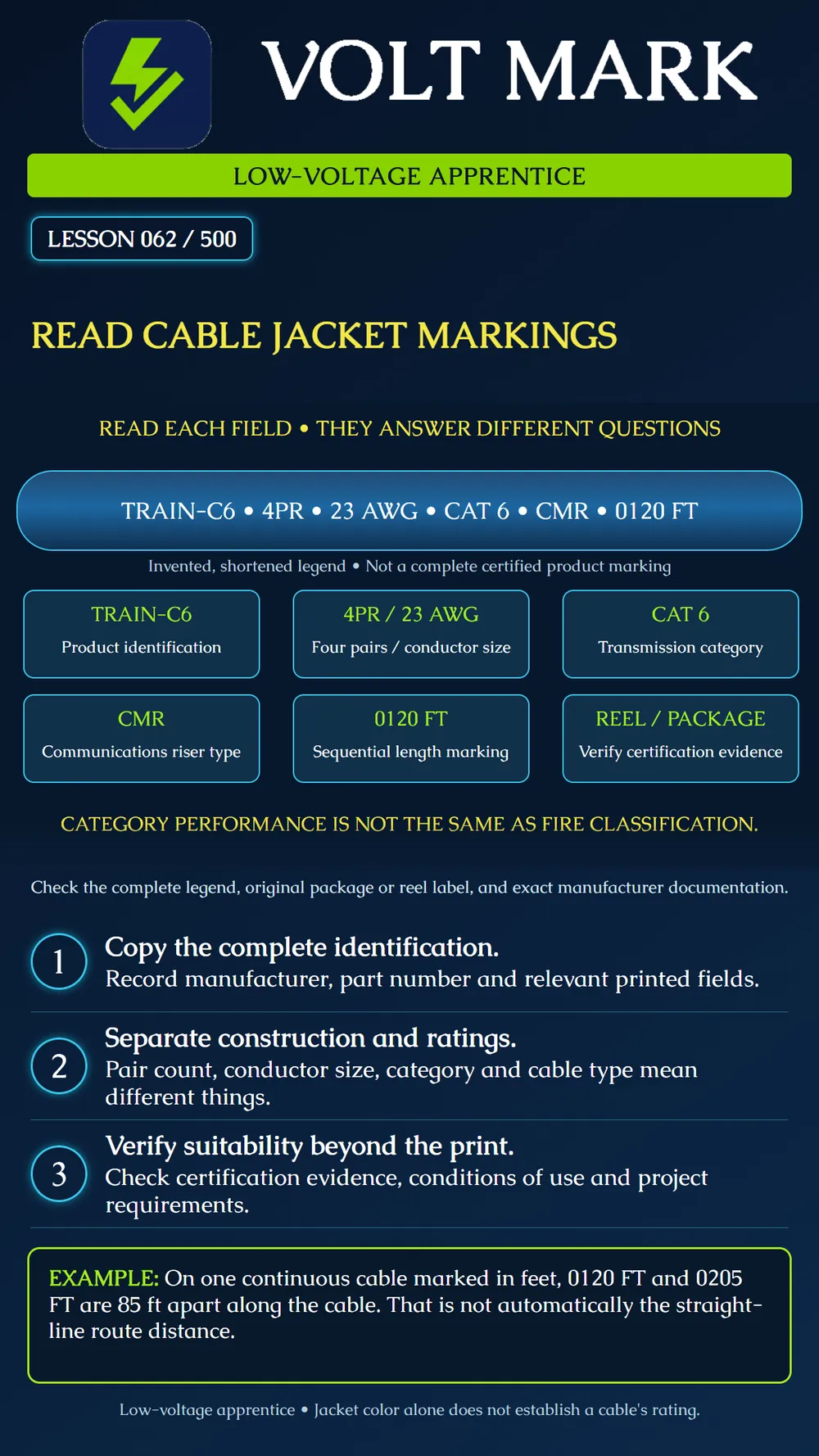
Read a cable's printed legend field by field, distinguish construction from performance and use classifications, and verify the identification against the complete documentation.
Read enough of the repeating print to capture the relevant information. Record the manufacturer and exact product identifier where provided, along with cable type, conductor or pair information, performance markings, and other applicable ratings. Photograph or transcribe the marking through the approved documentation process without damaging installed cable.
Do not fill in an unreadable suffix from memory. Match the actual product to its package or reel information and manufacturer data. If identity remains uncertain, record that uncertainty and obtain clarification before selecting or substituting the cable.
Conductor size is not the outside diameter of the whole cable. Pair count is not a statement of how many network applications are active. A category designation and a cable fire/use classification address different characteristics. Neither one alone answers every installation question.
Other markings may identify voltage, temperature, environmental suitability, manufacturing traceability, or additional certifications. Read their scope and associated documentation. Do not assume a printed voltage is the circuit's operating voltage or that an indoor type marking establishes outdoor, wet-location, or direct-burial suitability.
Use the relevant certification information and the actual product documentation to establish ratings and limitations. UL's application guidance distinguishes cable surface printing from the certification information associated with the tag, reel, or smallest package. Preserve that evidence where required rather than treating any printed letters as sufficient proof.
A performance-verification statement is not automatically the same as a safety listing for a particular use. Look up the exact product and applicable certification category when needed. The following lessons distinguish common cable families and locations; do not infer unrestricted substitution from one familiar suffix.
Sequential markings can increase or decrease along a cable, and their units and intervals depend on the product. Confirm the sequence and unit before subtraction.
For the original example, two points on the same continuous cable read 0120 FT and 0205 FT. The absolute difference is 85 ft of cable between those marks. That value is not automatically the route's straight-line distance, the length between finished connector faces, or a test instrument's reported electrical length. Intermediate slack and the exact measured endpoints matter.
Do not subtract marks from different reels or assume every cable uses feet. Missing, inconsistent, or damaged markings may require another documented measurement method.
An instructor supplies disconnected marked samples with their package labels and data sheets. Copy each complete identifier. Sort the observed fields into identification, construction, transmission performance, cable type, other limits, and traceability or length.
A second sample has a familiar jacket color but unreadable print. Explain why its color cannot establish the same type or rating as the first sample. Record the identification gap rather than assigning a rating by appearance.
The fictional cable has sequential marks 0120 FT and 0205 FT on the same continuous length. First confirm that both numbers use feet and belong to that sequence. Subtract the smaller number from the larger: 205 - 120 = 85 ft. Record 85 ft between the two marked points. Do not call this the room-to-room straight-line distance or finished connector-to-connector length. If one mark came from another reel, this subtraction would not establish a length.
Mistake: Reading CAT 6 as permission to use the cable in any space. Correction: Record transmission category and installation type as separate fields, then verify the actual route and product limitations.
Mistake: Copying an unreadable product suffix from a similar reel. Correction: Match the actual jacket, reel or package identification, and supporting documentation; leave an unresolved suffix unassigned.
Mistake: Calling the difference between length marks the straight-line room distance. Correction: Record the difference as cable between those marks on the same continuous sequence, with units and endpoints; account separately for route geometry and slack.
Mistake: Treating 23 AWG as the complete cable diameter when choosing a fitting. Correction: Read 23 AWG as conductor size and obtain the documented overall cable dimensions for the fitting selection.
UL Solutions, Wire and Cable Application Guide: https://www.ul.com/thecodeauthority/knowledge/wire-cable-guide UL Solutions, Wire and Cable: https://www.ul.com/industries/wire-and-cable Belden 2413 detailed data, example of sequential surface markings: https://catalog.belden.com/techdatam/2413.pdf Sources reviewed September 30, 2026. Apply actual product limitations, adopted requirements, and project specifications.
Texas journeyman, 15 questions, scored by topic against the 70% mark. No card, and no account needed to start.
Free study material for low-voltage apprentices. This is a national foundation course: requirements differ by state and by local jurisdiction, and a practice that is common in one place is not a rule everywhere. Nothing here is a licence, a certification, or authority to work unsupervised, and completing it does not count as apprenticeship hours or continuing-education credit. Check the codes adopted where you are working, the licensing authority for that work, and your employer's safety programme. VoltMark is not affiliated with, endorsed by, or sponsored by NFPA, OSHA, NICET, BICSI, FOA, or any state or local licensing authority.

Electrician licensing exam prep: practice questions, timed exam simulations, and step-by-step help finding every answer in the NEC.