Turn the verified device inventory into an auditable normal and peak load schedule with explicit assumptions.
Identify the supply and voltage rail being evaluated. Use current figures at that supply boundary. Do not simply add currents from different voltage rails or substitute a device's AC input current for its DC output demand. Account for intermediate converters using appropriate input data.
"Normal" must describe a real operating condition. A maximum operating condition may involve more active devices, a different lock state, illumination or alarm operation. Record which events can occur together and their duration. Do not assume loads never coincide merely because they seldom do during observation.
Separate startup transients from sustained operating peaks. A short current pulse has a magnitude and duration; a supply's ability to support it depends on its documented behavior. A continuous rating alone does not establish transient capability. Phoenix Contact's product documentation provides an example of model-specific boost capability, not permission to overload another supply.
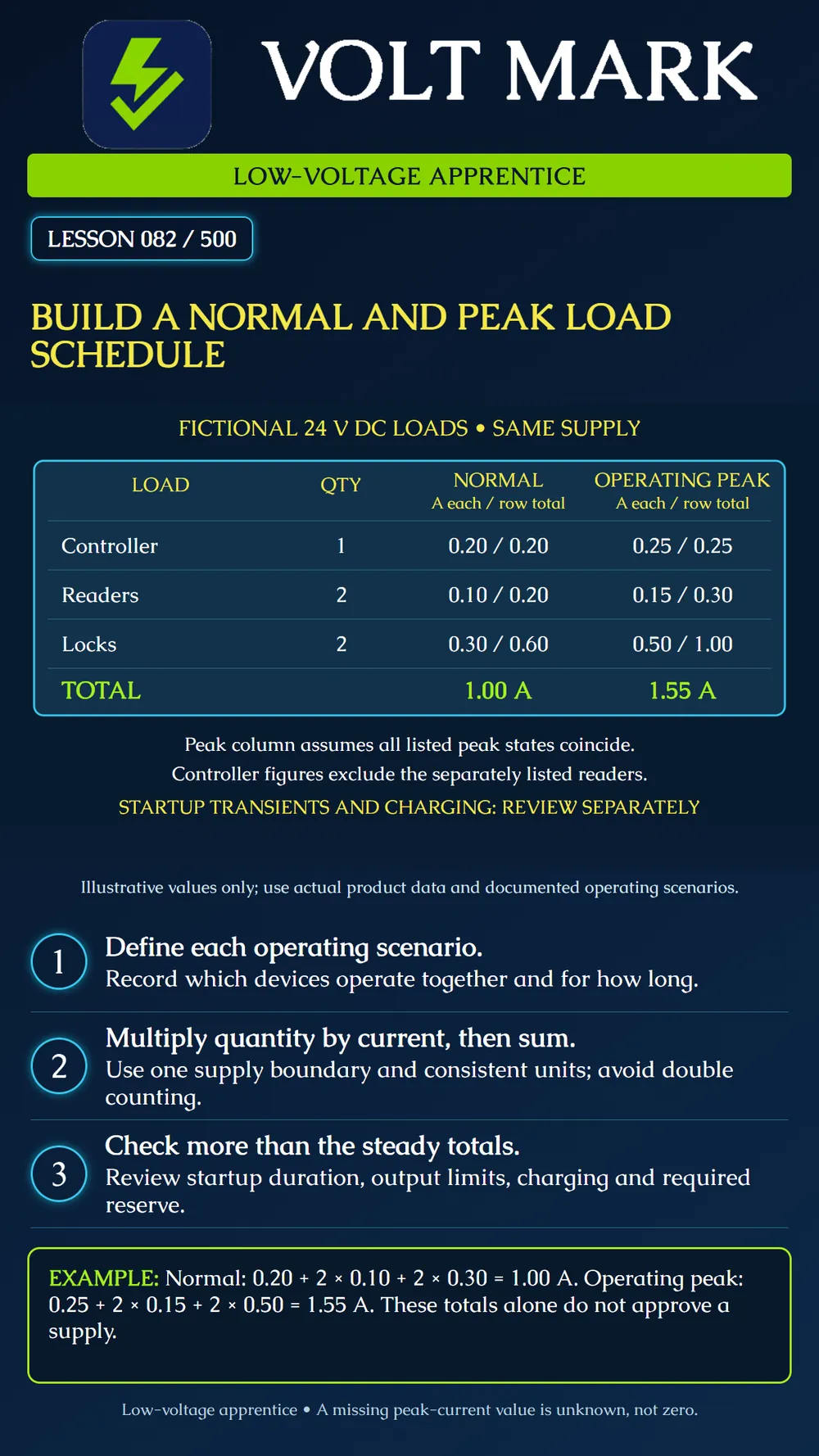
All listed loads are supplied at 24 V DC. For this exercise the controller figures exclude the readers. The two lock models have the fictional state currents shown; these are not typical values or a prediction of how every lock behaves.
Load Qty Normal each Normal row Operating peak each Peak row Controller 1 0.20 A 0.20 A 0.25 A 0.25 A Readers 2 0.10 A 0.20 A 0.15 A 0.30 A Locks 2 0.30 A 0.60 A 0.50 A 1.00 A
Normal total = 0.20 + 0.20 + 0.60 = 1.00 A. Simultaneous operating peak total = 0.25 + 0.30 + 1.00 = 1.55 A.
The peak scenario assumes every listed peak state occurs together. Startup/inrush data and charging treatment are not included in this table and remain unresolved design checks. Therefore 1.55 A is the peak of the stated operating scenario, not a proven absolute maximum demand.
For each row record the exact model, quantity, voltage, current source, operating mode and document revision. State whether a value is typical, maximum, measured or assumed. An undocumented blank remains unknown. Convert units before summing: 150 mA = 0.150 A.
Check what is already included. Adding separately powered readers is appropriate only when they are not already included in the controller's stated demand. Include applicable distribution-board consumption and other accessories in a real schedule; the example is deliberately limited to its listed loads.
Compare the completed schedule with the applicable total supply rating, branch-output ratings and relevant environmental or configuration limits. A fuse rating is not the normal device demand and does not independently establish usable supply capacity.
Read how the actual charger and supply ratings interact. Altronix's AL400ULX guide distinguishes output ratings, charging information and standby specifications. Do not invent a universal subtraction rule or apply that model's ratings to another unit. Required battery capacity and standby duration are separate evaluations.
Apply any reserve, derating or expansion allowance required by the actual design, equipment instructions and governing requirements. This lesson does not impose a universal percentage. Also evaluate voltage delivered at the devices; a correct source-current sum does not prove acceptable voltage at a distant load.
Supply ID and evaluated rail: Device/model/quantity: Normal mode and current: Peak mode, current and duration: Simultaneity assumption: Included and excluded accessory demand: Startup evidence: Charging treatment reference: Total and branch-limit review: Unknowns, reviewer and revision:
Altronix - AL400ULX Installation Guide: model-specific output, charging and standby specifications. https://www.altronix.com/library/pdf/installation_instructions/AL400ULX.pdf Phoenix Contact - QUINT-PS-3X400-500AC/24DC/40 product documentation: distinct output and boost capabilities for that model. Referenced only for the principle of checking actual supply behavior; no mains installation instruction is included. https://www.phoenixcontact.com/en-us/products/power-supply-quint-ps-3x400-500ac24dc40-2938646
All load values are fictional. No actual supply selection or installation is approved by this exercise.
Free study material for low-voltage apprentices. This is a national foundation course: requirements differ by state and by local jurisdiction, and a practice that is common in one place is not a rule everywhere. Nothing here is a licence, a certification, or authority to work unsupervised, and completing it does not count as apprenticeship hours or continuing-education credit. Check the codes adopted where you are working, the licensing authority for that work, and your employer's safety programme. VoltMark is not affiliated with, endorsed by, or sponsored by NFPA, OSHA, NICET, BICSI, FOA, or any state or local licensing authority.

Electrician licensing exam prep: practice questions, timed exam simulations, and step-by-step help finding every answer in the NEC.