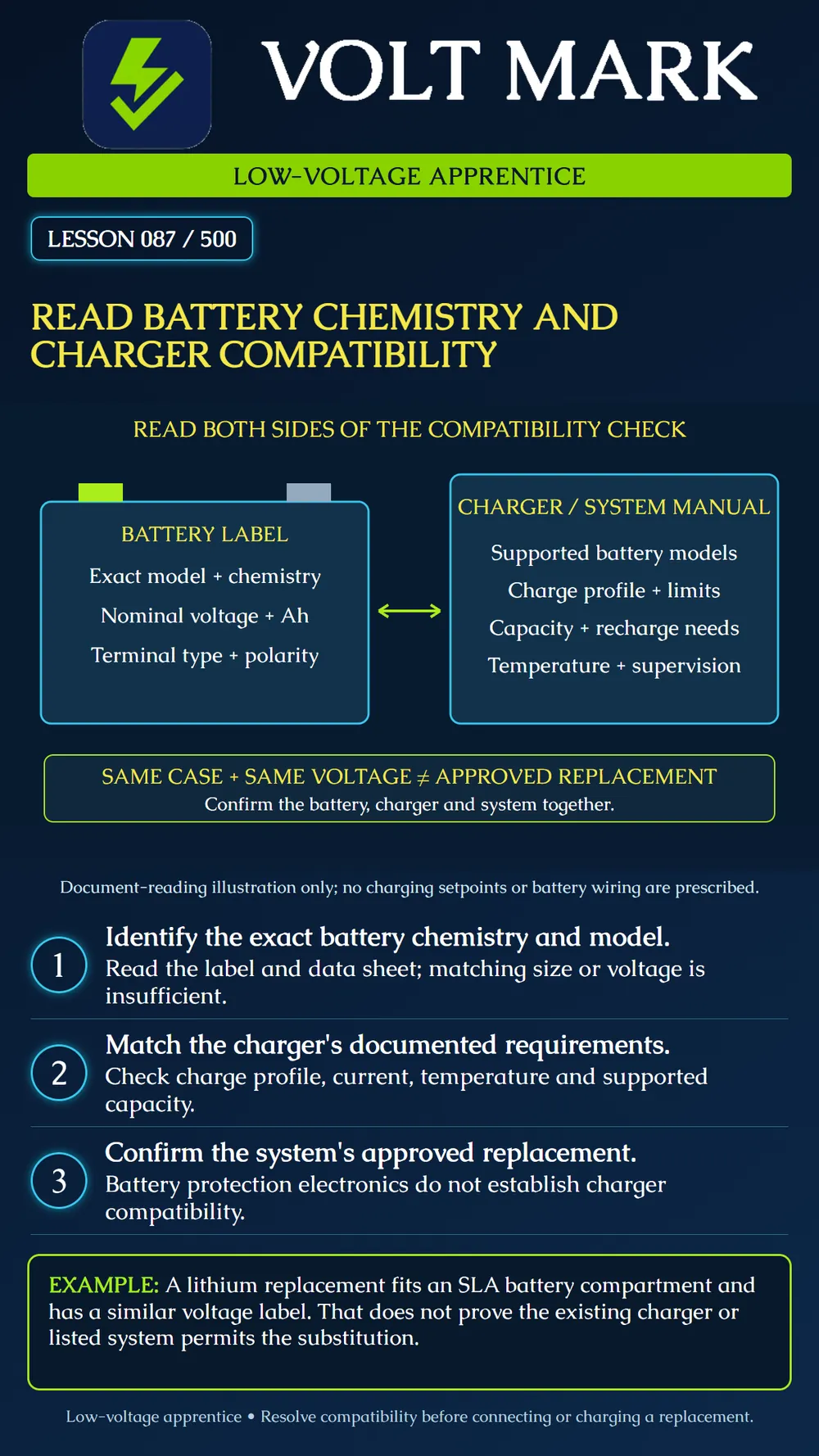
Use battery, charger and system documentation together to decide whether compatibility is established or remains unresolved.
Record its manufacturer, exact model, chemistry, nominal voltage, ampere-hour rating, terminal type and polarity. Read the full data sheet instead of judging by case size or connector appearance.
SLA commonly refers to sealed lead-acid batteries; VRLA means valve-regulated lead-acid. AGM and gel describe different lead-acid constructions. Lithium is also not one universal specification: identify the exact chemistry and pack model. These labels help locate the proper instructions; they do not by themselves approve a charger.
A nominal voltage describes the battery class, not a universal charger setpoint. Charging voltage, current limits, stages and termination behavior come from the exact battery and equipment instructions. A capacity label in Ah is not a charger-current setting and does not alone predict usable runtime.
Power-Sonic's PG-12V100 documentation distinguishes cyclic charging from standby/float service and addresses temperature compensation. Those model-specific details illustrate why a label alone is incomplete. This lesson deliberately supplies no universal charging voltage or current.
Check the supported chemistry, permitted battery models or specifications, capacity range, charge profile and applicable recharge requirements. Confirm the installed equipment revision. A larger battery is not automatically a compatible upgrade: enclosure space, terminals, charging limits, recharge performance and system requirements may differ.
Altronix's AL400ULX product documentation identifies its charger for sealed lead-acid or gel batteries. That statement is specific to the equipment; it does not authorize substituting another chemistry in it.
Check the permitted charging temperature, storage and discharge conditions in the battery instructions. These ranges can differ. Determine whether the system provides required temperature compensation or other controls. Do not apply a rule or setting from one battery model to another.
A battery supplier may describe a product as a replacement for some lead-acid applications. That does not establish that every existing charger, supervised panel or listed assembly accepts it. Obtain applicable compatibility evidence from the responsible equipment manufacturers and follow the approved replacement process.
Power-Sonic's lithium FAQ discusses model-specific charger conditions and battery-management protection. A BMS is not a substitute for matching the charge profile or confirming system compatibility. A pack's protective shutdown can also affect how the system behaves during discharge or supervision; evaluate the actual documentation.
A site record specifies an approved SLA battery. A proposed lithium pack fits the compartment and has a similar nominal voltage. The existing charger instructions do not list that pack or authorize the chemistry change.
Record "compatibility not established" and identify the missing evidence. Do not connect it to see whether it charges. Request the documented approved replacement or obtain a formally resolved compatibility decision through the project's process.
A second candidate has the correct chemistry and nominal voltage, but a different terminal configuration and unsupported capacity. It also remains unresolved. Matching two attributes is not equivalent to matching the complete requirement.
Battery terminals can deliver high fault current even in a low-voltage system. Protect against accidental shorts and follow the equipment's isolation, handling and replacement instructions. Do not continue charging a damaged, leaking, swollen or abnormally hot battery; follow the site's response procedure and manufacturer guidance. This lesson is not a battery-string wiring or energized-service procedure.
Equipment model and revision: Existing specified battery: Candidate battery model and chemistry: Nominal voltage and capacity rating basis: Terminal type, polarity and physical fit: Battery charge requirements: Charger supported profile/current/capacity: Temperature requirements and controls: System approval and supervision evidence: Missing information and final disposition:
The original site record specifies an approved SLA battery. The offered pack is lithium and fits the compartment, but the existing charger documentation does not authorize that chemistry change. Compare the attributes individually: physical fit is established; equal nominal voltage does not establish the charge profile; charger and system compatibility remain unproved. Enter "compatibility not established" with the exact candidate and charger references. Request the documented approved replacement or a resolved compatibility decision. Do not connect the pack as a test. The conclusion follows from the missing compatibility evidence, not a blanket claim that every lithium replacement is prohibited.
Mistake: Replacing the approved SLA battery with lithium because nominal voltage and case size match. Correction: Keep compatibility unresolved until the charger, battery, and system documentation establish an acceptable replacement.
Mistake: Reading the battery's Ah rating as the charger-current setting. Correction: Find the actual model's permitted charging profile and current limits, and compare them with the charger instructions.
Mistake: Assuming a battery-management system makes the pack compatible with any charger. Correction: Verify the pack's supported charging conditions and system behavior; protective shutdown does not replace that comparison.
Mistake: Accepting a matching chemistry while overlooking different terminals or unsupported capacity. Correction: Check polarity, terminal arrangement, capacity range, recharge requirements, and physical installation together.
Altronix - AL400ULX: documented supported battery type and charger features. https://altronix.com/products/AL400ULX Power-Sonic - PG-12V100 data sheet: cyclic/float charging and temperature-dependent requirements; no settings are generalized here. https://www.power-sonic.com/wp-content/uploads/datasheets/pg-12v100.pdf Power-Sonic - Lithium FAQs: product-specific charger compatibility and battery-management functions. Confirm current model documentation before use. https://cdn.power-sonic.com/documents/Lithium-FAQs.pdf
No actual battery replacement or charger adjustment is approved by this lesson.
Texas journeyman, 15 questions, scored by topic against the 70% mark. No card, and no account needed to start.
Free study material for low-voltage apprentices. This is a national foundation course: requirements differ by state and by local jurisdiction, and a practice that is common in one place is not a rule everywhere. Nothing here is a licence, a certification, or authority to work unsupervised, and completing it does not count as apprenticeship hours or continuing-education credit. Check the codes adopted where you are working, the licensing authority for that work, and your employer's safety programme. VoltMark is not affiliated with, endorsed by, or sponsored by NFPA, OSHA, NICET, BICSI, FOA, or any state or local licensing authority.
Electrician licensing exam prep: practice questions, timed exam simulations, and step-by-step help finding every answer in the NEC.