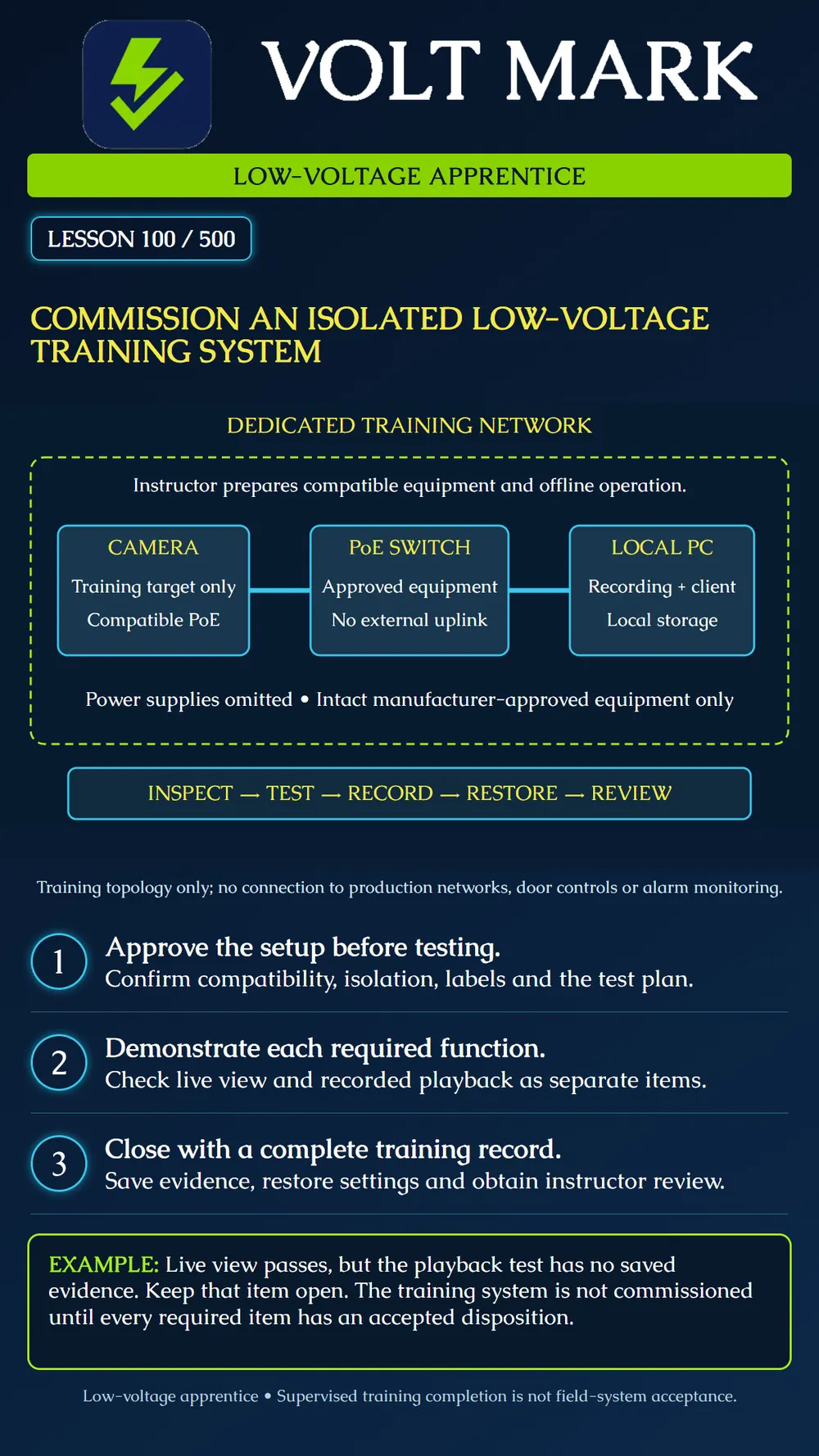
Use the planning, inspection, testing and documentation skills from the foundation lessons to commission a dedicated training setup under instructor supervision.
Use a compatible PoE camera, a dedicated PoE switch and a local computer providing the recording application, client and approved storage. The instructor chooses the actual models, confirms their compatibility and prepares the accounts, software and any required licenses in advance. Verify that the selected configuration can operate locally during the exercise. This diagram is a conceptual topology, not a product bill of materials.
Keep the training network separate from production networks and the internet during the exercise. Confirm that the training computer has no bridging or other active connection that defeats that separation. Do not connect door hardware, building alarm circuits, monitoring receivers or real response services. Aim the camera at an approved training target, not uninvolved people.
The instructor prepares intact manufacturer-approved power equipment and the safe work area. This lesson includes no mains wiring, enclosure opening or live internal measurements. “Isolated” describes the training system's separation from operational systems; it does not mean every component is electrically hazard-free. Power supplies are intentionally omitted from the conceptual diagram.
Review the equipment manuals, approved topology and asset list. Label the camera, switch ports and relevant cables. Inspect equipment condition, cable support and ventilation. Confirm the approved test plan, permitted tasks and stop conditions before the instructor authorizes operation.
Axis documentation treats live viewing and recorded playback as separate functions. Its recorder guidance also requires attention to ventilation and selection of recording storage. These support checking each function individually. The exercise does not assume that an online setup workflow can be completed while disconnected; preparation must resolve any model-specific account, license or setup dependency beforehand.
The instructor supplies the actual configuration and acceptance criteria. For this exercise, create distinct items for:
Do not substitute a live image for playback evidence. Do not invent a universal recording duration, retention period, resolution or frame rate; use the written exercise criteria. Record observations and the corresponding evidence for each item.
Work one checklist item at a time under supervision. Record the actual result, tester and time, and mark unperformed tests NOT TESTED. If a problem appears, stop the affected activity and document the discrepancy. Make only instructor-authorized corrections, then retain both the original result and retest evidence.
Compare settings with the authorized final configuration. Save baseline records, the checklist, asset list, drawing and configuration evidence according to the instructor's storage plan. Protect account secrets rather than placing passwords in the lesson worksheet. The instructor reviews exceptions and the final disposition. No actual training system has been tested by this published example.
Live view has a passing observation. Playback was listed but no test was performed and no evidence exists. Mark playback NOT TESTED, assign its next action and withhold completion of the exercise until the required items are resolved. A fully populated form with invented results is not commissioning.
Approved topology and equipment list: Inspection record: Checklist with criteria, results and evidence: Baseline readings and conditions: Configuration revision and restoration record: Exceptions, corrections and retests: Instructor disposition:
Review a fictional handover packet from the isolated training setup. Asset identification matches the drawing. Live view has recorded evidence. Recording is marked PASS but the packet contains only the live-view screenshot. Playback is NOT TESTED. A temporary test schedule remains active. Write a disposition for each unresolved item and list the actions needed before the instructor can close the exercise. Do not invent a successful test.
Recording lacks evidence for its own criterion; mark that claim unresolved and perform or document the authorized recording check. Leave playback NOT TESTED until the defined interval is retrieved from designated local storage and its result is retained. Keep restoration incomplete until the authorized target schedule is restored and verified under supervision. Retain the original findings and any correction/retest records. Matching labels and successful live view remain separate observations; they do not close the other items.
Mistake: Connecting the training computer to production Wi-Fi while its camera uses the separate switch. Correction: Verify the computer has no active bridge or other connection that defeats the required training-network separation before the exercise.
Mistake: Marking recording and playback passed from a live image alone. Correction: Execute each distinct instructor-approved check and retain its own result and evidence.
Mistake: Writing anticipated results into the checklist before testing. Correction: Keep unperformed items NOT TESTED and record only actual observations with tester, time, and evidence.
Mistake: Completing the final packet while a temporary test setting remains unresolved. Correction: Compare the final configuration with the authorized target and retain the restoration result or open exception for instructor disposition.
AXIS Camera Station Pro User manual, local-server operation, recording configuration, live view and recordings: https://help.axis.com/en-us/axis-camera-station-pro AXIS S4000 Rack Recorder User manual, ventilation, storage selection and setup dependencies: https://help.axis.com/en-us/axis-s4000 Sources illustrate specific manufacturer functions and limitations; they do not establish compatibility for an unspecified training kit.
Scope: Original supervised training exercise for national low-voltage fundamentals. Use the actual equipment instructions and instructor-approved criteria.
Texas journeyman, 15 questions, scored by topic against the 70% mark. No card, and no account needed to start.
Free study material for low-voltage apprentices. This is a national foundation course: requirements differ by state and by local jurisdiction, and a practice that is common in one place is not a rule everywhere. Nothing here is a licence, a certification, or authority to work unsupervised, and completing it does not count as apprenticeship hours or continuing-education credit. Check the codes adopted where you are working, the licensing authority for that work, and your employer's safety programme. VoltMark is not affiliated with, endorsed by, or sponsored by NFPA, OSHA, NICET, BICSI, FOA, or any state or local licensing authority.
Electrician licensing exam prep: practice questions, timed exam simulations, and step-by-step help finding every answer in the NEC.