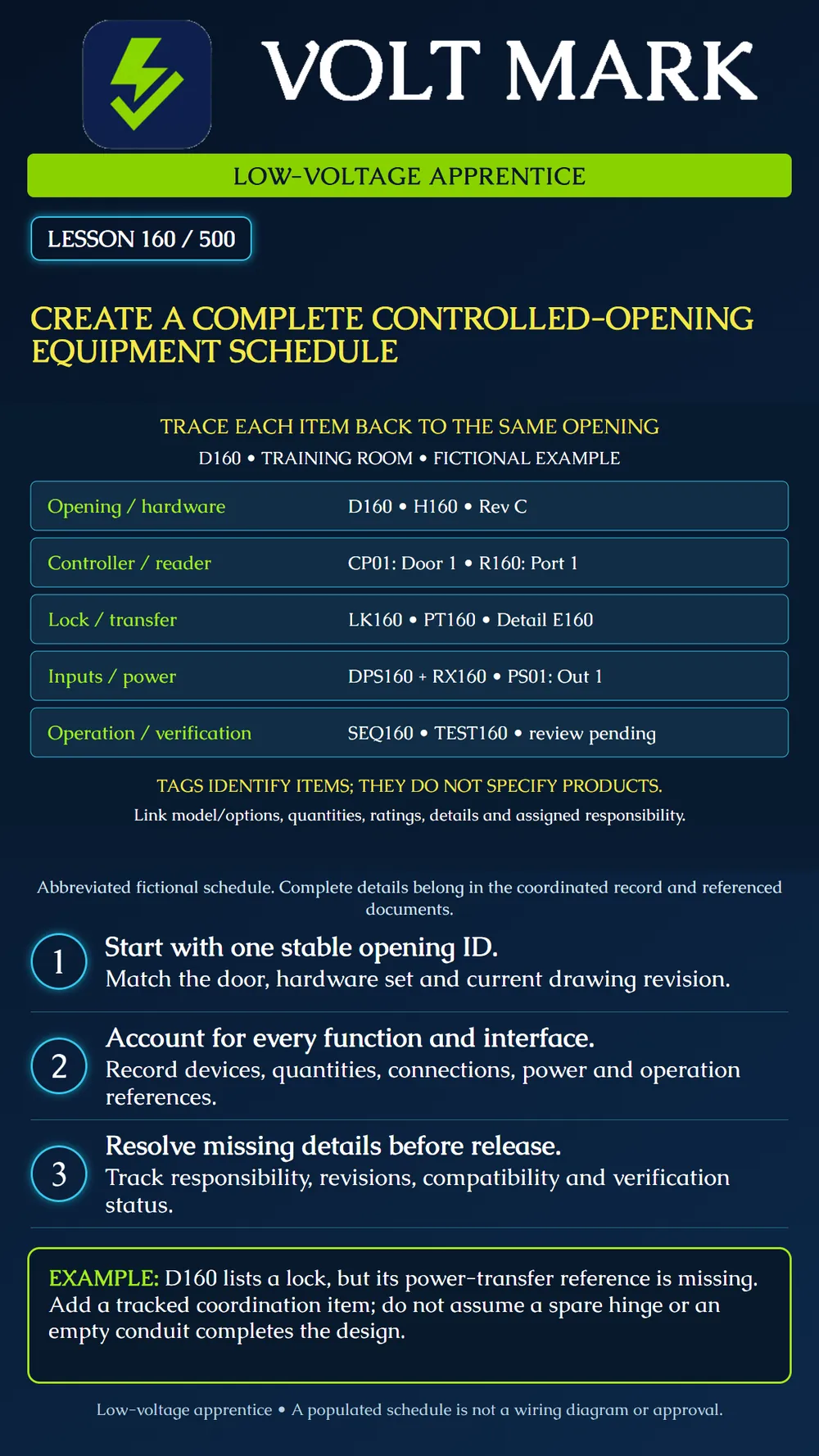
Create a traceable equipment schedule for a controlled opening, identify its supporting documents, and distinguish a coordinated record from an approved installation design.
Begin with the opening identifier used by the project. A room name can change; the opening ID connects the drawing, hardware set, device labels and test record. Confirm the current revision before transferring information. Allegion's report definitions illustrate how opening attributes, hardware sets and assigned products can be linked, and how changes between revisions can be reported. The lesson's example is an original teaching format, not a required national schedule template. [1]
A complete schedule is more than a list of reader and lock quantities. Include the relevant mechanical hardware and the electrical interfaces that make the specified operating sequence possible. Record a manufacturer's full model and ordering options where a product is selected. A device tag is an identifier, not a substitute for those details. Keep unresolved selections explicit instead of filling them with plausible guesses.
Separate physical identity from logical assignment. A controller enclosure may hold several boards; a board can serve more than one opening. Record the panel, board and assigned door or channel as required by the actual system. Record reader interface, input assignments and lock control connections by reference to the approved details. Manufacturer documentation establishes connector functions, supervision options, relay ratings and available power; these cannot safely be inferred from an arbitrary terminal name. For example, the Axis A1610 documentation distinguishes door-monitor inputs, reader connections and relay configurations, including powered versus dry-contact arrangements. This is a product-specific example, not a universal wiring rule. [2]
Power requires its own coordinated reference. Include supply identity, output/circuit assignment, operating voltage, startup and holding demand as applicable, and the related power-budget, voltage-drop and backup calculations. A shared supply is not purchased once per door just because it appears in several opening records. The schedule must distinguish shared equipment from per-opening quantities. Do not treat this list as a sizing calculation.
The poster abbreviates the following record: Opening D160, training room; hardware set H160; revision C. Controller CP01, Door 1; reader R160, Port 1. Lock LK160; power transfer PT160; connection detail E160. Door-position switch DPS160; request-to-exit signal RX160. Supply PS01, Output 1. Operating-sequence document SEQ160; verification record TEST160. Status: coordination review pending.
These tags do not describe actual manufactured products. RX160 names a signal item in the fictional record; it does not establish an egress-release method. CP01 and PS01 are shared-equipment references. The example is not ready for procurement or installation because it does not include the product selections, ratings, drawings or reviewed sequence. Its purpose is to show relationships without inventing a compatible real system.
Use a mock drawing and a fictional product list supplied by your supervisor. Build one opening record, then trace every device from the schedule to its associated drawing or detail. Give each missing reference a responsible person and due action. Now add a second opening using the same CP01 enclosure and PS01 supply. Count per-opening readers and locks separately from shared controller and supply equipment. Explain why two schedule references to PS01 do not automatically mean two physical power supplies. Finally, compare revisions B and C. Identify added, removed and changed items. Retain an audit trail so a purchase order or field crew cannot silently use an obsolete selection.
Ask whether a person unfamiliar with the job could locate the opening, identify every selected item, distinguish shared equipment, find the required connection and operation details, and see unresolved conditions. If not, the schedule is not yet complete for its intended issue. The schedule supports coordination; it does not replace manufacturer instructions, engineering, required code review or acceptance testing.
Answer: No; the record also needs its selected model and options.
Answer: No; issue and approval status must be explicit.
Answer: To link the equipment list to the coordinated current design.
Answer: No; distinguish a shared source from quantities to procure.
Answer: A documented coordination decision and revised supporting details, not an assumed spare component.
Mistake: Using LK160 as the complete lock description on a purchase request. Correction: Add the selected manufacturer, full model and ordering options from the coordinated hardware record; the tag identifies an item but does not specify a purchasable product.
Mistake: Ordering two PS01 supplies because two opening records reference PS01. Correction: Reconcile shared-equipment identity against the equipment quantity list and count per-opening loads separately from the shared source.
Mistake: Treating RX160 in the schedule as a complete exit-release design. Correction: Follow its assigned signal and operating-sequence references and verify the actual release arrangement from the approved details.
Mistake: Marking a populated schedule ready for installation while E160 or SEQ160 is missing. Correction: Keep the coordination status pending, identify the missing reference and assign its resolution before releasing dependent work.
[1] Allegion Overtur Resource Center, Report Definitions. https://support.overtur.allegion.com/hc/en-us/articles/13264186717716-Report-Definitions [2] Axis Communications, AXIS A1610 Network Door Controller documentation. https://help.axis.com/en-us/axis-a1610
Texas journeyman, 15 questions, scored by topic against the 70% mark. No card, and no account needed to start.
Free study material for low-voltage apprentices. This is a national foundation course: requirements differ by state and by local jurisdiction, and a practice that is common in one place is not a rule everywhere. Nothing here is a licence, a certification, or authority to work unsupervised, and completing it does not count as apprenticeship hours or continuing-education credit. Check the codes adopted where you are working, the licensing authority for that work, and your employer's safety programme. VoltMark is not affiliated with, endorsed by, or sponsored by NFPA, OSHA, NICET, BICSI, FOA, or any state or local licensing authority.
Electrician licensing exam prep: practice questions, timed exam simulations, and step-by-step help finding every answer in the NEC.