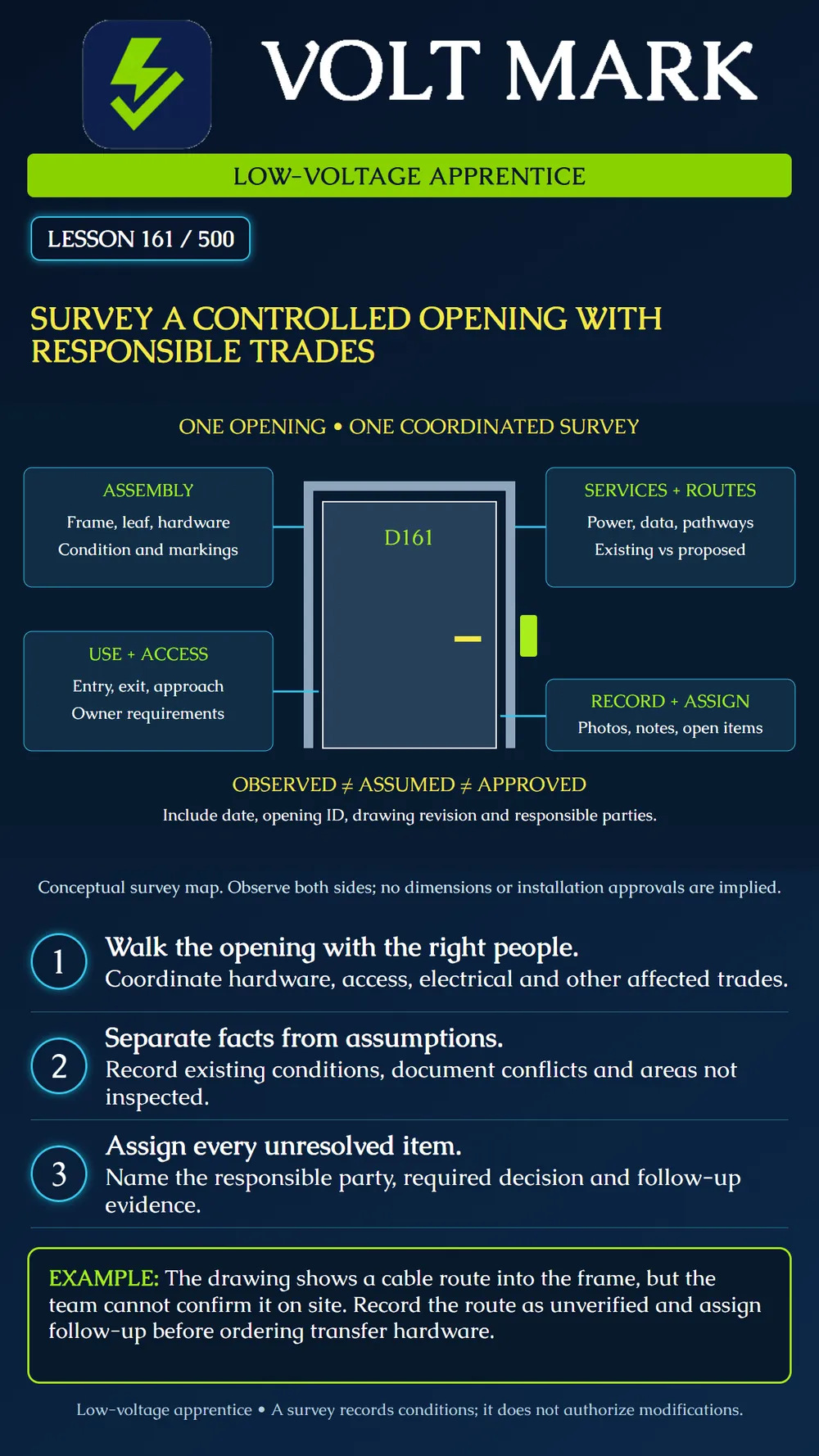
Participate in a coordinated opening survey, create a useful existing-condition record, and assign unresolved questions without presenting assumptions as verified facts.
A controlled-opening survey brings the physical door and the project documents together. Begin by identifying the building, level and opening ID. Check that the drawing and hardware schedule refer to the same opening. Bring the current revision and identify who can answer questions about hardware, electrical services, access control, facility operations and design. Other participants may include the network, fire-alarm, accessibility or rated-assembly specialists when their scope is affected. This is a coordination model; the project establishes each party's contractual responsibilities.
Agree on the survey's limits before work starts. Identify occupied areas, operating hours, access permissions and any required service coordination. An apprentice does not open energized equipment or defeat a protective function just to obtain a photograph. Any intrusive inspection or operational test needs the appropriate authorized personnel, preparation and site procedure. Keep the occupied route usable and avoid creating a new obstruction.
Inspect the opening as an assembly. Record leaf and frame type, visible hardware, markings, handing convention and existing condition. Observe both sides where access is authorized. Describe a symptom before assigning its cause: "door rubs at upper latch edge" is stronger evidence than "bad electric strike" when no diagnosis has been performed. SDI's steel-door guidance identifies several mechanical causes of poor operation, including alignment, binding and frame conditions; more complex changes require manufacturer consultation. A low-voltage problem report should not overlook the mechanical opening. [1]
Review the approach as well as the opening itself. Locate the reader, operating hardware and any planned changes. Record obstacles, thresholds and the clear spaces that the responsible reviewer needs to evaluate. The Access Board's door guidance addresses these features together with operation and maneuvering requirements. A survey photograph alone does not establish accessibility compliance, and an apprentice should not invent a universal clearance for every approach. [2]
Trace services through documents and authorized observation. Identify the proposed controller, power source, network connection and cable route. Mark a concealed route as unverified if it has not been confirmed. Distinguish an existing empty raceway, a proposed raceway and a route that only appears in an old drawing. Record whether power-transfer hardware is present and whether its identity is known. Do not assume an existing cable or hinge has the required conductors or ratings.
Ask the facility representative how the opening is used: who enters, who exits, when the door is attended, which operating periods matter, and what known trouble occurs. Record requested behavior separately from approved design requirements. A request for different exit behavior can require specialist review; it is not an instruction to change the programming during the walk.
Create one coordinated record. Allegion's field-survey tools demonstrate the practice of associating opening data, notes and photographs with the opening. The tool is optional; the essential result is a traceable record that the project team can use. [3]
The D161 drawing shows a route into the hinge jamb. During the walk, the door-hardware installer identifies the existing hinge but cannot confirm an electrical transfer. The access installer cannot trace the concealed route. The facility representative remembers a previous renovation, but has no revised drawing. Write: "Route and transfer provision unverified; existing hinge identity recorded; drawing revision and survey photographs attached." Assign the responsible trade to establish the permitted inspection method and provide findings for the design team. Do not order an assumed transfer product or drill the frame from memory.
Use a secured training opening and mock drawings. Have one learner record physical observations, one track document differences, and one record questions for the facility representative. The supervisor establishes permitted observations and any demonstration. Create three columns: observed fact, source or evidence, unresolved question. For example, a photographed label can support the statement that a marking is present; it does not prove the entire modified assembly still meets every requirement. Review the record together and remove unsupported conclusions.
Include opening ID and location; survey date and participants; drawing/schedule revisions; annotated photographs from both sides where permitted; existing hardware and visible markings; measurements with units and reference points when taken; approach conditions; identified services and routes; owner requests; discrepancies; areas not inspected; and assigned follow-up actions. For each open item, record who will respond, what decision or evidence is needed, and how the final response will be linked to the schedule. Protect sensitive site information according to the owner's requirements. Do not include passwords, credential secrets or unnecessary personal details in the survey package.
Answer: Mechanical, electrical and operational conditions overlap at an opening.
Answer: No. Record whether it has actually been verified.
Answer: No. Required design, manufacturer and authority decisions remain separate.
Answer: A clear question, supporting evidence and a named responsible party.
Answer: No. It is input to the coordinated design and review process.
[1] Steel Door Institute, SDI 122-21, Installation Troubleshooting Guide for Standard Steel Doors and Frames, reaffirmed 2026. https://steeldoor.org/sdi-122/ [2] U.S. Access Board, Chapter 4: Entrances, Doors, and Gates. https://www.access-board.gov/ada/guides/chapter-4-entrances-doors-and-gates/ [3] Allegion, Overtur OnSite App. https://discover-overtur.allegion.com/en/product/overtur-onsite-app.html
Free study material for low-voltage apprentices. This is a national foundation course: requirements differ by state and by local jurisdiction, and a practice that is common in one place is not a rule everywhere. Nothing here is a licence, a certification, or authority to work unsupervised, and completing it does not count as apprenticeship hours or continuing-education credit. Check the codes adopted where you are working, the licensing authority for that work, and your employer's safety programme. VoltMark is not affiliated with, endorsed by, or sponsored by NFPA, OSHA, NICET, BICSI, FOA, or any state or local licensing authority.

Electrician licensing exam prep: practice questions, timed exam simulations, and step-by-step help finding every answer in the NEC.