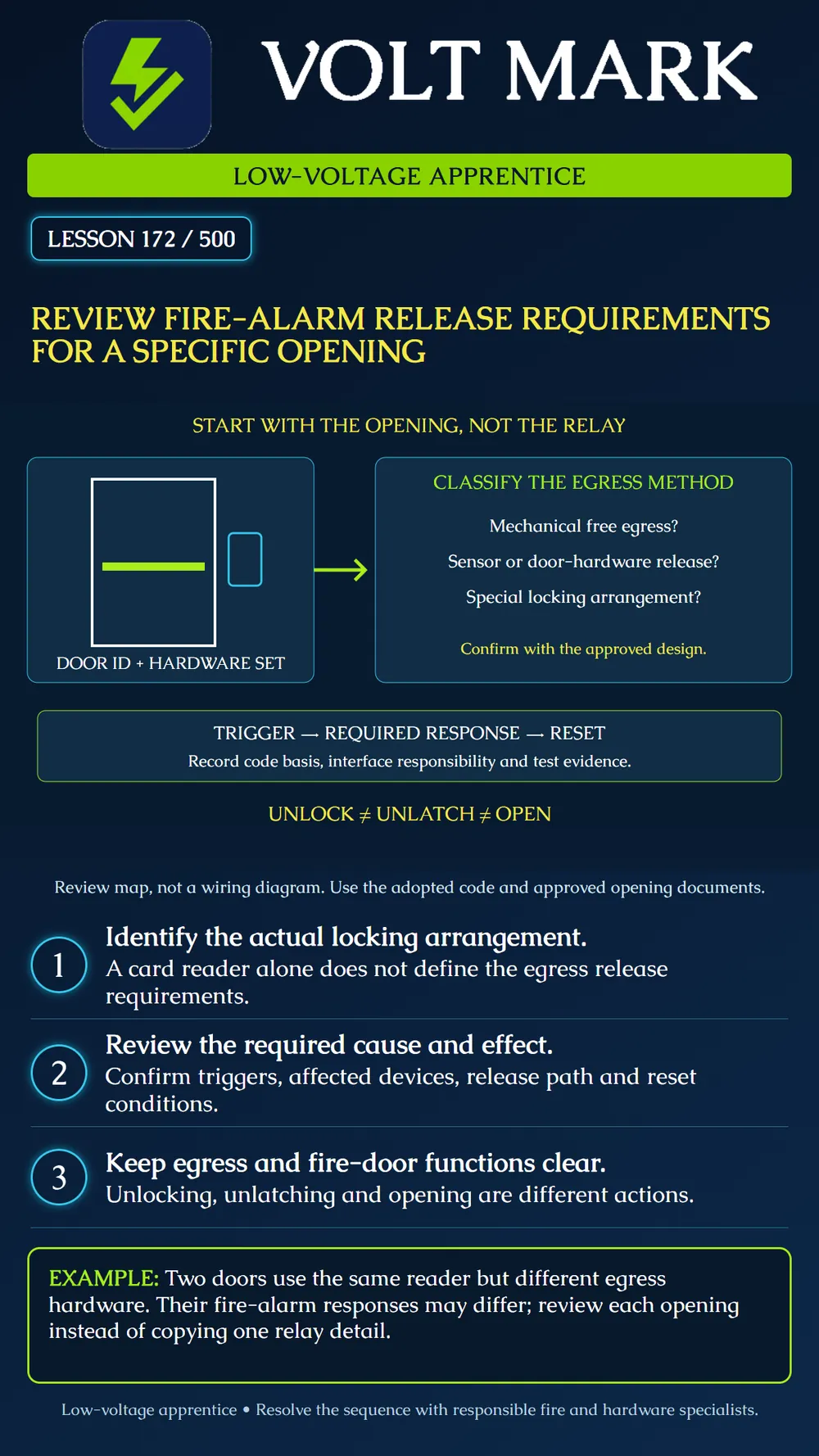
Prepare an opening-specific review record that identifies the egress arrangement, applicable approved fire-alarm response, responsible reviewers and unresolved questions. Do not turn a generic access-control diagram into a life-safety design.
A credential reader controls an access request; its presence does not classify how a person exits. Identify the physical opening, both sides of the door, its hardware set and its actual egress operation. Ordinary ingress control with mechanical egress, sensor release, door-hardware release, delayed egress and controlled egress are not interchangeable descriptions.
ICC's 2020 educational article distinguishes several electrical egress-locking arrangements using the 2018 IBC. It explains that the egress requirements still apply when access control is added. Use that article for vocabulary, not as proof that its edition, occupancy limits or section numbers govern a current project. Source: https://www.iccsafe.org/building-safety-journal/bsj-technical/doors-in-the-means-of-egress-electrical-locking-systems-permitted-by-the-codes/
Allegion's electromagnetic-lock guidance differentiates sensor-release and door-hardware-release arrangements. In its model-code discussion, sensor-release systems include fire alarm/sprinkler release among the required release methods; the door-hardware-release provisions it describes do not impose that same alarm-release requirement. Both have additional conditions. This is a bounded comparison, not permission to omit an interface on a particular project. Source: https://idighardware.com/2022/07/faqs-about-electromagnetic-locks/
Allegion also explains that unlocking only during a fire alarm generally does not make a door that otherwise prevents required egress acceptable. Special locking arrangements have specific qualifying conditions. An alarm-release relay is not a substitute for the required normal egress method. Source: https://idighardware.com/2023/03/qq-fire-alarm-release-of-electrified-locks/
For each project, identify the adopted building, fire and life-safety provisions, their editions, local amendments and applicable approved design. Record the responsible authority having jurisdiction (AHJ). Requirements can depend on occupancy, the opening's location and purpose, fire rating, stair reentry, the permitted locking arrangement and other project conditions. Do not label a lesson example as approved in every state.
Gather the door schedule, hardware set, approved access-control and fire-alarm drawings, sequence or cause-and-effect matrix, product instructions, relevant listings and applicable code references. Verify the revision of each document. A drawing for a similar door or an old floor plan is not evidence for this opening.
Record the exact device affected by a release. Does the sequence concern an electromagnetic lock, electrified trim, an electric strike, a delayed-egress function, an automatic operator or a hold-open device? Keep those functions separate. A command to permit entry is not the same as retracting a latch, and releasing a hold-open device is not the same as unlocking an access lock. Confirm required closing and latching with the responsible hardware/fire-door professional.
Ask the responsible design team to identify which initiating condition produces which response at this door. Avoid vague entries such as 'fire input unlocks everything.' The record should identify the approved source/condition, interface reference, affected devices, required response, any required maintained state and the conditions for reset or restoration. Do not assume alarm silence, fire-panel reset and restoration of the access system are identical events.
Review how the specified release path behaves with the actual power supplies and backup arrangement. Do not invent a terminal connection, contact state or software rule from a generic diagram. Product compatibility and required release operation belong in the approved details. Document who owns the fire-system side, who owns the access-control side and who verifies the physical hardware response.
A training packet contains two fictional openings, D172-A and D172-B, with identical readers. A has documented mechanical egress hardware. B is labeled 'electrically locked' but has no confirmed egress-release classification. A copied sketch shows one fire relay serving both.
The apprentice should not conclude that both must unlock or that neither needs release. First verify A's approved sequence and any other applicable requirement. For B, mark the egress classification and release requirements unresolved. Ask the hardware/design specialist and fire-alarm designer to reconcile the schedule, device list and cause-and-effect record. Preserve the disagreement in the review log until an authorized resolution identifies the correct revision. Do not connect or test the copied detail while it is unresolved.
The exercise is complete when each opening has a traceable review result: approved document reference, exact expected response, responsibility and remaining issue status. It is not complete merely because a relay has available contacts.
On paper, label the opening's entry and egress sides and identify the hardware without modifying it. Write a three-column table: trigger; required response; reset/restoration condition. Add a source reference and reviewer to each row. If information is missing, write 'unresolved' instead of guessing. Explain how a later supervised acceptance test could compare observed behavior with that approved table. Live fire-interface testing belongs to the coordinated process in the next lesson.
Answer: No; determine the opening's arrangement and applicable approved requirements.
Answer: No.
Answer: No; identify the physical function required.
Answer: No; review the actual opening and sequence.
Answer: Record the conflict and obtain an authorized, traceable resolution before dependent installation or testing.
Mistake: Copying the same fire-relay detail to D172-A and D172-B because their readers match. Correction: Identify each opening's actual egress arrangement and approved sequence, leaving B's classification unresolved until the responsible reviewers determine it.
Mistake: Treating alarm-only unlocking as proof that normal egress is acceptable. Correction: Obtain the approved normal egress method and applicable special-locking review separately from the fire-alarm response.
Mistake: Writing unlock when the required function is release of a hold-open device. Correction: Name the affected hardware and exact required physical response, including applicable closing and latching behavior, in the cause-and-effect record.
Mistake: Assuming alarm silence, fire-panel reset and access-system restoration are the same trigger. Correction: Record the approved maintained state and separate reset or restoration conditions for each affected device and interface.
ICC, Doors in the means of egress: Electrical locking systems permitted by the codes (2020; discussion of 2018 IBC). https://www.iccsafe.org/building-safety-journal/bsj-technical/doors-in-the-means-of-egress-electrical-locking-systems-permitted-by-the-codes/ Allegion, FAQs About Electromagnetic Locks (2022). https://idighardware.com/2022/07/faqs-about-electromagnetic-locks/ Allegion, QQ: Fire Alarm Release of Electrified Locks (2023). https://idighardware.com/2023/03/qq-fire-alarm-release-of-electrified-locks/ These historical model-code discussions support vocabulary and review questions, not a determination of the requirements adopted for a particular project.
Texas journeyman, 15 questions, scored by topic against the 70% mark. No card, and no account needed to start.
Free study material for low-voltage apprentices. This is a national foundation course: requirements differ by state and by local jurisdiction, and a practice that is common in one place is not a rule everywhere. Nothing here is a licence, a certification, or authority to work unsupervised, and completing it does not count as apprenticeship hours or continuing-education credit. Check the codes adopted where you are working, the licensing authority for that work, and your employer's safety programme. VoltMark is not affiliated with, endorsed by, or sponsored by NFPA, OSHA, NICET, BICSI, FOA, or any state or local licensing authority.

Electrician licensing exam prep: practice questions, timed exam simulations, and step-by-step help finding every answer in the NEC.