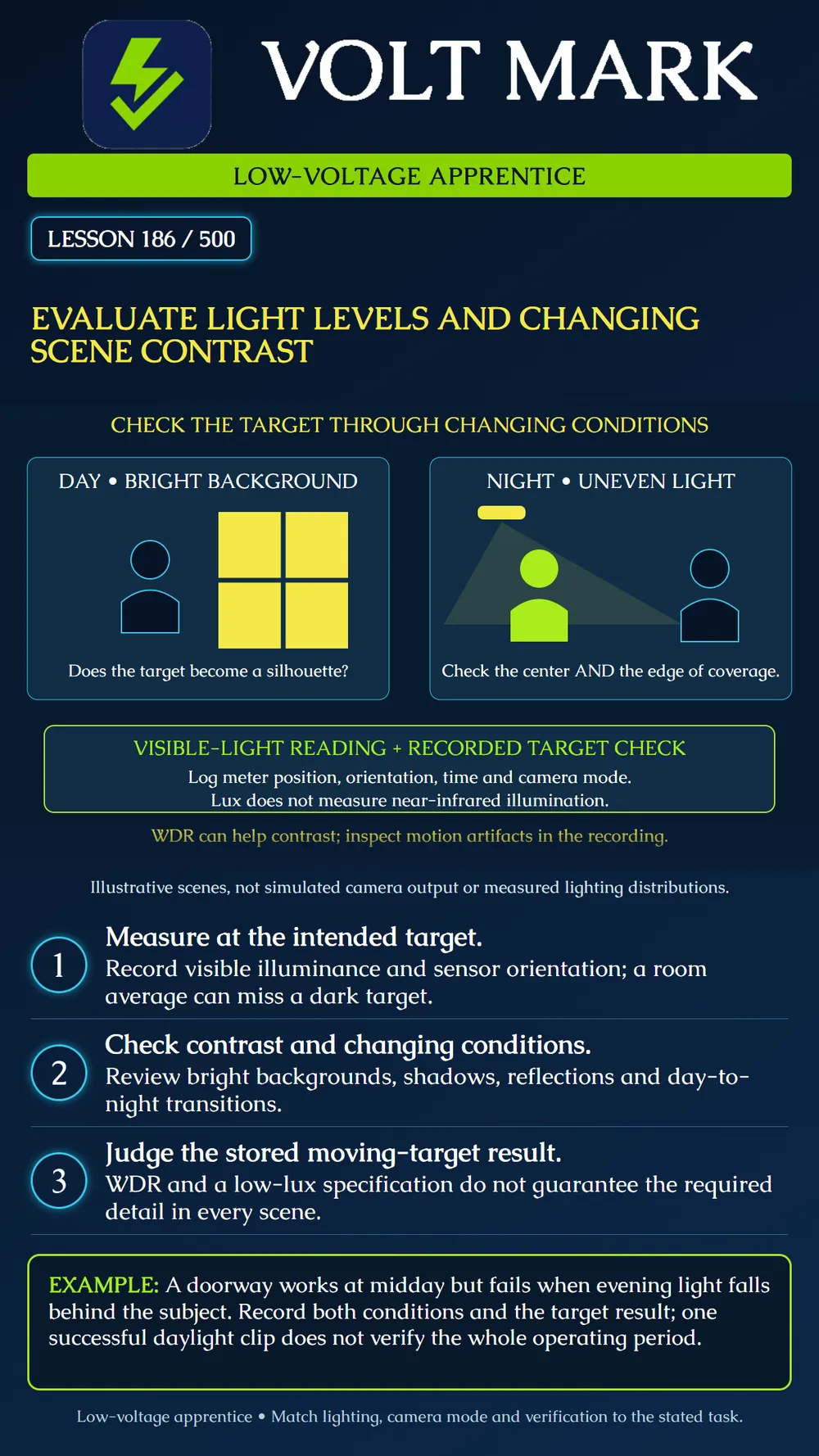
Describe lighting at a security-camera target, identify changing bright/dark conditions and plan checks of actual recorded detail. Separate measurements from conclusions about task performance.
Illuminance describes light arriving at a surface. Visible illuminance is measured in lux. The camera receives light reflected toward it; two surfaces under the same illumination need not appear equally bright. Meter location and orientation therefore belong in the record. Lux does not quantify near-infrared illumination, so a visible-light reading cannot certify an IR-assisted view. Minimum-lux specifications also depend on test conditions and the meaning of an acceptable image. These principles apply to planning nationwide; no universal camera acceptance lux value is assigned here.
A dim subject against a bright doorway can be difficult even when another part of the room is well lit. Wide dynamic range processing can retain information across bright and dark regions, but implementations and scenes differ. Multiple-exposure WDR may create ghosting or motion artifacts; flickering sources can introduce banding or pulsing. A datasheet's dynamic-range number alone does not establish the moving-target result.
A fictional lobby camera is intended to show a visitor carrying a labeled training parcel through the entrance. The brief requires the label to be readable in the stored recording. It does not merely require a person-shaped object to be visible. Mark the entrance, the target route and two check positions. Ask when exterior light can shine behind the visitor. Ask what changes after interior lamps switch to their scheduled night setting. Prepare observations for midday, the difficult sun angle, the lighting transition and the intended nighttime mode. If any condition cannot be observed, mark it pending. Do not replace a missing evening check with a second midday check.
For each authorized visible-light measurement, record the instrument and relevant check/calibration status, time, weather or artificial-light state, target location and height, detector orientation, reading and units. Follow the meter's operating instructions and avoid shading its detector with your body. A reading made horizontally on a desk is not automatically representative of a vertical label or face elsewhere. Explain which plane was measured and why. Do not divide arbitrary lux readings from different surfaces and label the result a calibrated camera dynamic-range measurement.
Use the intended recording stream and playback path. Note image mode, exposure behavior, gain, WDR state and any illuminator setting available to the authorized tester. Compare the agreed task with stationary and representative moving targets. Record observations such as "parcel visible; label unreadable during motion" rather than "camera bad." Note whether the detail is lost in shadow, washed out in a highlight, obscured by a reflection or disrupted by an artifact. Keep requested settings separate from observed outcomes. A WDR checkbox marked on is not a task-performance result.
At midday, the label is readable. At evening, the target becomes dark against the opening. The appropriate conclusion is that the tested midday condition succeeded and the tested evening condition did not. Candidate design changes may include revisiting view direction, appropriate lighting or camera configuration. The responsible designer selects a change; repeat the relevant recording comparison afterward. A night image looks brighter after a setting change but the moving label is now smeared. Brightness alone is not the success criterion. An IR-assisted monochrome image shows the parcel outline clearly, but the brief requires its color. Record that mismatch instead of treating the brighter picture as proof the color task was met.
Include test conditions, source readings, clips or clip references, settings, task outcomes, untested conditions and unresolved issues. Preserve the original evidence before an authorized setting change. Do not silently remove a difficult condition from the agreed operating requirement.
A fictional lobby record contains two clips of the same marked parcel route: the midday label is readable; at low evening sun the label becomes a dark patch against the doorway. No night clip is supplied. The learner enters "midday reading task passed," "tested evening task failed," and "night not tested." An unrelated bright desk reading cannot overturn the evening observation because it describes a different location and plane. The learner requests target-plane measurement context and a designer-approved investigation of lighting, view and camera settings. Any correction must be followed by the evening route test again. These decisions use supplied fictional evidence, not a universal lux threshold.
Mistake: Measuring a convenient horizontal desk and reporting it as the light at a vertical parcel label. Correction: Measure at the specified target plane with the meter's documented orientation and record location, lighting state and units.
Mistake: Treating a brighter WDR image as a successful moving-label test. Correction: Inspect the actual recorded moving label for detail and artifacts and compare with the agreed reading task.
Mistake: Using a visible-light lux reading to certify the IR-assisted night view. Correction: Record the visible-light reading for its proper purpose and separately test the required target in the actual night mode.
Why can equal illuminance yield different recorded brightness on two objects?
Answer: Their surfaces can reflect different amounts of light toward the camera.
Why is an unobserved lighting condition left pending?
Answer: A test provides evidence for the condition actually captured, not every sun angle or scheduled lighting state.
Axis Communications, Lighting for network video: https://whitepapers.axis.com/en-us/lighting-for-network-video Basis: illumination, reflection, visible-light measurement and IR distinction. No marketing sensitivity claim is treated as an acceptance guarantee. Axis Communications, Wide dynamic range: https://whitepapers.axis.com/en-us/wide-dynamic-range Basis: bright/dark scene handling and WDR artifacts. Original scenarios and worksheet above are teaching exercises.
Texas journeyman, 15 questions, scored by topic against the 70% mark. No card, and no account needed to start.
Free study material for low-voltage apprentices. This is a national foundation course: requirements differ by state and by local jurisdiction, and a practice that is common in one place is not a rule everywhere. Nothing here is a licence, a certification, or authority to work unsupervised, and completing it does not count as apprenticeship hours or continuing-education credit. Check the codes adopted where you are working, the licensing authority for that work, and your employer's safety programme. VoltMark is not affiliated with, endorsed by, or sponsored by NFPA, OSHA, NICET, BICSI, FOA, or any state or local licensing authority.

Electrician licensing exam prep: practice questions, timed exam simulations, and step-by-step help finding every answer in the NEC.