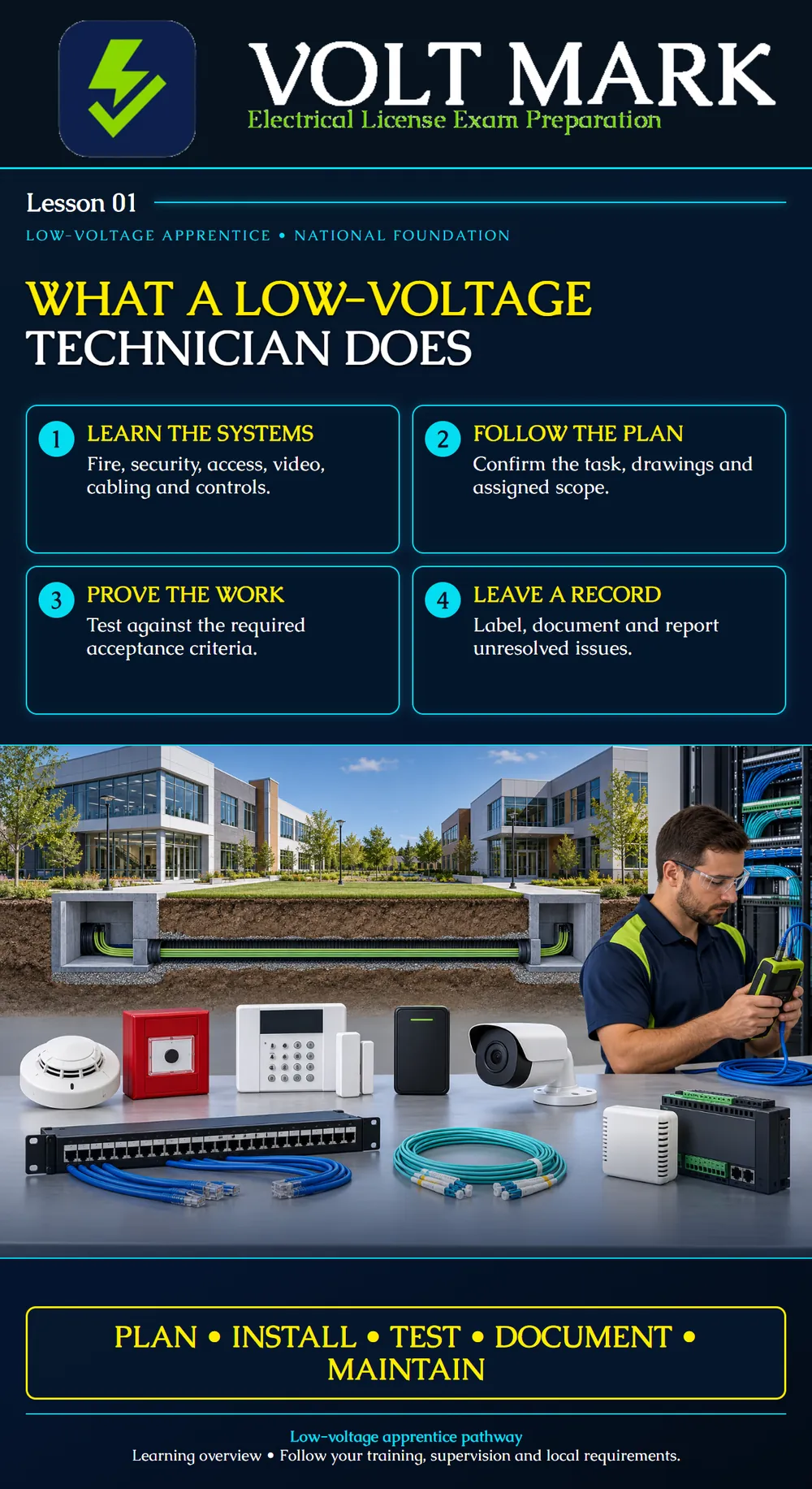
After this lesson, you should be able to name the main systems in this course, describe the technician's basic workflow, and recognize when a task needs additional training, supervision or jurisdiction-specific review.
Low-voltage technicians help install, configure, test, maintain and troubleshoot building and communications systems. Work can involve devices, cable pathways, copper and fiber connections, software settings, measurements and project records. Different technicians specialize in different parts of that work; the job title alone does not establish permission to perform every specialty. [1][2]
A cable that looks neatly installed is only part of a working system. The technician must understand what the equipment is supposed to do, compare observed results with the project's requirements, and leave records that another person can follow.
These are course groupings, not six universal license categories. Other lessons address intercoms, audio, wireless and specialty systems. No single image can show every device or every responsibility. [1][2]
PLAN: Identify the task, drawings, equipment instructions, assigned responsibilities and conditions needing clarification. An apprentice should know who is supervising the work.
INSTALL: Perform the assigned installation steps within the approved scope. Keep labels and records current instead of trying to reconstruct everything at the end.
TEST: Compare actual operation and measurements with the defined acceptance criteria. “It turns on” and “it passed the required tests” are different statements.
DOCUMENT: Record device identity, location, cable identification, settings where appropriate, measurements and unresolved problems. Do not put customer passwords in ordinary job notes.
MAINTAIN: Use the owner's service process and appropriate procedures to investigate faults, make authorized changes, retest and update records.
Your supervisor gives you a drawing for a small office project. It shows two cameras, one badge reader, an equipment rack and a fiber connection to another building.
Your first assignment is to compare the delivered equipment labels with the device schedule and flag anything that does not match.
You find three issues:
A useful response is to record each discrepancy, identify where you found it, and ask the supervisor to resolve it before dependent work proceeds. Guessing a substitute, choosing a new route or changing a controlled door's behavior would go beyond this assignment.
This exercise teaches a habit: distinguish what you know, what the documents say, and what still needs a decision.
This introductory course lesson does not grant a license, qualify you to work without required supervision, or authorize changes to an operating fire-alarm or access-control system. It does not establish a universal voltage threshold for the trade.
Do not assume an apparently low-voltage cable is isolated or harmless. Do not perform electrical work, enter electrical equipment, or test on or near exposed energized parts unless the specific task has been assigned and you have the training, qualification, authorization and supervision required for that work. The next lesson examines hazards, including stored energy, nearby electrical equipment and the work environment.
No equipment operation, live wiring or site access is needed.
For each fictional item, identify the system family and the next appropriate action:
Practice answers:
Answer: No. Actual work authority depends on the person's role, qualifications, supervision and applicable requirements.
Answer: Testing, followed by documentation and ongoing maintenance. In practice, planning and documentation also continue throughout the job.
Answer: No. Acceptance depends on the required checks and their recorded results.
Answer: Yes. This course includes optical communications from building links through campus and industrial systems.
Answer: Record it and obtain a decision from the responsible person before dependent work proceeds.
Explain the six illustrated families in your own words. Put PLAN, INSTALL, TEST, DOCUMENT and MAINTAIN in sequence. Correctly identify the next action in all five paper scenarios. Revisit any answer that assumes permission to change a system without the required authority.
Mistake: treating the six course families as nationwide license categories. Correction: they organize learning; the actual system and job location determine which licensing questions to research. Mistake: accepting an installation because a power light is on. Correction: compare the required tests with their recorded results; an indicator does not establish the complete system response. Mistake: substituting a delivered device that looks similar to the scheduled model. Correction: record the model mismatch and obtain the responsible decision before dependent installation, because appearance does not establish compatibility or approval.
Sources support occupational scope, not permission to practice in a particular state. Scenarios and questions are original fictional teaching exercises. [1] O*NET, Security and Fire Alarm Systems Installers: https://www.onetonline.org/link/details/49-2098.00 [2] U.S. Bureau of Labor Statistics, Telecommunications Technicians: https://www.bls.gov/ooh/installation-maintenance-and-repair/telecommunications-equipment-installers-and-repairers-except-line-installers.htm Research date: September 30, 2026.
Texas journeyman, 15 questions, scored by topic against the 70% mark. No card, and no account needed to start.
Free study material for low-voltage apprentices. This is a national foundation course: requirements differ by state and by local jurisdiction, and a practice that is common in one place is not a rule everywhere. Nothing here is a licence, a certification, or authority to work unsupervised, and completing it does not count as apprenticeship hours or continuing-education credit. Check the codes adopted where you are working, the licensing authority for that work, and your employer's safety programme. VoltMark is not affiliated with, endorsed by, or sponsored by NFPA, OSHA, NICET, BICSI, FOA, or any state or local licensing authority.

Electrician licensing exam prep: practice questions, timed exam simulations, and step-by-step help finding every answer in the NEC.