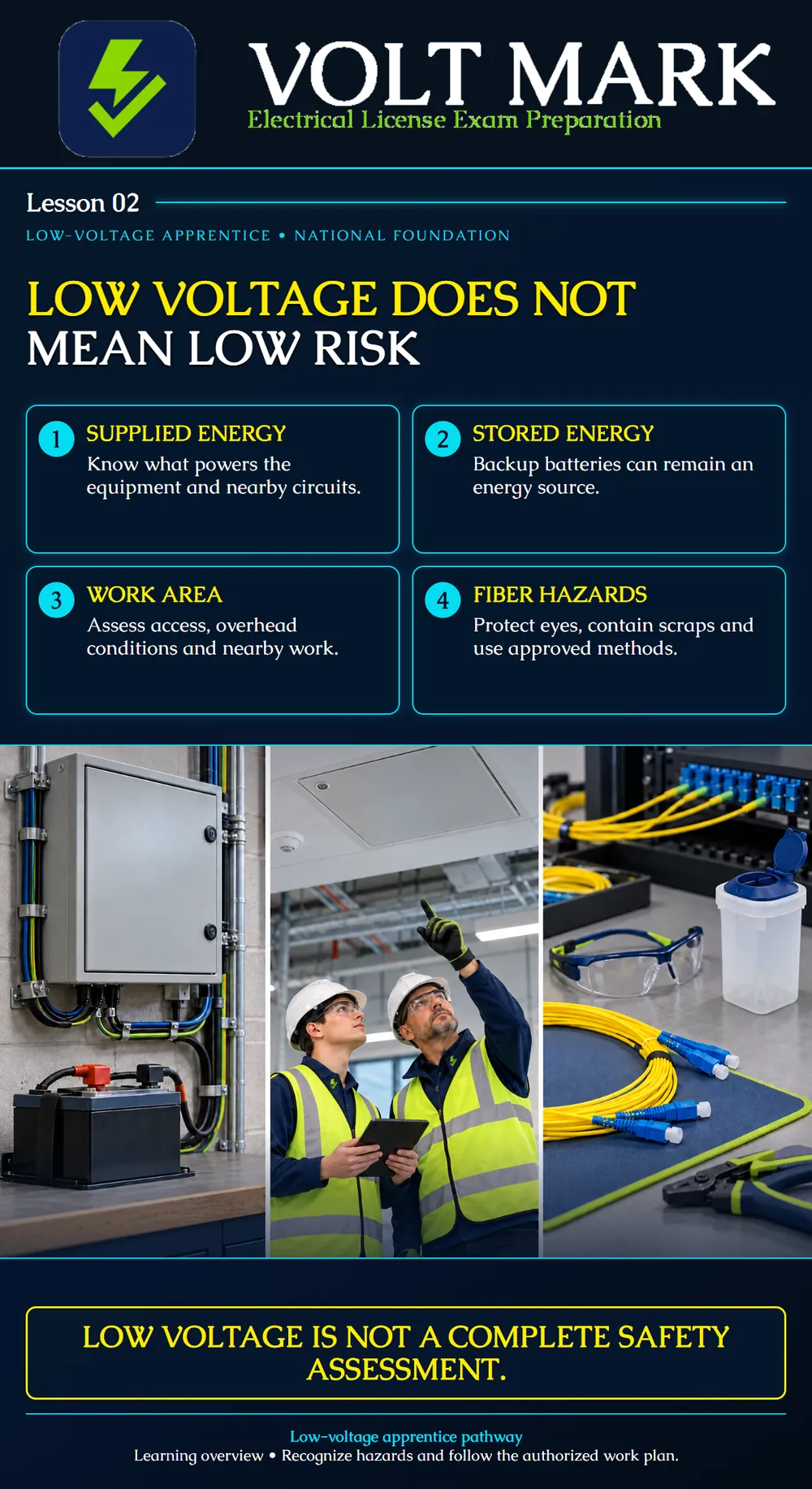
Identify three different sources of risk on a low-voltage job. Explain why a device voltage label is not a complete hazard assessment. Describe an appropriate response when a hazard or work boundary is uncertain.
“Low voltage” describes part of a system; it does not describe every hazard around the task. A technician may encounter electrical sources, stored energy, access hazards and fiber materials on the same visit. Evaluate the actual job rather than deciding that all equipment in a low-voltage room is safe to touch.
Electrical hazards can involve shock, burns and fire. The nearby equipment and how the worker could contact it matter. For construction work, OSHA 1926.416 addresses locating electrical circuits that the work could contact and protecting employees from electrical contact. An apprentice should report an uncertainty and obtain the employer’s approved plan through the responsible supervisor or qualified personnel, not invent an isolation method. [1]
A supervisor asks a new apprentice to inventory labels on closed equipment without opening it. The apprentice notices a battery connection shown on a drawing. Another worker says, “The building power is off, so just remove the cover and check inside.”
What is known? The assigned task is an external label inventory. The drawing indicates another potential source. What is unknown? Whether an approved energy-control procedure has been completed and whether this apprentice is trained and authorized for the proposed new task.
The appropriate response is to stay within the original task, report the requested change to the responsible supervisor and obtain a safe, authorized plan. The apprentice does not need to prove that an injury will happen before raising the uncertainty.
Mistake: Treating a small voltage number as a complete safety assessment. Correction: Identify sources, exposure, surroundings and the specific activity.
Mistake: Treating an indicator light that is off as proof of isolation. Correction: Do not use a display state as a substitute for the applicable employer-approved energy-isolation and verification procedure.
Mistake: Treating optical cable as ordinary harmless string. Correction: Account for shards, inspection equipment and optical sources.
Mistake: Assuming that another trade checked the work area. Correction: Confirm the responsibilities and assessment for your own task.
For each fictional situation, record a hazard or uncertainty and the next action:
Answer guide:
Identify the issue and appropriate referral in all four scenarios. Explain the difference between recognizing a hazard and being qualified to control or test it.
National introductory teaching. Specific occupational-safety requirements depend on the work setting and applicable federal or state-plan rules. The construction reference below is not automatically the procedure for every maintenance setting. No state license or supervision requirement is waived.
[1] OSHA, 1926.416, General requirements: https://www.osha.gov/laws-regs/regulations/standardnumber/1926/1926.416 [2] OSHA, Lithium-ion Battery Safety: https://www.osha.gov/sites/default/files/publications/OSHA4480.pdf Battery chemistry matters; this source is specific to lithium-ion hazards. [3] FOA, Fiber Optic Safety: https://www.thefoa.org/tech/ref/safety/safe.html
Texas journeyman, 15 questions, scored by topic against the 70% mark. No card, and no account needed to start.
Free study material for low-voltage apprentices. This is a national foundation course: requirements differ by state and by local jurisdiction, and a practice that is common in one place is not a rule everywhere. Nothing here is a licence, a certification, or authority to work unsupervised, and completing it does not count as apprenticeship hours or continuing-education credit. Check the codes adopted where you are working, the licensing authority for that work, and your employer's safety programme. VoltMark is not affiliated with, endorsed by, or sponsored by NFPA, OSHA, NICET, BICSI, FOA, or any state or local licensing authority.

Electrician licensing exam prep: practice questions, timed exam simulations, and step-by-step help finding every answer in the NEC.