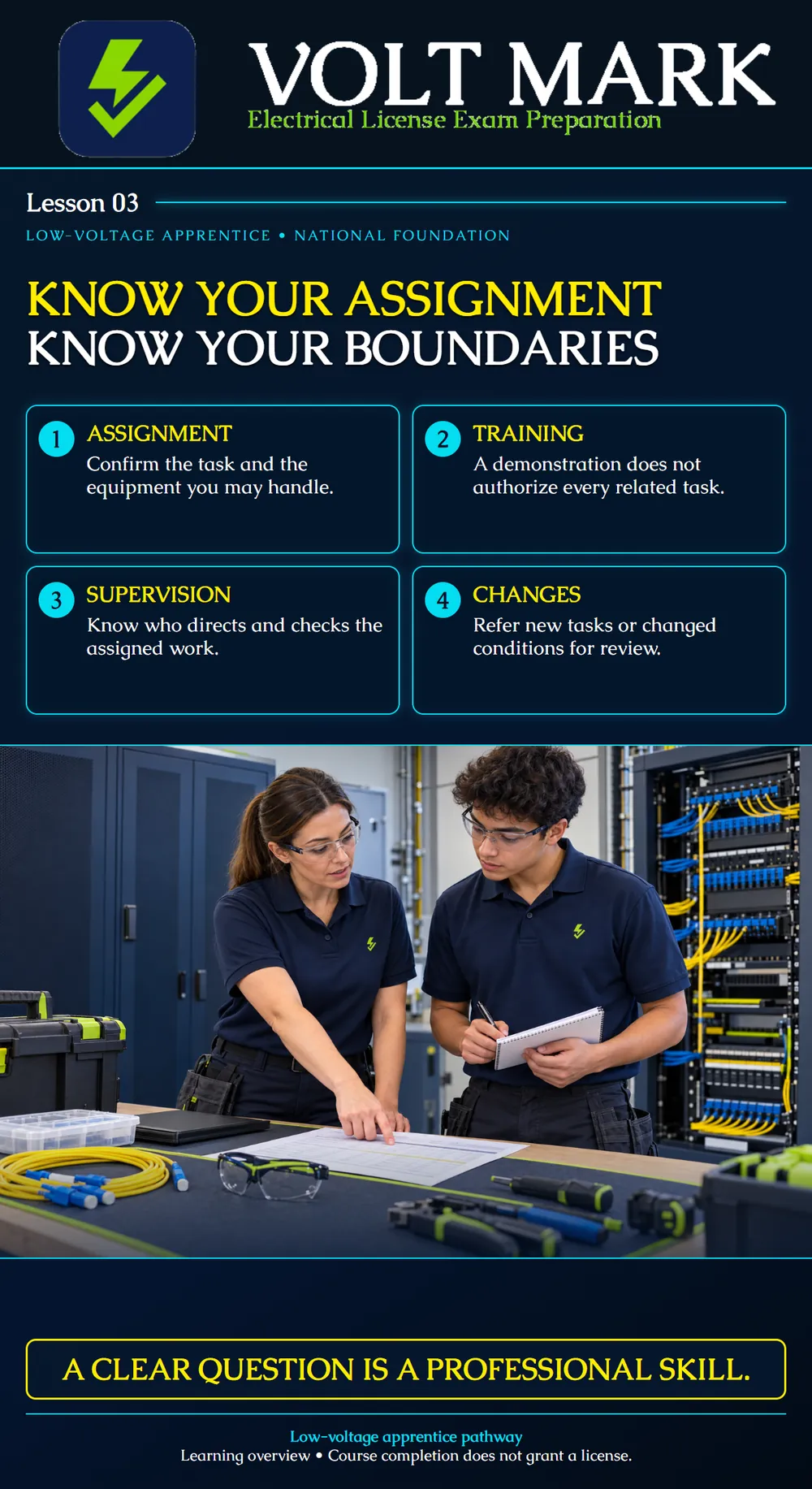
Describe the assignment before starting. Separate a task you have been taught from one you have been authorized to perform. Recognize a change that requires the responsible supervisor's decision.
An apprentice contributes by doing assigned work carefully, recording what was actually done, and reporting uncertainty promptly. Asking a precise question is a useful trade skill. It gives the supervisor a chance to resolve an issue before it becomes a defective installation or an unsafe activity.
Before starting, be able to explain: the task; the equipment or documents involved; the person responsible for supervision; the conditions that require you to pause; and how your completed work will be checked. Those five points form this lesson's assignment checklist. They are a course practice tool, not a universal legal definition of supervision.
You may have watched a demonstration without being authorized to repeat it on an operating system. You may be authorized to label a closed enclosure without being authorized to open it or change its contents.
For construction rules, OSHA 1926.32 defines an authorized person in terms of specific duties or locations approved or assigned by the employer. Its competent-person definition combines the ability to identify existing and predictable hazards with authorization to take prompt corrective measures. Section 1926.32 also defines “qualified” based on recognized credentials or extensive knowledge, training and experience, together with demonstrated ability related to the subject matter, work or project. These terms must be read in the context of the applicable rule. A job title or online course completion does not automatically satisfy every role. [1]
OSHA 1926.21(b)(2) places a construction-work training responsibility on the employer concerning unsafe conditions and the employee's work environment. The training needed for one task is not proof of preparation for every other task. Ask for the instruction relevant to the activity actually assigned. [2]
Task: What exact result am I responsible for? Equipment: What may I handle, and what must remain untouched? Supervision: Who gives direction and checks the work? Change: What conditions require a new decision? Evidence: What records show what I completed?
A female lead technician assigns a new male apprentice to compare labels on packaged devices with the approved equipment schedule. The apprentice may open the shipping cartons, record model numbers and organize the inventory. The lead will review discrepancies.
A customer asks the apprentice to install one reader immediately because the doorway is convenient to reach.
The requested work is a different assignment. It involves an opening and system behavior that were not included in the inventory task. The apprentice records the request and refers it to the lead. Being physically able to attach a reader does not resolve authorization, approved design, qualifications or supervision.
A useful response is: “I am checking the delivered equipment. I will bring this installation request to our lead so the work can be assigned and reviewed correctly.”
“I saw somebody do it.” Observation is not the same as documented preparation and authorization. “The customer asked me.” A customer request does not resolve the employer's work assignment or applicable requirements. “I only changed one setting.” A small configuration change can affect system behavior; treat changes according to the actual scope. “My supervisor is somewhere on the project.” Do not invent a universal supervision arrangement. Confirm the requirement for the activity and location.
Write the five-point assignment checklist for this fictional job: You are asked to identify cable labels on a disconnected training board and record any mismatch with its drawing. You must not remove terminations. The instructor reviews the record.
Model answer: Task: compare cable identifiers with the drawing. Equipment: inspect the isolated trainer as instructed; do not remove terminations. Supervision: designated instructor. Change: missing labels, conflicting drawings or a request to alter wiring. Evidence: a dated discrepancy sheet identifying each affected terminal or cable.
Now identify the correct response:
Answers:
Explain all five assignment-check items and correctly resolve the three change scenarios. No hands-on credential is awarded by this paper exercise.
No statewide apprentice ratio, proximity rule or credential exemption is asserted here. Research the actual jurisdiction, system, employer responsibilities and work setting. The cited OSHA provisions concern construction; other settings can have different applicable requirements.
[1] OSHA 1926.32, Definitions: https://www.osha.gov/laws-regs/regulations/standardnumber/1926/1926.32 [2] OSHA 1926.21, Safety training and education: https://www.osha.gov/laws-regs/regulations/standardnumber/1926/1926.21
Texas journeyman, 15 questions, scored by topic against the 70% mark. No card, and no account needed to start.
Free study material for low-voltage apprentices. This is a national foundation course: requirements differ by state and by local jurisdiction, and a practice that is common in one place is not a rule everywhere. Nothing here is a licence, a certification, or authority to work unsupervised, and completing it does not count as apprenticeship hours or continuing-education credit. Check the codes adopted where you are working, the licensing authority for that work, and your employer's safety programme. VoltMark is not affiliated with, endorsed by, or sponsored by NFPA, OSHA, NICET, BICSI, FOA, or any state or local licensing authority.
Electrician licensing exam prep: practice questions, timed exam simulations, and step-by-step help finding every answer in the NEC.