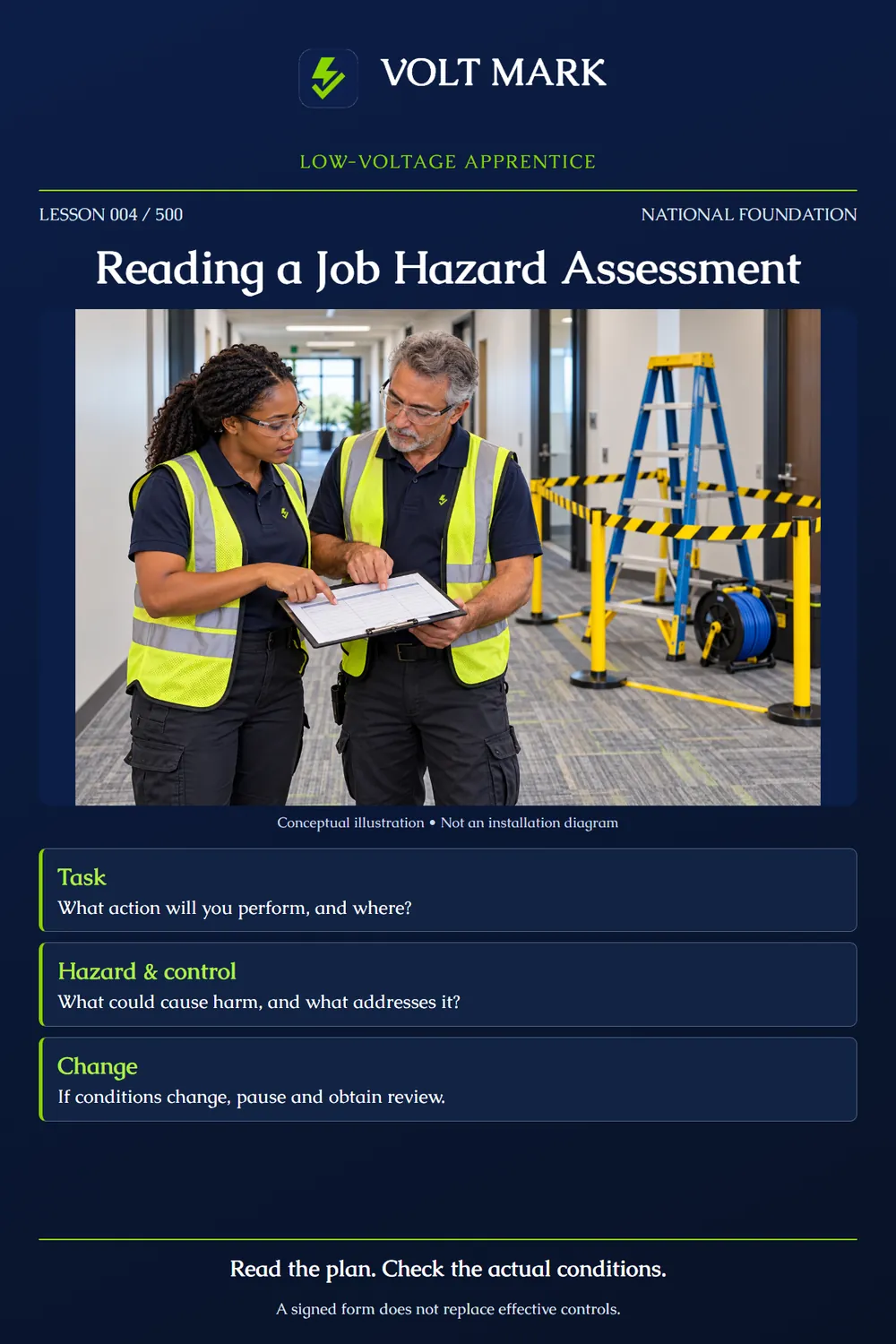
Find the task, hazards and controls in a job hazard assessment. Explain why a generic instruction such as “be careful” is incomplete. Recognize when site conditions no longer match the assessment.
A job hazard analysis examines a job in steps, considering the worker, task, tools and environment. Its purpose is to identify hazards and decide how they will be addressed before exposure occurs. Employers may use different form names and formats. Read what the form actually covers instead of relying on its title. [1]
An apprentice's role in this lesson is to understand the assigned plan, identify a mismatch and report it. Reading or signing a form does not by itself qualify someone to select every control or supervise every hazard.
Task step: What action is being considered? Hazard: What could cause harm during that action? Control: What specific measure addresses that hazard? Responsibility: Who establishes the measure and checks that it is in place? Change trigger: What new condition requires the task to be reviewed?
The last two questions are part of this course's reading checklist; your employer's form may organize them differently.
A hazard description is more useful when it explains the exposure and possible event. “Cable reel” names an object. “A reel placed in the walking route could trip a person” describes a potential event. OSHA's worksheet encourages analysis of individual job steps and the conditions that could produce harm. [2]
OSHA's prevention guidance uses a hierarchy of controls that includes elimination, substitution, engineering controls, administrative or work-practice controls, and personal protective equipment. Selecting suitable controls requires the actual conditions and relevant expertise. A generic PPE instruction does not establish that every hazard has been adequately addressed. [3]
The planned task is to inventory packaged network devices at a worktable. The supervisor's plan calls for keeping the adjacent corridor clear and reporting any need to change the setup.
The apprentice notices that a newly delivered reel has been placed in that corridor. The assessment was written before delivery.
Useful observation: “The reel is now in the route that the plan says must stay clear.” Unhelpful response: “We already signed the form, so it must be fine.”
The apprentice reports the mismatch and pauses any affected handling task. The responsible person arranges the appropriate correction and confirms the plan before work continues. This example does not authorize the apprentice to lift or move an unfamiliar heavy reel.
Task: bring packaged devices to a designated worktable. Potential event: stored materials could obstruct the planned pedestrian route. Proposed action for responsible review: arrange storage and delivery so the identified route stays clear, and check it before handling begins. Unresolved information: package weights, handling method, actual access requirements and nearby work. This row illustrates the reasoning. It is not sufficient approval for a real material-handling job.
Wrong task: the form describes cable pulling, but the assignment changed to drilling. Wrong location: a copied assessment assumes an empty room, but occupants are present. Vague control: “Use PPE” does not identify the protection or the exposure it addresses. Missing decision: nobody is identified to resolve an unassessed condition. Stale assumption: the route or equipment has changed since the assessment.
Rewrite each weak entry as a question for the responsible person:
Model responses:
Identify task, hazard, control, responsibility and change trigger in the fictional example. Explain all four practice responses. Apply the employer's actual process during supervised work.
This is a reading exercise, not a complete safety program or task authorization. Employer procedures, applicable occupational-safety rules and site conditions determine what is required. Do not infer a universal state rule or a particular required form from this poster.
[1] OSHA, Job Hazard Analysis: https://www.osha.gov/sites/default/files/publications/osha3071.pdf [2] OSHA, Identifying Hazard Control Options: Job Hazard Analysis: https://www.osha.gov/sites/default/files/Job_Hazard_Analysis_Worksheet.pdf [3] OSHA, Hazard Prevention and Control: https://www.osha.gov/safety-management/hazard-prevention
Texas journeyman, 15 questions, scored by topic against the 70% mark. No card, and no account needed to start.
Free study material for low-voltage apprentices. This is a national foundation course: requirements differ by state and by local jurisdiction, and a practice that is common in one place is not a rule everywhere. Nothing here is a licence, a certification, or authority to work unsupervised, and completing it does not count as apprenticeship hours or continuing-education credit. Check the codes adopted where you are working, the licensing authority for that work, and your employer's safety programme. VoltMark is not affiliated with, endorsed by, or sponsored by NFPA, OSHA, NICET, BICSI, FOA, or any state or local licensing authority.

Electrician licensing exam prep: practice questions, timed exam simulations, and step-by-step help finding every answer in the NEC.