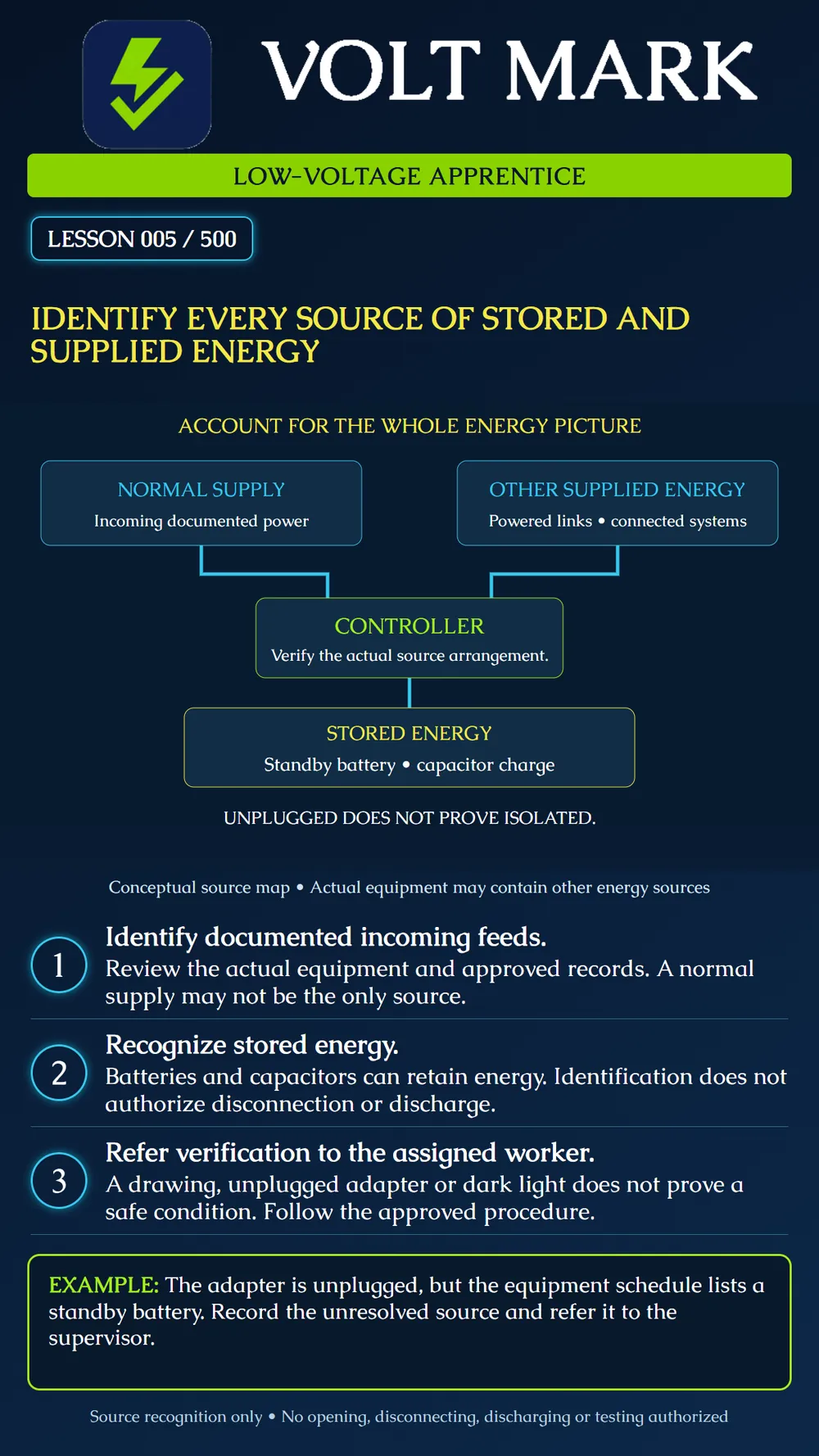
A system can receive power from more than one place. Removing the supply you can see does not establish that the equipment is safe to touch.
Your assignment may involve a reader, camera or controller that looks simple from outside. Its power arrangement is a separate question. Before work begins, the responsible person needs accurate equipment information. An apprentice can help gather that information without assuming authority to isolate or test the system.
Supplied energy: identify documented incoming feeds. A separate power supply, powered network connection or another connected system can matter. Do not infer a source solely from cable appearance. Stored energy: batteries and capacitors can retain energy. Their presence is a reason to consult the approved procedure, not permission to disconnect terminals or attempt discharge. Verification: a dark indicator or an unplugged adapter is not a test of every part. Establishing a safe work condition belongs to the applicable procedure and assigned qualified personnel.
For general-industry electrical work within its scope, 1910.333 addresses disconnection from electrical energy sources, hazardous stored energy and qualified-person verification. It also makes clear that control-circuit devices such as push buttons, selector switches and interlocks are not, by themselves, a substitute for the required means of deenergizing equipment. Construction electrical work is governed by applicable construction provisions, including 1926.416 and 1926.417. The employer must determine the requirements that apply to the actual work. This lesson teaches source recognition only; it is not an electrical isolation, lockout/tagout or verification procedure. [1,2,3]
You are asked to compare an access-control equipment schedule with delivered hardware. The schedule lists a controller, a power supply and a standby battery. A coworker points to an unplugged adapter and says the controller must be dead.
Your observation should be specific: the schedule also lists a battery, and you have not established the actual connections or equipment condition. Record the discrepancy and bring it to the supervisor. Do not open the enclosure to prove your point.
The useful distinction is between identifying a possible source and proving the state of the equipment. A drawing helps with the first. It does not complete the second.
Draw three boxes: incoming supply, stored energy, verification responsibility. Under incoming supply, write the feeds identified by the approved documents. Under stored energy, write any listed battery or capacitor assembly. Under verification responsibility, name the role assigned by the employer's procedure. Use “unknown—ask supervisor” where information is missing. Do not fill a gap with a guess.
Answer: No. That observation concerns one connection.
Answer: No. Identification does not authorize disconnection.
Answer: No.
Answer: The specific equipment identifier and discrepancy, for the responsible supervisor to resolve.
Answer: A source-information checklist with unresolved questions, not a declaration that equipment is safe.
Treating a familiar-looking device as a familiar power arrangement. Check the actual model, approved documents and assigned work procedure. Avoid borrowing assumptions from a different installation.
Identify supplied energy. Recognize stored energy. Do not confuse an observation with verification. Bring missing or conflicting information to the person responsible for the work plan.
[1] OSHA 1910.333, especially (b)(2)(ii) and (iv), general-industry electrical work: https://www.osha.gov/laws-regs/regulations/standardnumber/1910/1910.333 [2] OSHA 29 CFR 1926.416 - General requirements (construction electrical): https://www.osha.gov/laws-regs/regulations/standardnumber/1926/1926.416 [3] OSHA 29 CFR 1926.417 - Lockout and tagging of circuits (construction): https://www.osha.gov/laws-regs/regulations/standardnumber/1926/1926.417
Texas journeyman, 15 questions, scored by topic against the 70% mark. No card, and no account needed to start.
Free study material for low-voltage apprentices. This is a national foundation course: requirements differ by state and by local jurisdiction, and a practice that is common in one place is not a rule everywhere. Nothing here is a licence, a certification, or authority to work unsupervised, and completing it does not count as apprenticeship hours or continuing-education credit. Check the codes adopted where you are working, the licensing authority for that work, and your employer's safety programme. VoltMark is not affiliated with, endorsed by, or sponsored by NFPA, OSHA, NICET, BICSI, FOA, or any state or local licensing authority.

Electrician licensing exam prep: practice questions, timed exam simulations, and step-by-step help finding every answer in the NEC.