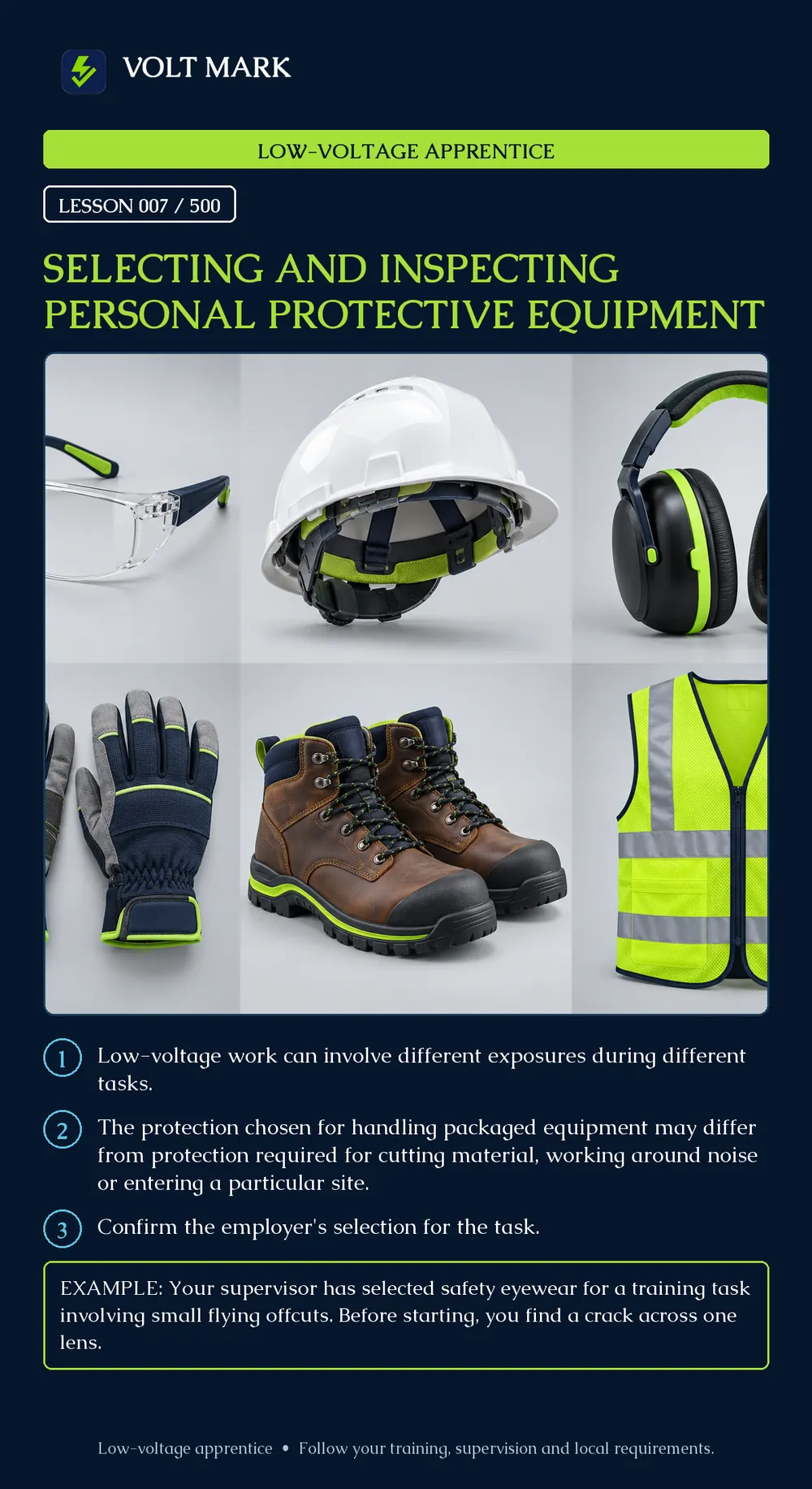
PPE must suit the actual hazard, fit the person and be in usable condition. An inspection is a decision about whether the item can serve its intended purpose, not a quick look at its color or brand.
Low-voltage work can involve different exposures during different tasks. The protection chosen for handling packaged equipment may differ from protection required for cutting material, working around noise or entering a particular site. Confirm the employer's selection for the task. Do not choose a complete PPE kit from this poster.
Lens: a crack in protective eyewear is a visible defect. Check lenses, side protection, frame and attachment points according to the manufacturer's instructions. Shell: inspect the helmet shell and suspension as a system. A visible crack is a reason to report the item and obtain suitable replacement, not to cover the damage with a sticker. Glove: inspect the material and seams for damage relevant to the intended protection. A work glove's appearance does not establish electrical insulation or chemical resistance. Cushion: examine earmuff cushions and their condition using the manufacturer's inspection instructions. A damaged sealing surface needs attention; do not assume a broken item retains its intended performance.
The damaged items shown are teaching examples. Actual inspection and replacement criteria depend on the product and work.
OSHA 1926.95 addresses construction PPE requirements including selection for workplace hazards, proper fit, maintenance and reliable condition. OSHA 1926.102 contains specific requirements for eye and face protection, including protection appropriate to the hazard, side protection where required, and provisions for workers who wear prescription lenses. Other PPE categories can be subject to additional construction standards, including head protection under 1926.100, hearing protection under 1926.101 and electrical protective equipment under 1926.97. The actual task and hazard determine which requirements apply. [1-5]
Your supervisor has selected safety eyewear for a training task involving small flying offcuts. Before starting, you find a crack across one lens. The eyewear still sits comfortably on your face. Good fit does not correct the crack. Report the defect and obtain suitable replacement before beginning the task. Check the replacement too. Do not continue simply because the task is short.
For each illustrated defect, name the item, describe the defect and write the action you would report. Do not intentionally damage or test real PPE. Model response: protective eyewear; visible cracked lens; report and obtain suitable replacement before the assigned work.
Treating inspection as a formality. State the defect precisely and act on it. A checked box does not change the condition of the equipment.
Match the task. Check fit. Inspect condition. Report defects and obtain suitable protection before work.
[1] OSHA 1926.95 - Criteria for personal protective equipment: https://www.osha.gov/laws-regs/regulations/standardnumber/1926/1926.95 [2] OSHA 1926.102 - Eye and face protection: https://www.osha.gov/laws-regs/regulations/standardnumber/1926/1926.102 [3] OSHA 1926.100 - Head protection: https://www.osha.gov/laws-regs/regulations/standardnumber/1926/1926.100 [4] OSHA 1926.101 - Hearing protection: https://www.osha.gov/laws-regs/regulations/standardnumber/1926/1926.101 [5] OSHA 1926.97 - Electrical protective equipment: https://www.osha.gov/laws-regs/regulations/standardnumber/1926/1926.97
Texas journeyman, 15 questions, scored by topic against the 70% mark. No card, and no account needed to start.
Free study material for low-voltage apprentices. This is a national foundation course: requirements differ by state and by local jurisdiction, and a practice that is common in one place is not a rule everywhere. Nothing here is a licence, a certification, or authority to work unsupervised, and completing it does not count as apprenticeship hours or continuing-education credit. Check the codes adopted where you are working, the licensing authority for that work, and your employer's safety programme. VoltMark is not affiliated with, endorsed by, or sponsored by NFPA, OSHA, NICET, BICSI, FOA, or any state or local licensing authority.

Electrician licensing exam prep: practice questions, timed exam simulations, and step-by-step help finding every answer in the NEC.