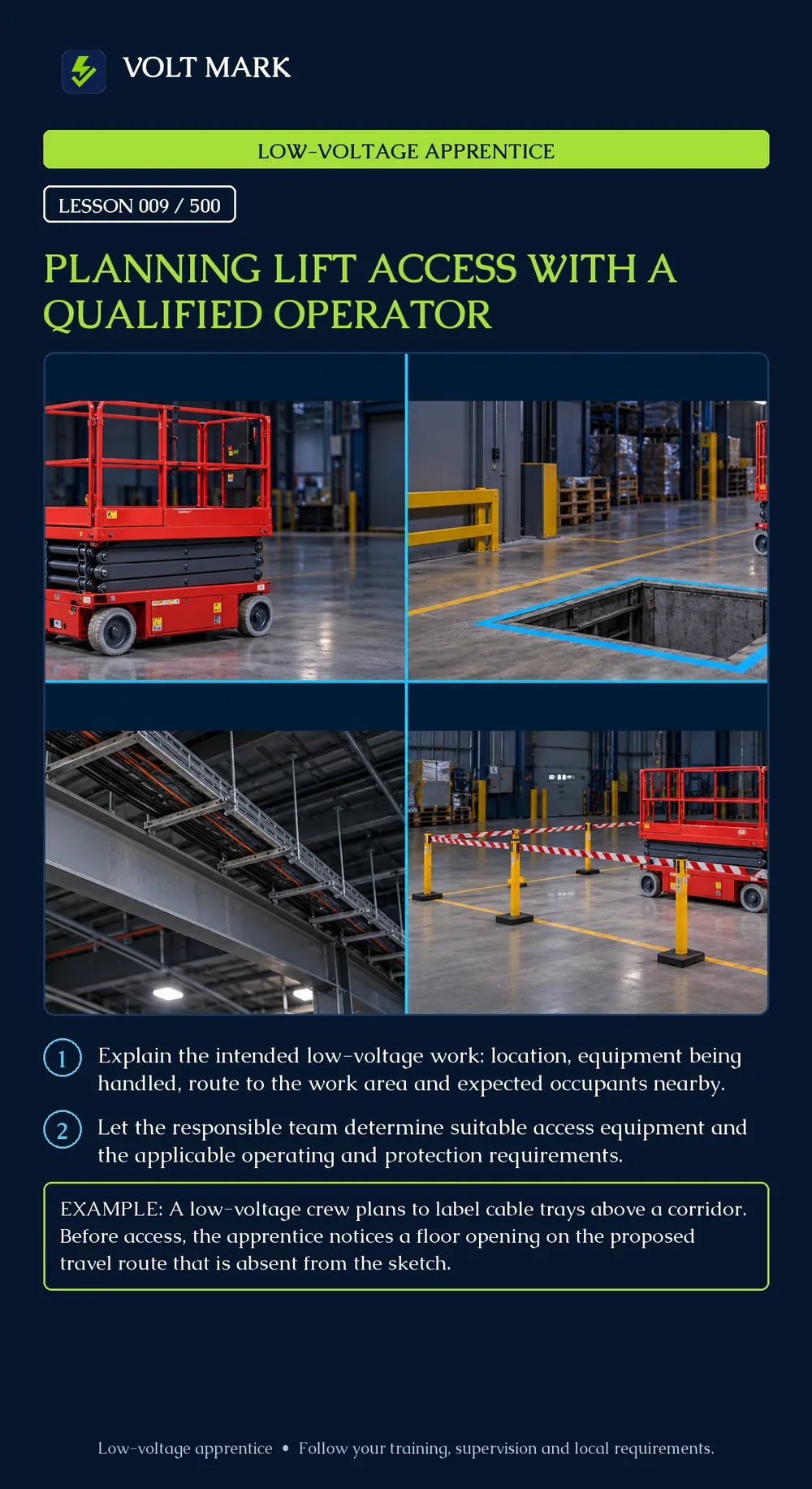
A lift-access plan joins the task, equipment, operator and site conditions. Choosing a machine that reaches the cable tray does not complete that plan.
Explain the intended low-voltage work: location, equipment being handled, route to the work area and expected occupants nearby. Let the responsible team determine suitable access equipment and the applicable operating and protection requirements.
Equipment and operator: confirm the specific lift and who is trained and authorized to operate it. A familiar control layout does not prove competence. Travel route: report openings, changes in level, obstructions or uncertain supporting surfaces. Do not interpret a drawing's clear line as proof the actual route is usable. Overhead space: identify beams, services and other obstructions for the plan. Account for equipment movement and working space, not just the nominal height of the destination. Work area: determine how other people and moving equipment will be kept from interfering with the operation. A diagram of barriers is an illustration, not a complete barricade design.
OSHA treats aerial lifts and scissor lifts differently under its construction requirements. Aerial lifts are addressed by 29 CFR 1926.453, which provides that only authorized persons may operate an aerial lift, along with other equipment-specific requirements. Scissor lifts are not simply treated as aerial lifts; applicable scaffold requirements and OSHA scissor-lift guidance address hazards such as fall protection, stabilization, positioning, workplace conditions and worker training. Determine the actual equipment type and applicable requirements rather than transferring every rule from one type of lift to another. [1-5]
For this course's paper exercise, write down: The task and equipment selected by the responsible team. The operator and person coordinating the work. Known route, surface and overhead concerns. How the area will be controlled. Communication and emergency arrangements established by the work plan. Any unresolved issue that prevents access.
These are prompts for a planning conversation, not a complete operator checklist.
A low-voltage crew plans to label cable trays above a corridor. Before access, the apprentice notices a floor opening on the proposed travel route that is absent from the sketch. The useful report names the location and discrepancy. The crew pauses the proposed access and refers the changed condition to the responsible team. The apprentice does not invent a bridge, drive around it or decide a wheel will probably clear it.
Using the floor-opening picture, write a two-sentence report. Include the location, the changed condition and the decision still needed. Example: "The planned route to the east cable-tray work area now crosses an uncovered floor opening. Access is paused pending the responsible team's revised plan."
Treating access planning as the operator's concern alone. An apprentice can contribute valuable site observations while respecting the operator's role and the work plan.
Confirm the equipment and operator. Assess the actual work area. Resolve access controls before proceeding.
[1] OSHA 29 CFR 1926.453 - Aerial lifts: https://www.osha.gov/laws-regs/regulations/standardnumber/1926/1926.453 [2] OSHA 29 CFR 1926.451 - General requirements (scaffolds): https://www.osha.gov/laws-regs/regulations/standardnumber/1926/1926.451 [3] OSHA 29 CFR 1926.452 - Additional requirements applicable to specific types of scaffolds: https://www.osha.gov/laws-regs/regulations/standardnumber/1926/1926.452 [4] OSHA 29 CFR 1926.454 - Training requirements: https://www.osha.gov/laws-regs/regulations/standardnumber/1926/1926.454 [5] OSHA - Working Safely with Scissor Lifts, OSHA 3842: https://www.osha.gov/sites/default/files/publications/OSHA3842.pdf
Supplementary teaching resources, not the regulatory basis: OSHA aerial-lift eTool: https://www.osha.gov/etools/scaffolding/aerial-lifts OSHA scissor-lift eTool: https://www.osha.gov/etools/scaffolding/scissor-lifts/
Texas journeyman, 15 questions, scored by topic against the 70% mark. No card, and no account needed to start.
Free study material for low-voltage apprentices. This is a national foundation course: requirements differ by state and by local jurisdiction, and a practice that is common in one place is not a rule everywhere. Nothing here is a licence, a certification, or authority to work unsupervised, and completing it does not count as apprenticeship hours or continuing-education credit. Check the codes adopted where you are working, the licensing authority for that work, and your employer's safety programme. VoltMark is not affiliated with, endorsed by, or sponsored by NFPA, OSHA, NICET, BICSI, FOA, or any state or local licensing authority.

Electrician licensing exam prep: practice questions, timed exam simulations, and step-by-step help finding every answer in the NEC.