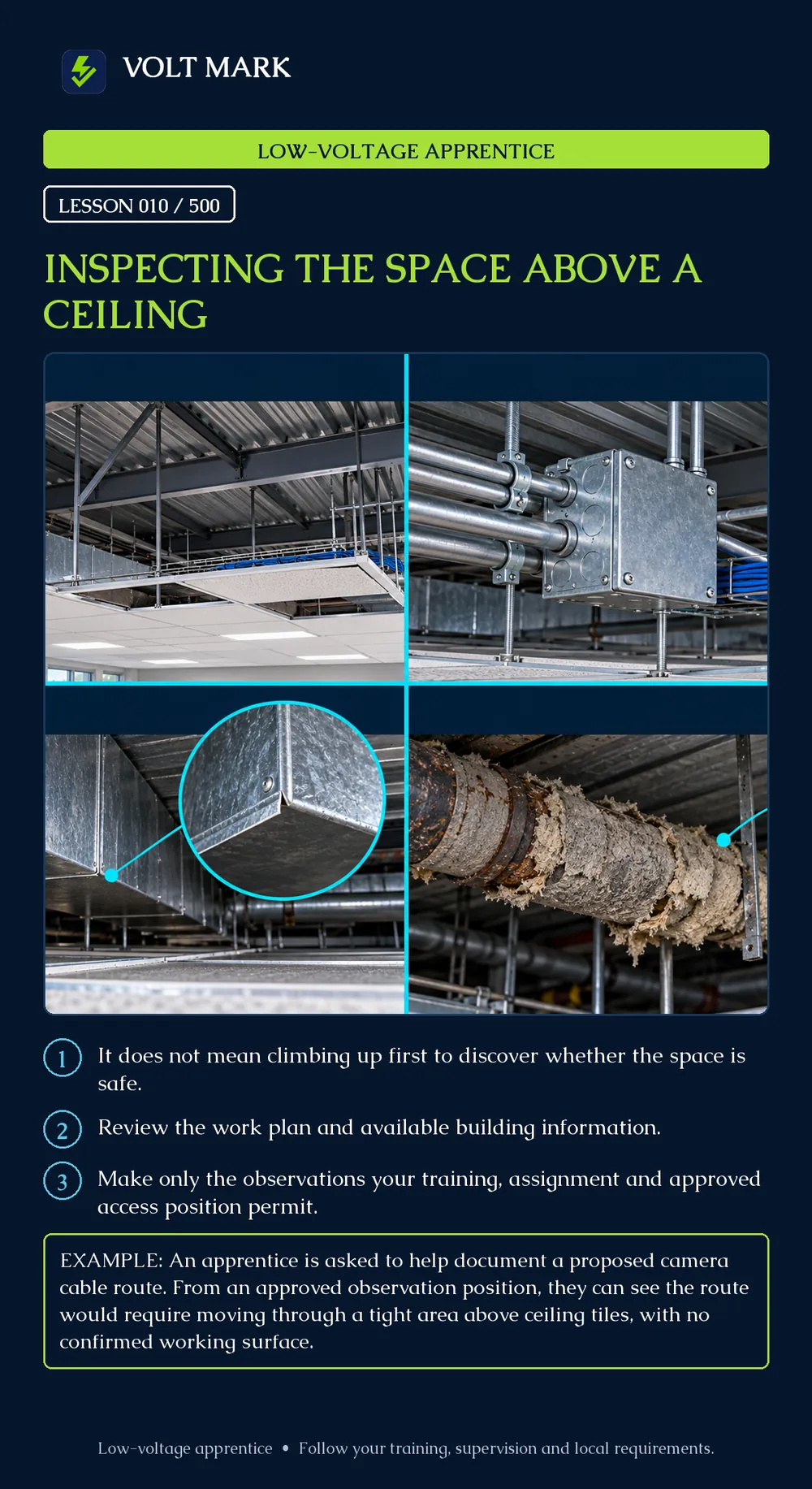
The space above a ceiling is part of a building, not automatically a usable work area. The access method, support, services and materials must be considered before the planned work proceeds.
It does not mean climbing up first to discover whether the space is safe. Review the work plan and available building information. Make only the observations your training, assignment and approved access position permit. Do not remove panels, reach into unknown spaces or disturb material simply to finish this lesson.
OSHA 1926.501(a)(2) requires the employer to determine whether walking/working surfaces on which employees are to work have the strength and structural integrity to support them safely. OSHA 1926.416 addresses electrical exposure in construction, including the employer’s responsibility to determine before work begins whether exposed or concealed energized circuits are positioned so that the work could bring a person, tool or machine into physical or electrical contact with them. Building materials above ceilings can also present exposure concerns. OSHA 1926.1101 contains construction requirements for asbestos, including requirements concerning asbestos-containing material (ACM), presumed asbestos-containing material (PACM), hazard communication, training and work that may disturb covered materials. Do not identify an unknown material as asbestos or asbestos-free based only on appearance, and do not disturb or sample unknown material merely to investigate it. The employer and building/facility information, applicable assessment process and qualified personnel must establish what requirements apply. [1-4]
An apprentice is asked to help document a proposed camera cable route. From an approved observation position, they can see the route would require moving through a tight area above ceiling tiles, with no confirmed working surface. The correct report identifies the location and the missing access information. The apprentice does not crawl across the grid or stand on a duct to obtain a better photograph. The responsible supervisor must resolve access before that activity is assigned.
Use location, condition and unresolved decision: "Above room 210, the proposed path is obstructed by ductwork. The access plan does not identify a suitable working surface there. Please confirm the method before entry." This is more useful than "the ceiling looks bad."
For each poster panel, write one question for the planning discussion. Suggested answers: What surface and access equipment are approved for this task? What services could the worker or tools encounter? Is there enough clear space for the planned action? Has the material that could be disturbed been assessed?
Confusing visibility with access. Being able to see the destination does not establish a safe route to it.
Confirm support and access. Identify services and obstructions. Report unknown conditions before proceeding.
[1] OSHA 29 CFR 1926.501 - Duty to have fall protection, especially 1926.501(a)(2): https://www.osha.gov/laws-regs/regulations/standardnumber/1926/1926.501 [2] OSHA 29 CFR 1926.416 - General requirements, especially 1926.416(a)(1) and (a)(3): https://www.osha.gov/laws-regs/regulations/standardnumber/1926/1926.416 [3] OSHA 29 CFR 1926.1101 - Asbestos: https://www.osha.gov/laws-regs/regulations/standardnumber/1926/1926.1101 [4] EPA - Protect Your Family from Exposures to Asbestos (supplementary; not the occupational authority for construction work): https://www.epa.gov/asbestos/protect-your-family-exposures-asbestos
Texas journeyman, 15 questions, scored by topic against the 70% mark. No card, and no account needed to start.
Free study material for low-voltage apprentices. This is a national foundation course: requirements differ by state and by local jurisdiction, and a practice that is common in one place is not a rule everywhere. Nothing here is a licence, a certification, or authority to work unsupervised, and completing it does not count as apprenticeship hours or continuing-education credit. Check the codes adopted where you are working, the licensing authority for that work, and your employer's safety programme. VoltMark is not affiliated with, endorsed by, or sponsored by NFPA, OSHA, NICET, BICSI, FOA, or any state or local licensing authority.

Electrician licensing exam prep: practice questions, timed exam simulations, and step-by-step help finding every answer in the NEC.