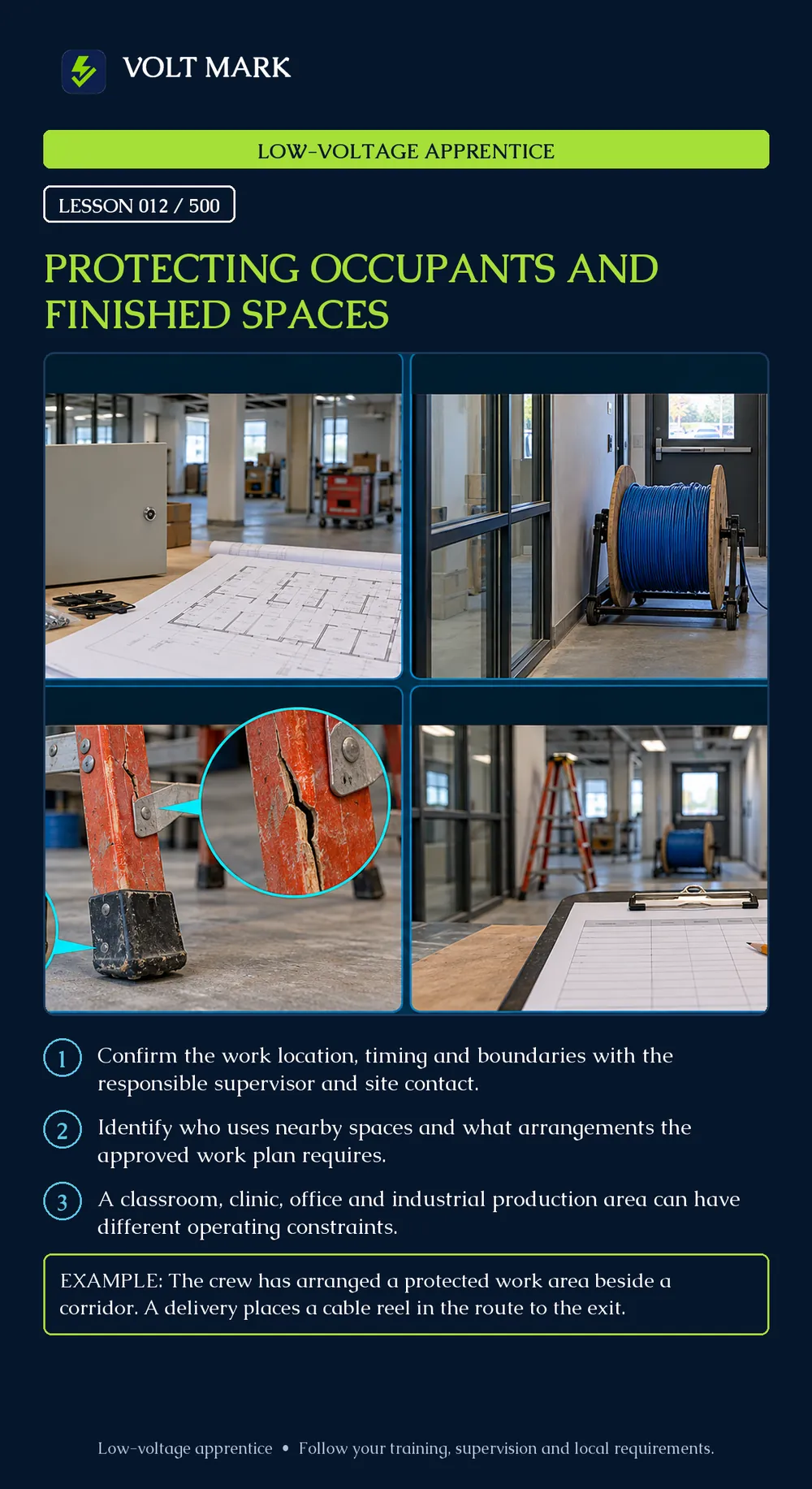
The installation is only part of the work. People must be able to use the building safely, and finished surfaces must be protected while tools and materials move through the area.
Confirm the work location, timing and boundaries with the responsible supervisor and site contact. Identify who uses nearby spaces and what arrangements the approved work plan requires. A classroom, clinic, office and industrial production area can have different operating constraints. Do not assume the same setup fits every building.
OSHA 1926.25 requires construction debris to be kept clear of work areas, passageways and stairs and includes requirements for appropriate collection and disposal of waste. OSHA 1926.34 requires exits in buildings or structures to be arranged and maintained to provide free and unobstructed egress whenever the building or structure is occupied, and requires means of egress to be continually maintained free of obstructions or impediments to emergency use. OSHA 1926.250 also addresses construction material storage and requires aisles and passageways to be kept clear for the free and safe movement of employees or material-handling equipment. Detailed protection of furniture and finished surfaces depends on the project, material compatibility, manufacturer information and site requirements; this poster is not a universal floor-covering or finish-protection specification. [1-3]
The crew has arranged a protected work area beside a corridor. A delivery places a cable reel in the route to the exit. The apprentice reports the new obstruction and the team corrects the setup through the responsible person. A route that was clear during the morning check must remain clear during the work. Do not regard the earlier checklist as proof of its present condition.
Use the agreed process to check surfaces, collect tools and materials, remove authorized temporary protection and report unresolved damage or work. Confirm who is responsible for accepting the area. Do not independently disable or cover alarms, sprinklers or other life-safety equipment to simplify the job.
Sketch a work area beside a corridor. Mark the work boundary, equipment storage, surface protection and unobstructed route. Write who approves the setup and what change would require reassessment. Model trigger: a delivery placed outside the planned storage boundary.
Protecting the object being installed while overlooking the people and property around it. Expand the planning view to the route, workspace and handback.
Coordinate the setup. Protect finishes. Control tools and debris. Keep routes clear throughout work.
[1] OSHA 29 CFR 1926.25 - Housekeeping: https://www.osha.gov/laws-regs/regulations/standardnumber/1926/1926.25 [2] OSHA 29 CFR 1926.34 - Means of egress: https://www.osha.gov/laws-regs/regulations/standardnumber/1926/1926.34 [3] OSHA 29 CFR 1926.250 - General requirements for storage: https://www.osha.gov/laws-regs/regulations/standardnumber/1926/1926.250
Texas journeyman, 15 questions, scored by topic against the 70% mark. No card, and no account needed to start.
Free study material for low-voltage apprentices. This is a national foundation course: requirements differ by state and by local jurisdiction, and a practice that is common in one place is not a rule everywhere. Nothing here is a licence, a certification, or authority to work unsupervised, and completing it does not count as apprenticeship hours or continuing-education credit. Check the codes adopted where you are working, the licensing authority for that work, and your employer's safety programme. VoltMark is not affiliated with, endorsed by, or sponsored by NFPA, OSHA, NICET, BICSI, FOA, or any state or local licensing authority.

Electrician licensing exam prep: practice questions, timed exam simulations, and step-by-step help finding every answer in the NEC.