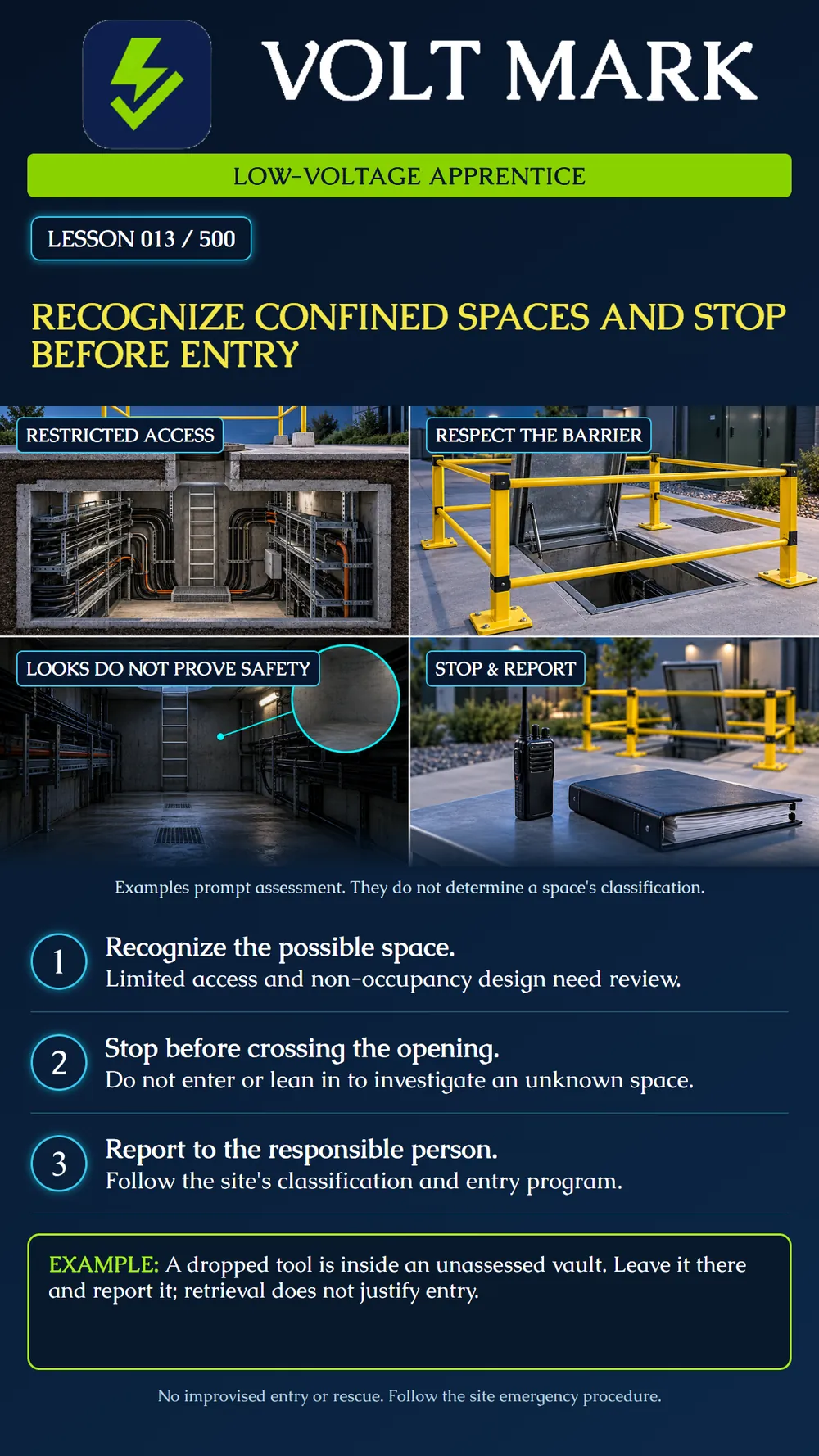
A low-voltage task can involve a space that requires formal assessment and entry controls. Recognition should trigger a stop and a report, not a closer look from inside.
Under OSHA 1926.1202, a confined space is large enough for bodily entry, has limited or restricted entry or exit, and is not intended for continuous employee occupancy. A permit-required confined space has specified additional hazards, such as a potentially hazardous atmosphere or another recognized serious hazard. Under 1926.1202, entry is the action by which any part of a person passes through an opening into a permit-required confined space. [1] OSHA has explained this in practical terms as occurring when any part of the entrant’s body breaks the plane of an opening into a permit-required confined space large enough for bodily entry, so a quick reach through the opening is not a workaround merely because the worker does not intend to place their whole body inside. [3] Under 1926.1203, the employer must have a competent person identify confined spaces and permit spaces before work, address employee information, and take measures against unauthorized entry where employees are not to enter. [2] These are construction provisions. The applicable sector and site program must be established for the actual work.
During exterior cable identification, a small hand tool drops into a nearby vault. Someone suggests leaning through the hatch to grab it because it is visible. The apprentice stays outside and reports the dropped tool and location. Tool retrieval is a new activity requiring the responsible team's decision. A quick reach is not a substitute for assessment or authorization.
Name the location and opening. Describe the requested task and what information is missing. Identify any signs, barriers or known restrictions without entering to gather more detail. Example: "A tool fell into the west telecommunications vault. I have no entry assignment or space assessment for it. I am staying outside and reporting it for the responsible team's action."
Do not attempt improvised entry rescue. Activate the site emergency procedure and obtain the designated help. This lesson does not train an entrant, attendant, entry supervisor or rescuer.
Write the original task, the new request and the missing authorization in the fictional example. Model answer: exterior cable identification; reaching into the vault for a tool; no assigned entry role or established entry conditions.
Judging the decision by how short the activity will be. Duration does not establish classification, conditions or authorization.
Recognize possible confined-space characteristics. Stop before entry. Report and follow the site program.
[1] OSHA 29 CFR 1926.1202 - Definitions: https://www.osha.gov/laws-regs/regulations/standardnumber/1926/1926.1202 [2] OSHA 29 CFR 1926.1203 - General requirements: https://www.osha.gov/laws-regs/regulations/standardnumber/1926/1926.1203 [3] OSHA Standard Interpretation, 18 October 1995 - When permits are required for entry into a permit required confined space (supplementary explanation, not the regulation): https://www.osha.gov/laws-regs/standardinterpretations/1995-10-18-0
Texas journeyman, 15 questions, scored by topic against the 70% mark. No card, and no account needed to start.
Free study material for low-voltage apprentices. This is a national foundation course: requirements differ by state and by local jurisdiction, and a practice that is common in one place is not a rule everywhere. Nothing here is a licence, a certification, or authority to work unsupervised, and completing it does not count as apprenticeship hours or continuing-education credit. Check the codes adopted where you are working, the licensing authority for that work, and your employer's safety programme. VoltMark is not affiliated with, endorsed by, or sponsored by NFPA, OSHA, NICET, BICSI, FOA, or any state or local licensing authority.

Electrician licensing exam prep: practice questions, timed exam simulations, and step-by-step help finding every answer in the NEC.