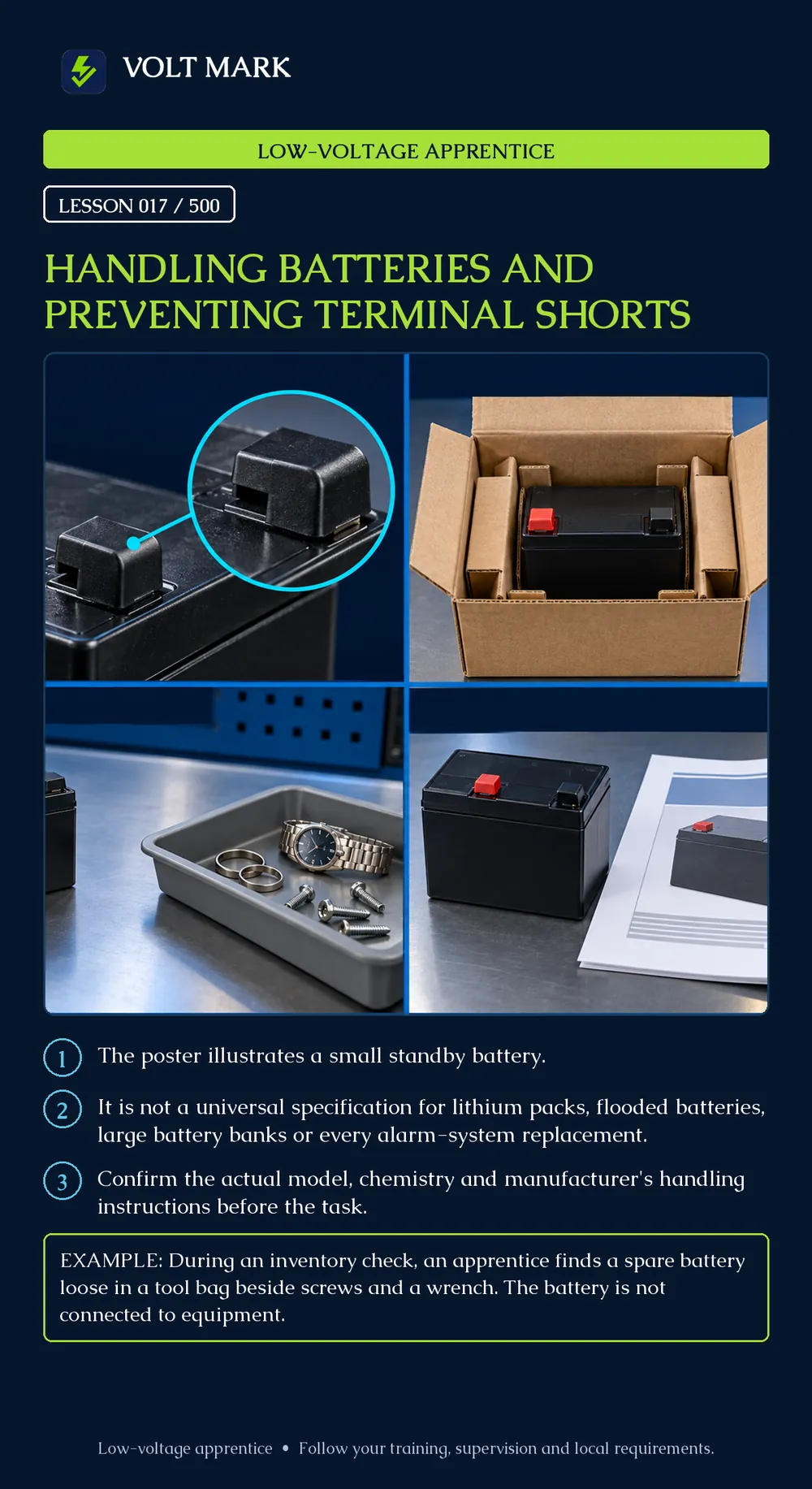
A disconnected battery still stores energy. Keep its terminals from contacting conductive objects during the handling you are trained and assigned to perform.
The poster illustrates a small standby battery. It is not a universal specification for lithium packs, flooded batteries, large battery banks or every alarm-system replacement. Confirm the actual model, chemistry and manufacturer's handling instructions before the task.
GS Yuasa's VRLA safety information warns against shorting terminals and describes protection against accidental contact through appropriate packaging or insulating covers. It also notes that used batteries can retain electrical energy. Its guidance applies to the stated products; obtain the instructions for the actual battery. [2] A conductive object bridging terminals can form an unintended path. Do not demonstrate this effect or test a battery by deliberately shorting it.
OSHA construction Subpart K includes 29 CFR 1926.441, Batteries and battery charging. Its requirements include provisions addressing battery installations, charging areas and specific hazards associated with battery handling. Some provisions specifically concern unsealed batteries, electrolyte/acid hazards or charging installations and must not be generalized to every small sealed standby battery. The actual battery type, chemistry, task and work setting determine which requirements apply. Manufacturer instructions and the employer’s applicable procedures remain necessary for the specific product and activity. [1,2]
During an inventory check, an apprentice finds a spare battery loose in a tool bag beside screws and a wrench. The battery is not connected to equipment. The concern is still present: loose objects can move during carrying. The apprentice reports the arrangement and follows the employer’s approved process so that suitable terminal protection and secure storage can be provided by personnel assigned and trained for the required handling. If the apprentice is specifically trained and assigned to perform that handling, they follow the applicable product instructions and employer procedure. They do not assume "unplugged" means empty.
Confirm what product you are handling and where it is going. Check that the packaging and protective parts required by the instructions are available. Keep the staging area organized. If the casing or terminals appear damaged, do not proceed with ordinary handling as though the product were intact. Report it and follow the product-specific response. Do not substitute this lesson for training, required PPE or site procedures.
Describe the tool-bag problem in one sentence and the information needed to correct it. Model response: "The battery is unsecured beside conductive loose parts. We need its handling instructions, suitable terminal protection and approved storage."
Thinking only about installed batteries. Storage, movement and return handling also require control of accidental terminal contact.
Identify the product. Protect the terminals. Separate metal objects. Follow the actual handling instructions.
[1] OSHA 29 CFR 1926.441 - Batteries and battery charging: https://www.osha.gov/laws-regs/regulations/standardnumber/1926/1926.441 [2] GS Yuasa VRLA Industrial Batteries safety data sheet, Issue 23, product-specific handling and short-circuit precautions: https://news.yuasa.co.uk/wp-content/uploads/2009/04/SDS-01-VRLA-Industrial-Batteries-Issue-23.pdf
Texas journeyman, 15 questions, scored by topic against the 70% mark. No card, and no account needed to start.
Free study material for low-voltage apprentices. This is a national foundation course: requirements differ by state and by local jurisdiction, and a practice that is common in one place is not a rule everywhere. Nothing here is a licence, a certification, or authority to work unsupervised, and completing it does not count as apprenticeship hours or continuing-education credit. Check the codes adopted where you are working, the licensing authority for that work, and your employer's safety programme. VoltMark is not affiliated with, endorsed by, or sponsored by NFPA, OSHA, NICET, BICSI, FOA, or any state or local licensing authority.

Electrician licensing exam prep: practice questions, timed exam simulations, and step-by-step help finding every answer in the NEC.