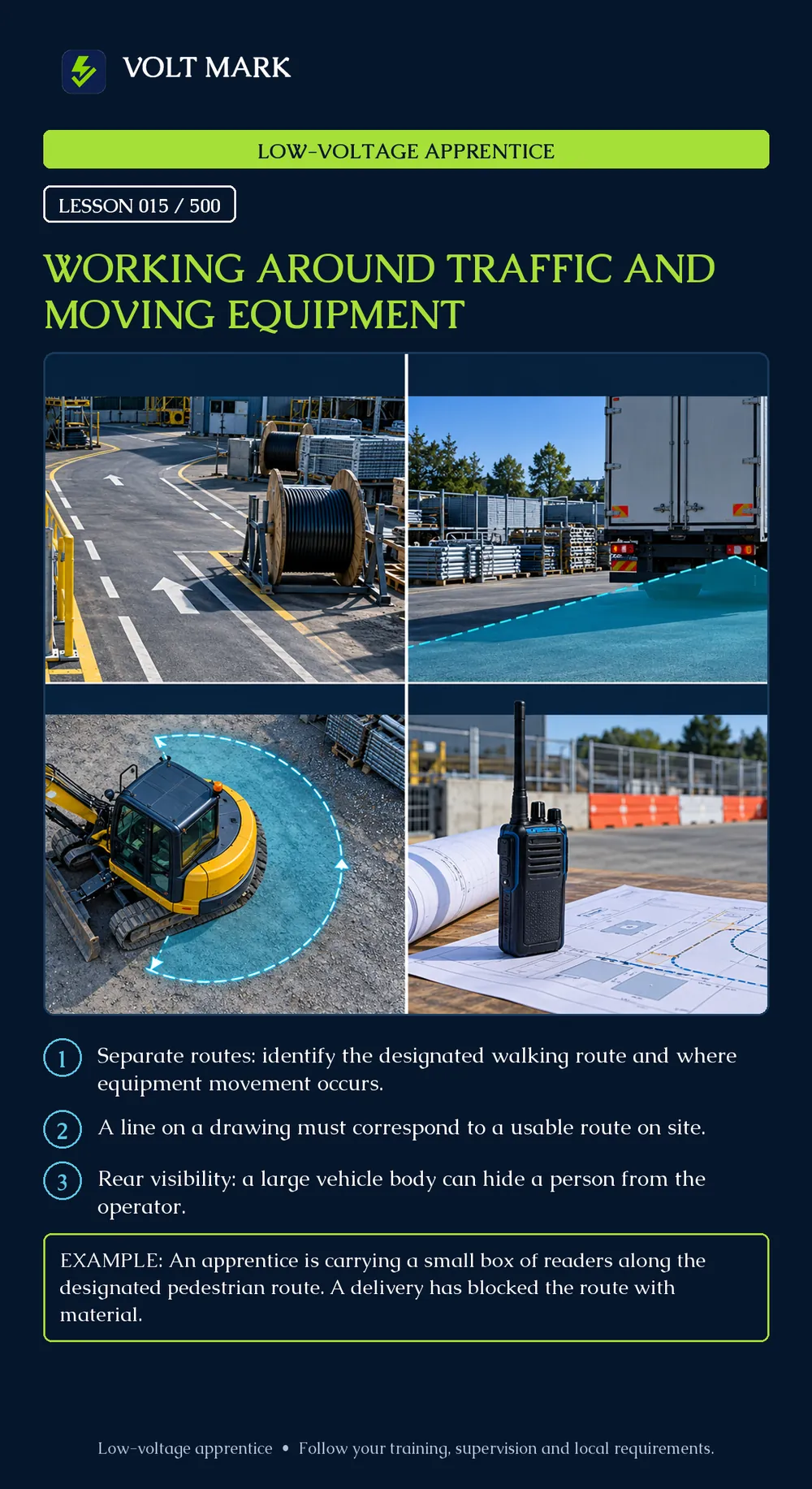
A low-voltage work location may sit beside deliveries, vehicles or mobile equipment. Plan how people, equipment and materials will move before work begins.
Separate routes: identify the designated walking route and where equipment movement occurs. A line on a drawing must correspond to a usable route on site. Rear visibility: a large vehicle body can hide a person from the operator. The shaded area is an illustration, not the blind-area map for a real truck. Swing and travel: consider the movement of the whole machine, including its rear and attachments. Do not choose a distance from this picture. Communication: confirm who coordinates movement, which signals or communication methods are used and what to do when contact is lost. Do not appoint yourself a spotter.
OSHA's backover guidance discusses visibility limitations, internal traffic planning, spotters and communication practices. Its recommended spotter practices include agreeing on signals before backing, maintaining visual contact between the driver and spotter, and stopping the backing movement if the driver loses sight of the spotter. OSHA expressly identifies these backover solutions as informational recommendations rather than requirements imposed by that guidance itself. Applicable OSHA standards, equipment-specific requirements, employer procedures and site conditions must be evaluated separately. [1,2] OSHA 1926.601 applies to specified motor vehicles operating within an off-highway jobsite not open to public traffic. For covered motor vehicles with an obstructed view to the rear, 1926.601(b)(4) requires either a reverse signal alarm audible above surrounding noise or backing only when an observer signals that it is safe to do so. These requirements must not be presented as a complete rule for all roads, vehicles or mobile equipment. [3] NIOSH distinguishes internal traffic coordination from temporary traffic control for the public traveling through a work zone. Identify which plans the actual job needs. [4]
An apprentice is carrying a small box of readers along the designated pedestrian route. A delivery has blocked the route with material. The apprentice stops in an approved location and reports the obstruction. They do not walk around the delivery through the equipment lane simply because the destination is nearby. The responsible team resolves the route conflict.
Useful: "The designated path beside the loading area is blocked by the delivery. I cannot reach the work area using that route." Less useful: "Traffic is bad." Name the location, the obstruction and the affected task. Remain within the approved boundary while the issue is resolved.
On a sketch, mark the planned pedestrian route, vehicle route, material delivery area and person responsible for coordination. Add an obstruction to the pedestrian route. Write the reporting action rather than drawing an unauthorized shortcut.
Planning only the installation location. Getting tools and materials to that location is part of the work and needs the same attention.
Know the routes. Respect equipment movement and visibility limits. Use the assigned communication process.
[1] OSHA - Preventing Backovers (informational guidance, not a regulation): https://www.osha.gov/preventing-backovers [2] OSHA - Preventing Backovers: Solutions (recommendations, not requirements): https://www.osha.gov/preventing-backovers/solutions [3] OSHA 29 CFR 1926.601 - Motor vehicles, especially 1926.601(b)(4): https://www.osha.gov/laws-regs/regulations/standardnumber/1926/1926.601 [4] https://www.cdc.gov/niosh/bulletin/2024/struck-by.html
Texas journeyman, 15 questions, scored by topic against the 70% mark. No card, and no account needed to start.
Free study material for low-voltage apprentices. This is a national foundation course: requirements differ by state and by local jurisdiction, and a practice that is common in one place is not a rule everywhere. Nothing here is a licence, a certification, or authority to work unsupervised, and completing it does not count as apprenticeship hours or continuing-education credit. Check the codes adopted where you are working, the licensing authority for that work, and your employer's safety programme. VoltMark is not affiliated with, endorsed by, or sponsored by NFPA, OSHA, NICET, BICSI, FOA, or any state or local licensing authority.

Electrician licensing exam prep: practice questions, timed exam simulations, and step-by-step help finding every answer in the NEC.