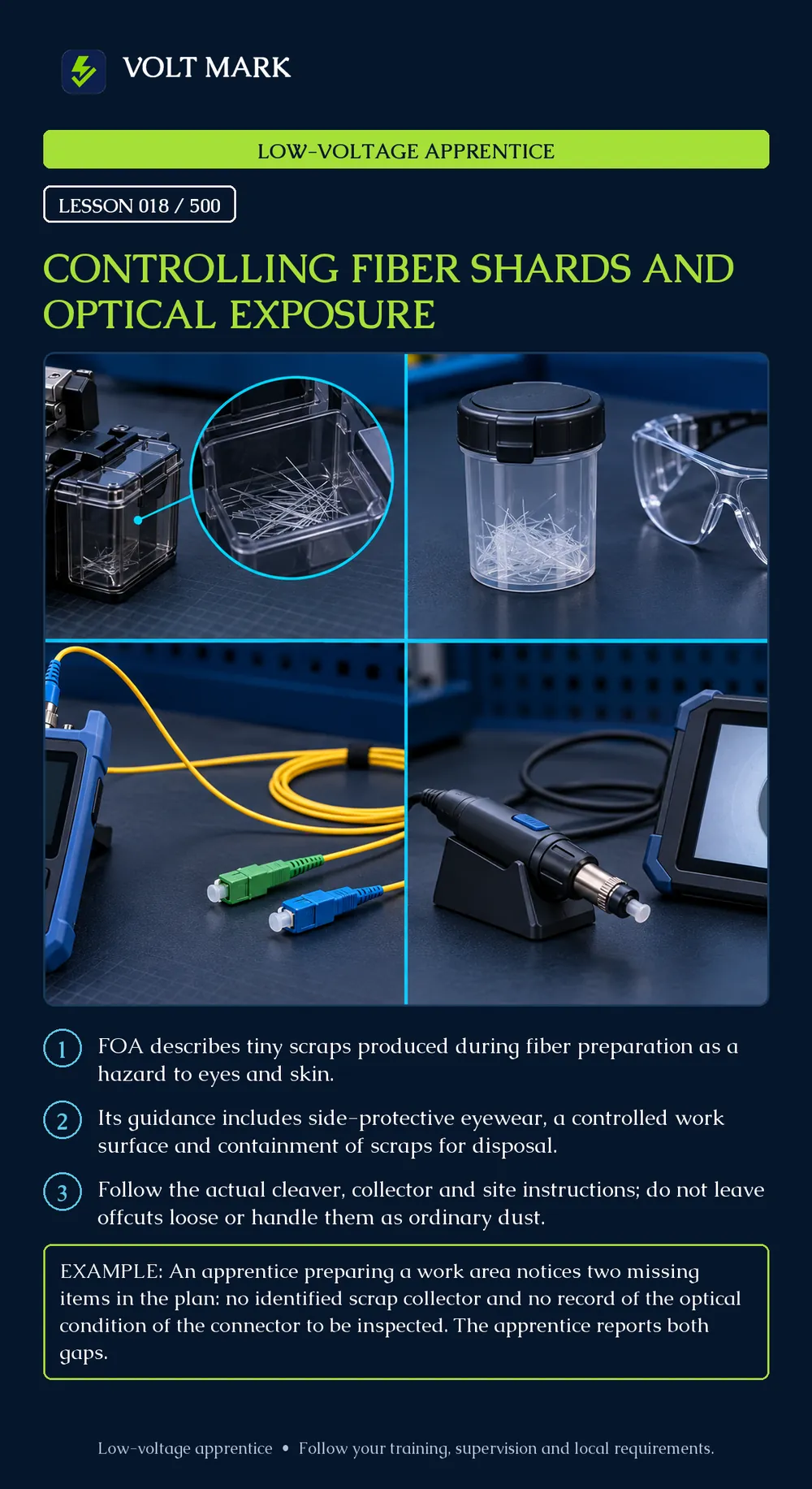
Fiber work presents two separate issues here: sharp glass scraps and possible optical energy. A measure for one does not automatically address the other.
FOA describes tiny scraps produced during fiber preparation as a hazard to eyes and skin. Its guidance includes side-protective eyewear, a controlled work surface and containment of scraps for disposal. Follow the actual cleaver, collector and site instructions; do not leave offcuts loose or handle them as ordinary dust. [3]
Network light may be invisible. FOA advises checking optical power before inspection and warns against looking into fiber ends. Power level and inspection method matter. Ordinary fragment-protection glasses do not establish protection against a particular optical source. A camera image also does not replace the required verification. [3]
OSHA 1926.102 requires appropriate eye or face protection where employees are exposed to eye or face hazards including flying particles and potentially injurious light radiation, and requires side protection where flying objects are a hazard. OSHA also has construction requirements addressing laser/nonionizing-radiation hazards, including 1926.54 and the laser-protection provisions of 1926.102. These requirements must be applied to the actual source and exposure; they do not mean that every communications fiber presents the same optical hazard or requires the same protective equipment. Fiber-specific work practices, equipment instructions and the employer’s approved procedure remain necessary for the actual link and activity. [1-4]
An optical power meter measures optical power; an inspection camera examines an endface. They answer different questions. Select equipment and follow instructions appropriate to the actual link and assigned procedure. The pictured instruments are generic illustrations, not model-specific operating instructions. Fluke Networks describes power measurement and inspection as distinct fiber-test capabilities. [4]
An apprentice preparing a work area notices two missing items in the plan: no identified scrap collector and no record of the optical condition of the connector to be inspected. The apprentice reports both gaps. A tidy table does not establish optical status, and a dark-looking connector does not settle the scrap-handling arrangement. Both questions must be resolved for the assigned activity.
The cleaver collector illustrates controlling waste where it is produced. The container and eyewear illustrate organized fragment protection. The meter illustrates optical-power measurement that may be used as part of an approved verification method by personnel trained and assigned for that procedure. The camera illustrates endface inspection performed under the approved procedure after the required optical conditions and worker responsibilities have been established.
Draw two columns: glass fragments and optical exposure. Under each, write the information needed before work. Model response: designated collector, disposal process and eyewear requirements; link information, authorized verification method and inspection instructions.
Treating fiber safety as one check. Keep the fragment and optical questions distinct and resolve both.
Contain glass scraps. Keep fiber ends away from eyes. Establish optical status using the approved method before authorized inspection.
[1] OSHA 29 CFR 1926.102 - Eye and face protection: https://www.osha.gov/laws-regs/regulations/standardnumber/1926/1926.102 [2] OSHA 29 CFR 1926.54 - Nonionizing radiation: https://www.osha.gov/laws-regs/regulations/standardnumber/1926/1926.54 [3] FOA - Fiber Optic Safety: https://www.thefoa.org/tech/ref/safety/safe.html [4] Fluke Networks - SimpliFiber Pro Optical Power Meter and Fiber Test Kits: https://www.flukenetworks.com/datacom-cabling/fiber-testing/SimpliFiber-Pro-Optical-Power-Meter-and-Fiber-Test-Kits
Texas journeyman, 15 questions, scored by topic against the 70% mark. No card, and no account needed to start.
Free study material for low-voltage apprentices. This is a national foundation course: requirements differ by state and by local jurisdiction, and a practice that is common in one place is not a rule everywhere. Nothing here is a licence, a certification, or authority to work unsupervised, and completing it does not count as apprenticeship hours or continuing-education credit. Check the codes adopted where you are working, the licensing authority for that work, and your employer's safety programme. VoltMark is not affiliated with, endorsed by, or sponsored by NFPA, OSHA, NICET, BICSI, FOA, or any state or local licensing authority.

Electrician licensing exam prep: practice questions, timed exam simulations, and step-by-step help finding every answer in the NEC.