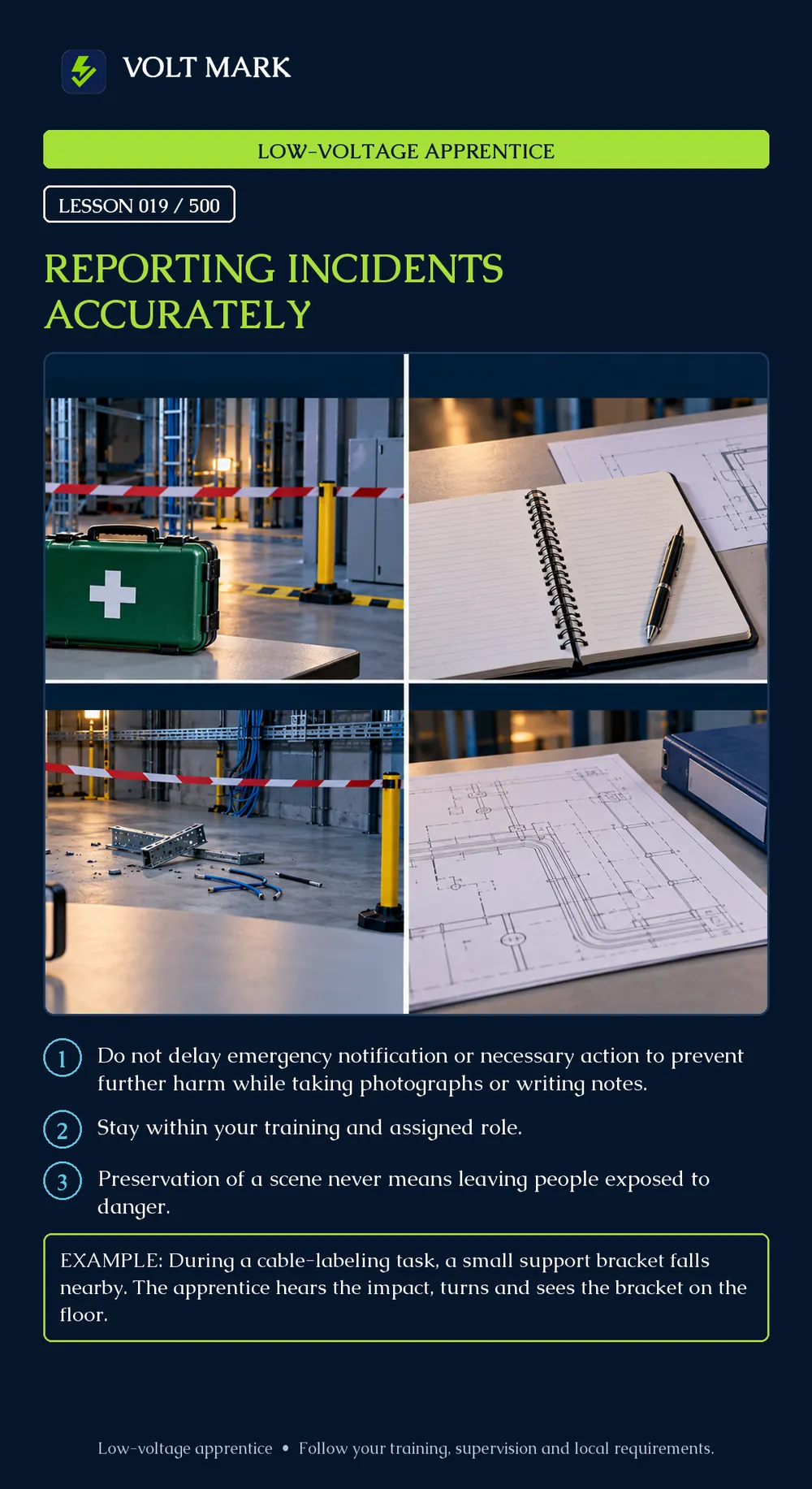
A useful incident report separates what happened, what you observed and what remains unknown. First follow the site's response procedure and obtain appropriate help.
Do not delay emergency notification or necessary action to prevent further harm while taking photographs or writing notes. Stay within your training and assigned role. Preservation of a scene never means leaving people exposed to danger.
OSHA encourages employers to investigate injuries, illnesses, incidents and close calls to identify underlying hazards, root causes and corrective actions rather than simply assigning blame. That investigation process is separate from OSHA’s injury and illness recordkeeping and government-reporting requirements under 29 CFR Part 1904. Depending on the employer and event, qualifying work-related injuries and illnesses may have to be recorded, and 29 CFR 1904.39 requires employers to report specified work-related fatalities and severe injuries to OSHA within the applicable time limits. An apprentice’s internal incident report supports the employer’s process; it does not by itself determine OSHA recordability, complete the employer’s OSHA records, or replace a required report to OSHA. [1-3] The apprentice supports that process by providing accurate information, not by deciding the final cause from a first impression.
During a cable-labeling task, a small support bracket falls nearby. The apprentice hears the impact, turns and sees the bracket on the floor. No injury is apparent to the apprentice. A careful report distinguishes the sound heard from what was seen afterward: "While labeling cables at the north worktable, I heard an impact. When I turned, I saw a bracket on the floor beside the table. I did not see it detach." An unsupported version would be: "The installer used the wrong fastener." The apprentice did not observe that and has not established it.
If the time is approximate, label it approximate. If someone else supplies information, identify it as their statement. If you correct a note, retain the original and the correction according to the site process rather than silently rewriting the history. Do not publish incident images or personal details. Give information to the responsible people through the authorized channel.
Write four short fields for the fictional example: Location. Task underway. First-hand observation. Action taken and person notified. Then add one sentence stating what you do not know. Model unknown: "I did not observe the attachment condition before the bracket fell."
Trying to make the report sound complete by filling gaps with assumptions. A clear statement of what is unknown is useful evidence for the responsible investigation.
Respond and notify. Record observations accurately. Preserve information safely. Hand it over without inventing a cause.
[1] OSHA - Incident Investigation: https://www.osha.gov/incident-investigation [2] OSHA - 29 CFR Part 1904, Recording and Reporting Occupational Injuries and Illnesses: https://www.osha.gov/laws-regs/regulations/standardnumber/1904 [3] OSHA 29 CFR 1904.39 - Reporting fatalities, hospitalizations, amputations, and losses of an eye as a result of work-related incidents to OSHA: https://www.osha.gov/laws-regs/regulations/standardnumber/1904/1904.39
Texas journeyman, 15 questions, scored by topic against the 70% mark. No card, and no account needed to start.
Free study material for low-voltage apprentices. This is a national foundation course: requirements differ by state and by local jurisdiction, and a practice that is common in one place is not a rule everywhere. Nothing here is a licence, a certification, or authority to work unsupervised, and completing it does not count as apprenticeship hours or continuing-education credit. Check the codes adopted where you are working, the licensing authority for that work, and your employer's safety programme. VoltMark is not affiliated with, endorsed by, or sponsored by NFPA, OSHA, NICET, BICSI, FOA, or any state or local licensing authority.

Electrician licensing exam prep: practice questions, timed exam simulations, and step-by-step help finding every answer in the NEC.