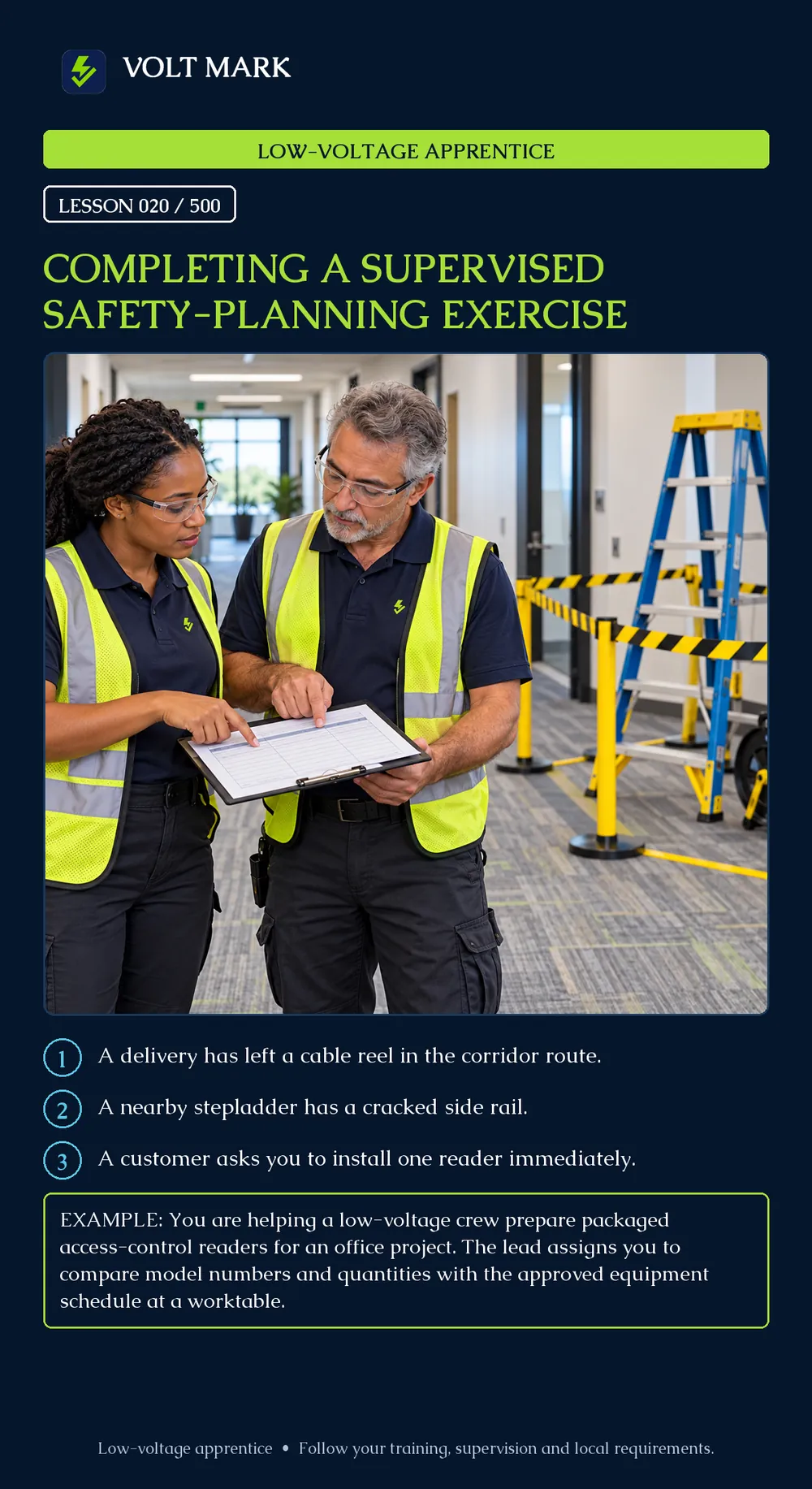
Bring the first nineteen lessons together. Demonstrate that you can describe an assignment, identify a conflicting condition, name the decision still needed and explain how the work will be reviewed.
You are helping a low-voltage crew prepare packaged access-control readers for an office project. The lead assigns you to compare model numbers and quantities with the approved equipment schedule at a worktable. Record discrepancies. The lead will review the inventory before installation is assigned. You are not assigned to climb, open installed equipment, connect wiring, operate a lift or change system settings.
Prepare one page with five fields:
Do not fill the page with general phrases such as "be careful." Connect each condition to a specific decision.
The assignment is an agreement about a particular activity, not permission for every task involving the same products. The corridor affects other people, not only the crew. The ladder's condition matters even if the proposed task would be brief. The customer's request must enter the work-assignment process. The controller's condition must be established through the applicable procedure rather than assumed from appearance.
The scenario uses the recognition principles covered in earlier lessons. Relevant construction provisions address clear passageways and egress, aisles and passageways affected by material storage, defective ladders, and electrical exposure. They do not replace the actual site plan. [1-5]
Ask the reviewer to check these five points: Did you preserve the original task limits? Did you identify each observation specifically? Did you avoid turning an assumption into a fact? Did you assign decisions to the appropriate role? Did you identify what must be resolved before affected work proceeds?
A missed item is a reason to revise the paper plan. It is not a reason to improvise a field demonstration.
The lead provides a new schedule revision after you have checked half the boxes. Question: What do you do with the previous inventory entries? Model response: Identify which revision was used, ask how the revised check should proceed and preserve the existing record. Do not silently relabel all prior results as though they were checked against the new revision.
State the assignment. Describe the conditions. Connect each concern to a decision. Review before the affected work proceeds.
Mistake: turning the inventory assignment into permission to install a reader. Correction: write the new request as a separate decision for the lead; inventory authority does not include installation. Mistake: writing only 'be careful' beside the blocked corridor or damaged ladder. Correction: identify the exact location or item and the responsible correction needed before affected work proceeds. Mistake: treating 'probably unpowered' as a verified condition. Correction: leave the enclosure closed and refer the electrical task; a coworker's guess is not the required procedure. Mistake: silently updating earlier inventory results to a new drawing revision. Correction: preserve the original revision and record how the lead directs the recheck, so the record remains traceable.
[1] https://www.osha.gov/laws-regs/regulations/standardnumber/1926/1926.25 [2] https://www.osha.gov/laws-regs/regulations/standardnumber/1926/1926.34 [3] https://www.osha.gov/laws-regs/regulations/standardnumber/1926/1926.1053 [4] https://www.osha.gov/laws-regs/regulations/standardnumber/1926/1926.416 [5] OSHA 29 CFR 1926.250 - General requirements for storage, especially 1926.250(a)(3): https://www.osha.gov/laws-regs/regulations/standardnumber/1926/1926.250
Texas journeyman, 15 questions, scored by topic against the 70% mark. No card, and no account needed to start.
Free study material for low-voltage apprentices. This is a national foundation course: requirements differ by state and by local jurisdiction, and a practice that is common in one place is not a rule everywhere. Nothing here is a licence, a certification, or authority to work unsupervised, and completing it does not count as apprenticeship hours or continuing-education credit. Check the codes adopted where you are working, the licensing authority for that work, and your employer's safety programme. VoltMark is not affiliated with, endorsed by, or sponsored by NFPA, OSHA, NICET, BICSI, FOA, or any state or local licensing authority.

Electrician licensing exam prep: practice questions, timed exam simulations, and step-by-step help finding every answer in the NEC.