Distinguish AC and DC voltage readings, select the intended measurement function from documentation and report a reading with its mode and reference.
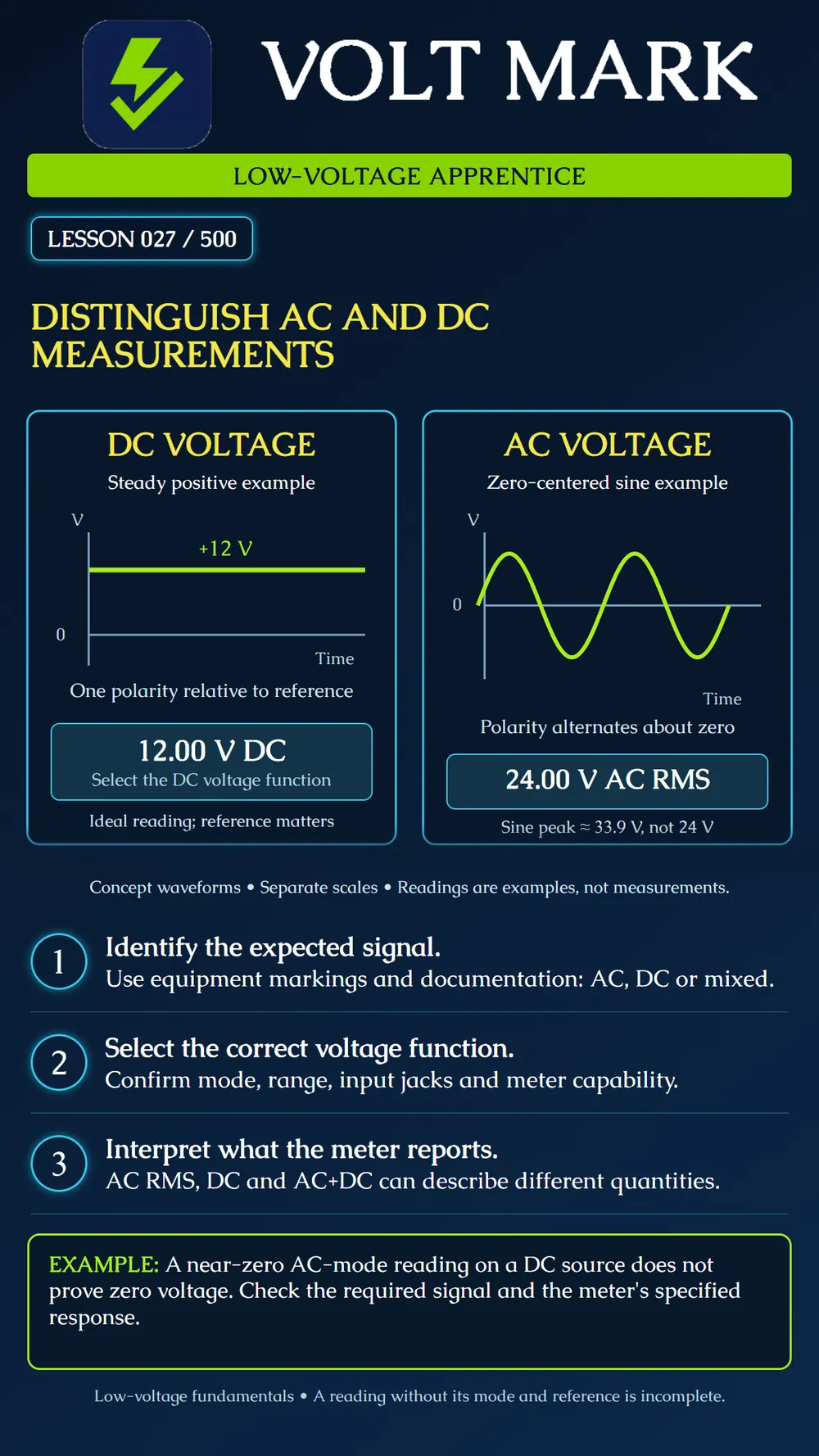
A steady DC voltage maintains one polarity relative to the chosen reference. The poster's AC example is a zero-centered sine wave that alternates polarity. Actual signals can contain both a DC component and a varying AC component; DC sources can also have ripple. The two plots are conceptual and use different scales. Their heights are not a comparison of their numerical values.
Left: a steady +12 V waveform. The fictional DC reading is 12.00 V relative to the stated reference. Right: a sinusoidal waveform whose fictional reading is 24.00 V AC RMS. For this sine wave, peak voltage is RMS × √2, approximately 33.9 V. That peak relationship is not universal for arbitrary waveforms. An RMS value characterizes effective magnitude; it is not the instantaneous maximum.
AC-only, DC and AC+DC functions need not report the same quantity. Many AC functions reject the DC component. Some instruments offer a separate combined AC+DC RMS function. “True RMS” does not by itself mean that every selected function includes DC. Use the instrument's manual to check its response, frequency range and other limits. A function label alone does not establish suitability for every waveform.
An instructor provides three fictional notes from a low-voltage trainer:
Given a documented DC reader output, identify the DC voltage function for checking its DC level. Given a documented low-voltage AC transformer secondary, identify the AC voltage function for checking its AC magnitude. This exercise concerns only the documented secondary and does not authorize access to the line-voltage primary. Given a request to assess ripple, identify that the question concerns a varying component and check the specified instrument method before drawing conclusions. Before any actual measurement, use the appropriate equipment, training and site procedure. Confirm function, range and input jacks. Voltage measurement and current measurement use different arrangements; a current input is not a substitute for a voltage input.
Answer: AC or DC, reference points, measurement mode and relevant operating conditions.
Answer: No; approximately 33.9 V.
Answer: No; consult the selected function's specification.
Answer: No. The flat trace is the steady example used here.
Answer: No.
Recording the digits while omitting AC/DC mode and the two points being compared.
Identify the signal before interpreting the number. DC, AC RMS and combined AC-plus-DC readings may answer different questions. Our DC example is twelve volts. Our sine-wave example is twenty-four volts RMS with about thirty-four volts peak. Report the mode and reference, and use the meter within its specified capability.
Fluke, Facts About True-RMS Measurement: https://www.fluke.com/en-gb/learn/blog/digital-multimeters/facts-about-true-rms-measurement The trainer readings, reporting exercise and waveform values are original fictional examples.
Free study material for low-voltage apprentices. This is a national foundation course: requirements differ by state and by local jurisdiction, and a practice that is common in one place is not a rule everywhere. Nothing here is a licence, a certification, or authority to work unsupervised, and completing it does not count as apprenticeship hours or continuing-education credit. Check the codes adopted where you are working, the licensing authority for that work, and your employer's safety programme. VoltMark is not affiliated with, endorsed by, or sponsored by NFPA, OSHA, NICET, BICSI, FOA, or any state or local licensing authority.

Electrician licensing exam prep: practice questions, timed exam simulations, and step-by-step help finding every answer in the NEC.