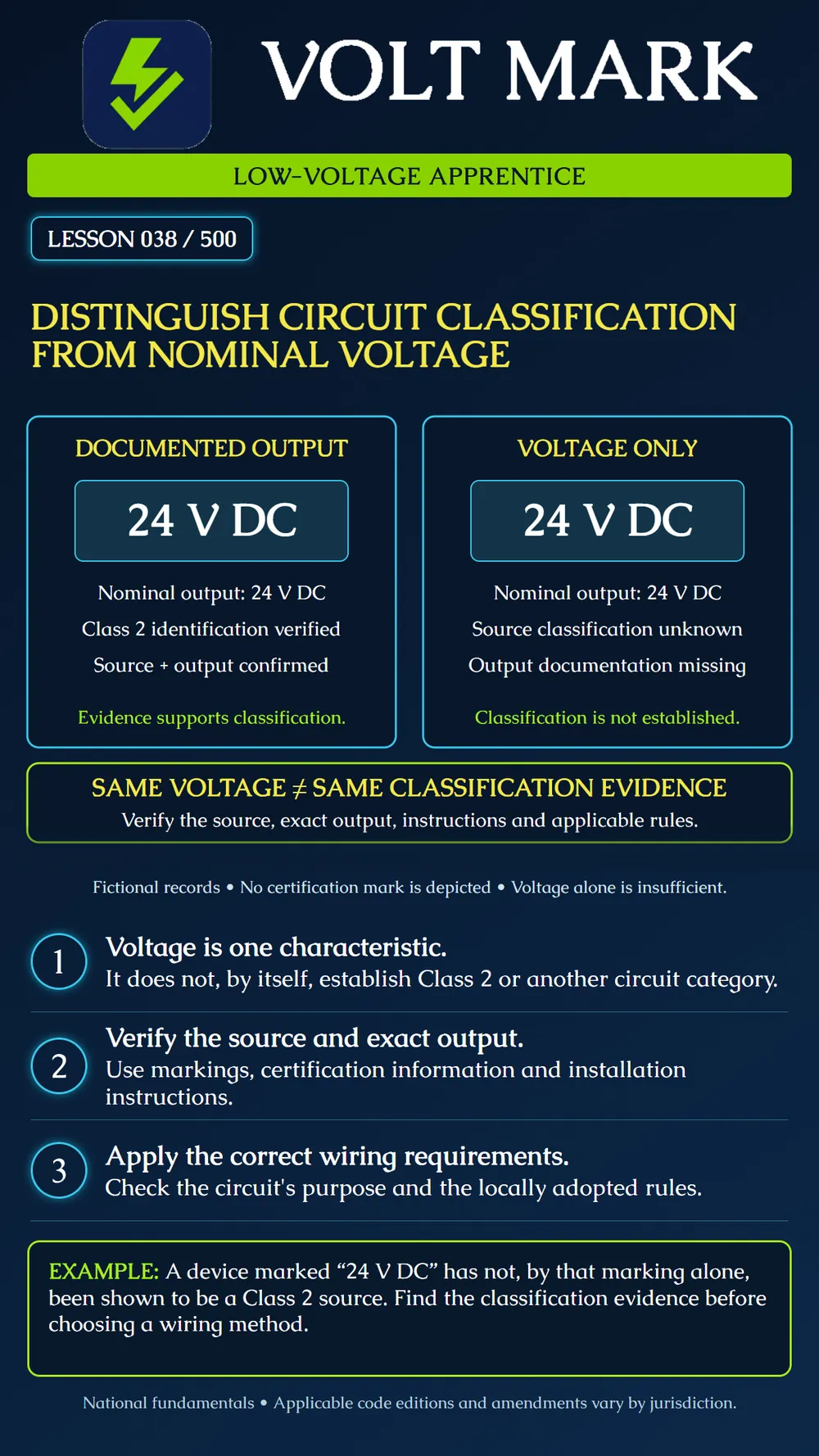
Explain why nominal voltage alone does not establish circuit classification, and identify the records needed before applying classification-dependent wiring requirements.
“24 V” describes a nominal voltage. It does not by itself describe available energy, output limitation, circuit purpose, source certification or the permitted wiring method. A circuit classification such as Class 2 is a defined category, not a nickname for every low-voltage circuit. Evaluate the applicable source/output identification and the governing requirements together.
An apprentice receives a proposed 24 V DC supply for a control device whose instructions require a Class 2 source. Record A contains only a seller's “24 V DC” description. Record B identifies the exact model, applicable certification information, the output marked Class 2, and the installation instructions. Record B provides relevant classification evidence to review against the complete design. Record A does not demonstrate the required source category. A matching voltage number is necessary for many compatibility checks, but it does not resolve this separate classification requirement.
Some equipment has multiple outputs or circuits with different functions or limitations. Identify the connector, terminals and output covered by the marking or documentation. Do not apply an unrelated label elsewhere in an enclosure to every conductor leaving it. Likewise, a downstream cable jacket marking describes the cable's designation; it does not transform the connected source into a different source category.
For a fictional job file, record: Equipment model and document revision. Exact output terminal identification. Nominal voltage and AC/DC type. Applicable source/output classification evidence. Circuit purpose and receiving-device requirements. Required installation conditions. Jurisdiction and the code edition/amendments used by the responsible project team. The list records evidence; it is not a substitute for the applicable code or product instructions.
This course does not assume one NEC edition or one set of local amendments applies everywhere in the United States. Use the jurisdiction's adopted requirements and the authority responsible for the work. Different circuit purposes, including fire alarm, communications and remote control, can have distinct requirements. Do not move a circuit into a convenient category simply because its operating voltage is low. This introductory lesson deliberately avoids a single numeric voltage or wattage cutoff presented as a universal classification test.
A trainee proposes to use a convenient cable route because “everything here is only 24 volts.” A better response identifies the missing facts: which circuit, which source/output classification, which cable designation, which installation conditions and which applicable rules? The correct next step is to establish those facts and follow the approved design, rather than infer permission from voltage.
Q: Does a 24 V marking alone prove Class 2? A: No. Q: Does missing classification evidence prove a source is not Class 2? A: No; it means the claim has not been established. Q: Can one enclosure contain outputs needing separate identification? A: Yes. Q: Does a cable marking alone classify its source? A: No. Q: Is “low voltage” a complete wiring-method instruction? A: No. Q: Does this lesson establish one code edition for every state? A: No.
Treating nominal voltage as a shortcut around source identification and circuit-specific requirements.
Voltage and circuit classification answer different questions. Two outputs can both say twenty-four volts while providing different classification evidence. Identify the source and exact output, check the instructions and certification information, then apply the requirements for the circuit and jurisdiction.
UL Solutions, Wire and Cable Application Guide, markings and application information: https://www.ul.com/thecodeauthority/knowledge/wire-cable-guide UL, White Book guidance on low-voltage circuit source identification (2015 historical guidance, not a current local-code adoption claim): https://code-authorities.ul.com/wp-content/uploads/2014/09/UL-White-Book.pdf The fictional records are original teaching examples. Current project compliance must be checked against applicable current product documentation and the locally adopted requirements.
Free study material for low-voltage apprentices. This is a national foundation course: requirements differ by state and by local jurisdiction, and a practice that is common in one place is not a rule everywhere. Nothing here is a licence, a certification, or authority to work unsupervised, and completing it does not count as apprenticeship hours or continuing-education credit. Check the codes adopted where you are working, the licensing authority for that work, and your employer's safety programme. VoltMark is not affiliated with, endorsed by, or sponsored by NFPA, OSHA, NICET, BICSI, FOA, or any state or local licensing authority.
Electrician licensing exam prep: practice questions, timed exam simulations, and step-by-step help finding every answer in the NEC.