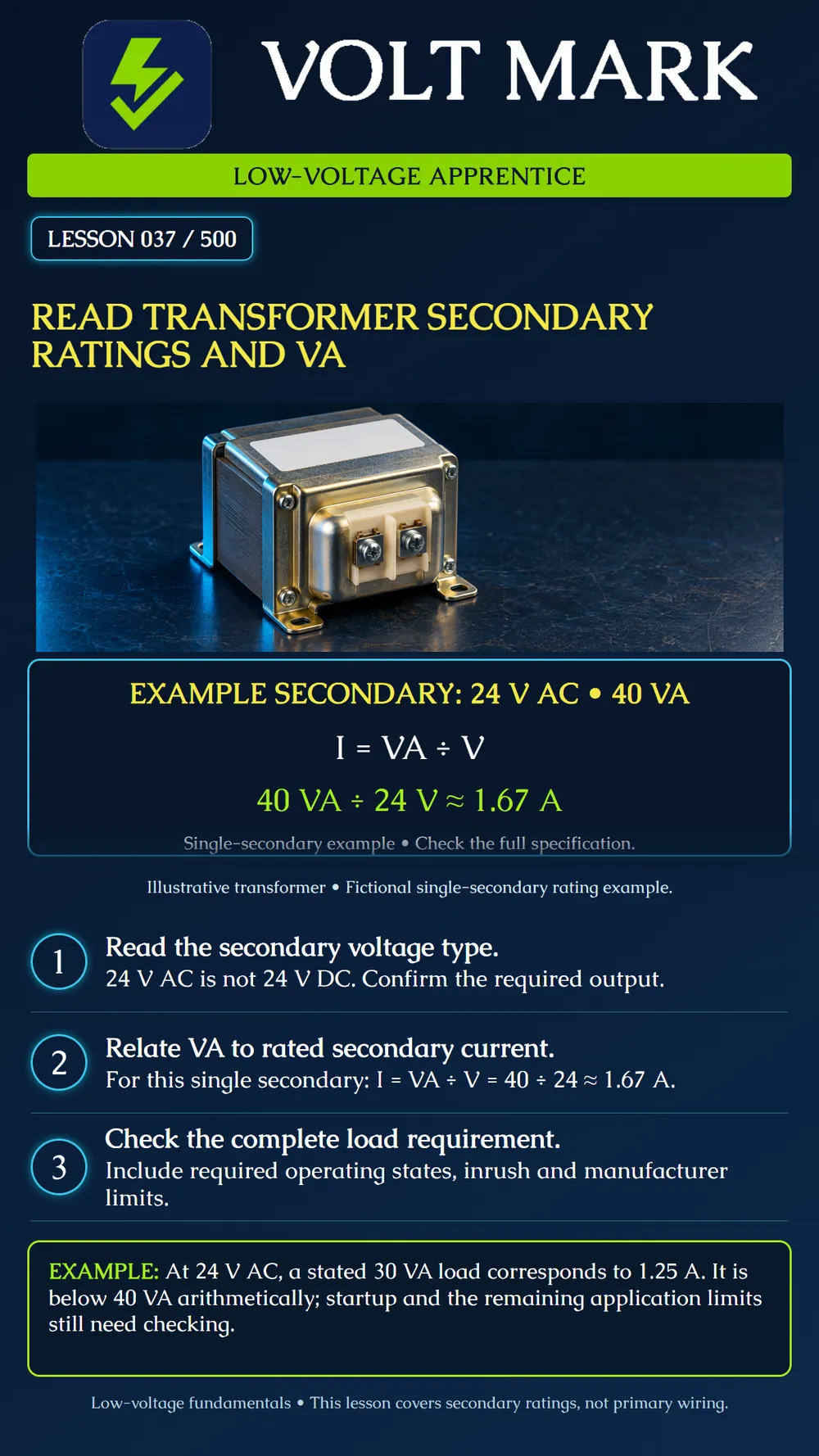
Identify the low-voltage secondary rating and convert a stated single-secondary VA rating into its corresponding rated current.
A transformer nameplate can list input and output information. This lesson addresses the secondary output. Check voltage, AC designation, frequency and the applicable VA rating together with the manufacturer's conditions. A conventional transformer changes AC voltage; its secondary rating does not by itself describe a regulated DC power supply. A device requiring DC must not be treated as compatible merely because the numerical voltage looks familiar.
For the single-phase secondary in this lesson, apparent power S = V RMS × I RMS, expressed in volt-amperes (VA). The current corresponding to a stated VA rating is I = S ÷ V. VA and watts are not interchangeable for every load. Real power in watts also depends on power factor. The VA number is a capacity rating under stated conditions, not the current drawn continuously by every connected load.
The fictional example specifies: Secondary: 24 V AC. Rating: 40 VA for one secondary under the stated conditions. Corresponding rated secondary current: I = 40 VA ÷ 24 V = 1.666... A, approximately 1.67 A. This is not 40 A. It is also not a claim that the transformer forces 1.67 A through any device connected to it. The photograph is illustrative and carries no actual product rating.
A worksheet states that the intended load requires 30 VA at 24 V AC in the specified operating condition. I load = 30 VA ÷ 24 V = 1.25 A. The stated demand is below 40 VA, leaving a 10 VA arithmetic difference. That is an initial steady-condition comparison, not full selection approval. Required startup behavior, voltage regulation, temperature, protection and the manufacturer's application limits still matter. The example does not establish a universal spare-capacity percentage.
WHAT HAPPENS WITHOUT LOAD? A transformer's actual secondary voltage may differ between unloaded and loaded conditions. Do not label a transformer defective solely because an unloaded reading differs from its nominal secondary number; compare with the relevant specification and input conditions. Likewise, do not assume a nominal 24 V secondary guarantees exactly 24.00 V at a remote device. Source behavior and cable voltage drop both affect the delivered voltage.
This worksheet has only one secondary. A real unit may have several windings or taps with shared, individual or configuration-dependent ratings. Do not assign the entire nameplate VA to every terminal pair, or combine windings by guesswork. Use the exact winding diagram and manufacturer instructions. This lesson does not authorize primary connections or changes to winding configuration.
Answer: 60 ÷ 24 = 2.50 A.
Answer: 24 ÷ 12 = 2.00 A.
Answer: No; its input requirements must explicitly support the supply type.
Answer: No; the applicable power factor or manufacturer input-current/VA data is needed.
Answer: No; circuit classification and applicable markings require separate verification.
“Worksheet transformer: single 24 V AC, 40 VA secondary. Corresponding rated current: approximately 1.67 A. Stated load: 30 VA at 24 V AC, or 1.25 A. Startup suitability and remaining conditions not yet established.” Keep that distinction between arithmetic and equipment approval in the actual job record.
Reading VA as amperes, or treating an AC secondary as a DC output.
Read the secondary's voltage type and VA together. Divide VA by secondary volts to obtain the corresponding current. Our single 24-volt AC, 40-VA example corresponds to about 1.67 amps. Check all required operating conditions before deciding the transformer is suitable.
Functional Devices, transformer specification and naming guidance: https://blog.functionaldevices.com/product-guidance/build-a-rib-workshop-part-4-optimus-prime Hammond Power Solutions, product catalog discussion of VA and current: https://emea.hammondpowersolutions.com/-/media/Project/HPS/shared/Product-documents/Product-Catalogs/HPSStandardProductCatalogHTP16.pdf All numerical worksheet ratings above are original hypothetical examples, not specifications for the photographed transformer.
Free study material for low-voltage apprentices. This is a national foundation course: requirements differ by state and by local jurisdiction, and a practice that is common in one place is not a rule everywhere. Nothing here is a licence, a certification, or authority to work unsupervised, and completing it does not count as apprenticeship hours or continuing-education credit. Check the codes adopted where you are working, the licensing authority for that work, and your employer's safety programme. VoltMark is not affiliated with, endorsed by, or sponsored by NFPA, OSHA, NICET, BICSI, FOA, or any state or local licensing authority.

Electrician licensing exam prep: practice questions, timed exam simulations, and step-by-step help finding every answer in the NEC.