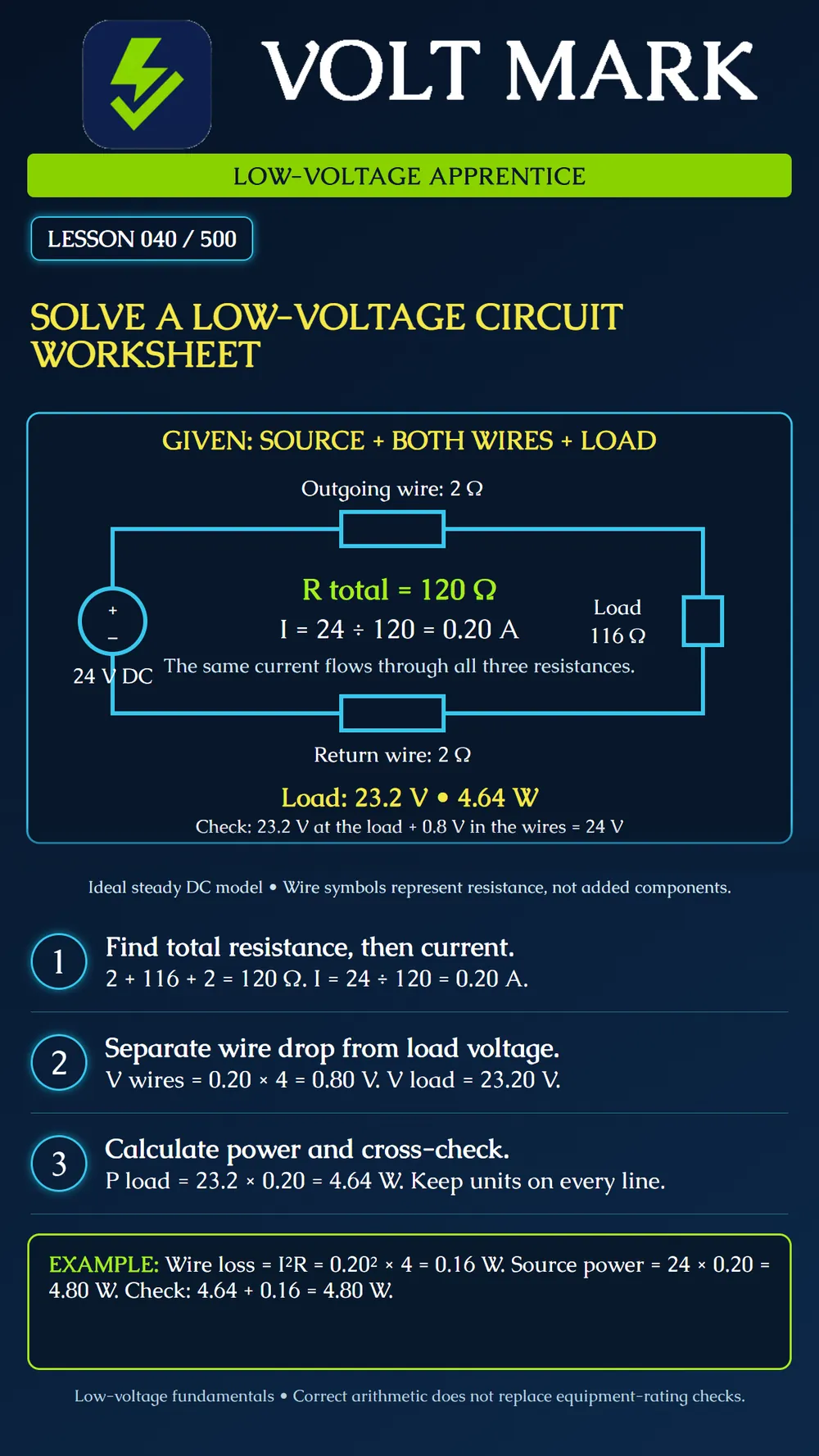
Solve one consistent DC model, distinguish wire-loop resistance from total circuit resistance, and verify the result using voltage and power checks.
This original fictional worksheet uses an ideal 24 V DC source, an outgoing wire resistance of 2 Ω, a fixed resistive load of 116 Ω, and a return wire resistance of 2 Ω. All three resistances are in series. Assume steady DC, constant resistance and no additional connection losses. These are calculation inputs, not specifications for a real cable or device.
Calculate:
Wire-loop resistance = 2 + 2 = 4 Ω. Total circuit resistance = 2 + 116 + 2 = 120 Ω. Current = 24 ÷ 120 = 0.20 A = 200 mA. Each wire drop = 0.20 × 2 = 0.40 V. Both wire drops = 0.40 + 0.40 = 0.80 V. Load voltage = 24 − 0.80 = 23.20 V. Independent load-voltage calculation = 0.20 × 116 = 23.20 V. Load power = 23.20 × 0.20 = 4.64 W. Wire power loss = 0.20² × 4 = 0.16 W. Source power = 24 × 0.20 = 4.80 W.
Voltage check: 0.40 + 23.20 + 0.40 = 24.00 V. Power check: 4.64 + 0.16 = 4.80 W. These checks support the arithmetic for this stated model. They do not establish that a physical installation has these values.
Wrong current: 24 ÷ 116 ≈ 0.207 A. Why wrong here: it ignores the two stated wire resistances. Wrong current: 24 ÷ 4 = 6 A. Why wrong here: it ignores the load and treats the wire-loop resistance as the entire circuit resistance. The load and wires all affect the current in this model. Lesson 029 supplied current as a given operating value; this worksheet derives it from the complete resistor network.
New fictional values: Source: 12 V DC. Outgoing wire: 1 Ω. Fixed load: 58 Ω. Return wire: 1 Ω. Find the same quantities before reading the key.
Answers:
Wire-loop resistance = 2 Ω. Total resistance = 60 Ω. Current = 0.20 A = 200 mA. Each wire drop = 0.20 V. Total wire drop = 0.40 V. Load voltage = 11.60 V. Load power = 2.32 W. Total wire loss = 0.08 W. Source power = 2.40 W. Checks: 0.20 + 11.60 + 0.20 = 12.00 V; 2.32 + 0.08 = 2.40 W.
WHAT CHANGES IF THE PATH OPENS? For the single-source, single-path model, an open interrupts steady current. The source can still maintain voltage across the interruption. A zero-current result is not proof that every point has zero voltage.
A real load may not behave like a fixed resistor. A real source may have regulation, current limiting and operating constraints. Conductor temperature, connections and branching can change the model. After calculating demand, verify source/output limits, cable suitability, load operating range and component dissipation requirements. Do not select a resistor whose allowable power is below the calculated dissipation. Circuit classification and locally applicable wiring requirements remain separate checks.
Award one point each for the first eight requested quantities and one point for each balance check: ten points total. For a fully correct result, require units and a stated distinction between wire-loop resistance and total circuit resistance. If the two checks fail, find the inconsistency before proceeding. Do not round early to make an incorrect result appear to balance.
Draw the path and list the assumptions. Add every series resistance to calculate current. Use only the wire resistances for wire drop, then find the load voltage and power. Finally, check that the voltage drops and power losses balance the source.
OpenStax, Physics, 19.2 Series Circuits: https://openstax.org/books/physics/pages/19-2-series-circuits OpenStax, Physics, 19.4 Electric Power: https://openstax.org/books/physics/pages/19-4-electric-power Both numerical worksheets and their review rubric are original teaching material.
Free study material for low-voltage apprentices. This is a national foundation course: requirements differ by state and by local jurisdiction, and a practice that is common in one place is not a rule everywhere. Nothing here is a licence, a certification, or authority to work unsupervised, and completing it does not count as apprenticeship hours or continuing-education credit. Check the codes adopted where you are working, the licensing authority for that work, and your employer's safety programme. VoltMark is not affiliated with, endorsed by, or sponsored by NFPA, OSHA, NICET, BICSI, FOA, or any state or local licensing authority.

Electrician licensing exam prep: practice questions, timed exam simulations, and step-by-step help finding every answer in the NEC.