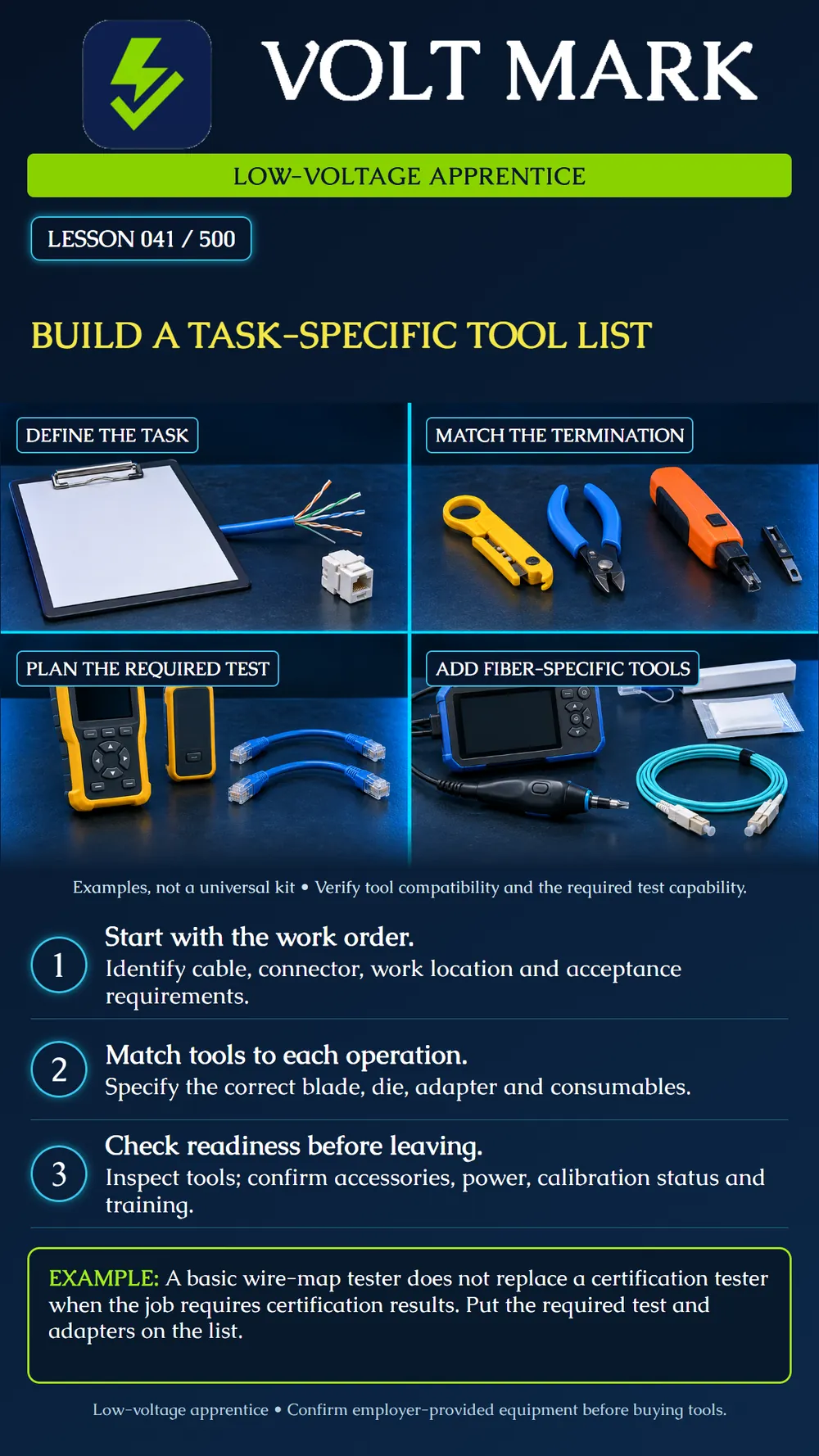
Prepare a reviewable tool list tied to the task, components and required acceptance test, including accessories and consumables.
Identify the work location, cable type, connector model, installation operations and deliverables. Read the work order and component instructions before choosing a termination tool. A tool's name is not enough. The blade, die, connector adapter, operating range and compatible consumables may determine whether it can perform the task correctly.
A fictional work order calls for terminating one specified twisted-pair cable into a compatible keystone jack, identifying the outlet and delivering the required test record. Build the list by operation: Identify: current work order, connector instructions and labeling schedule. Prepare: cable cutter and jacket tool suited to that cable construction. Terminate: the jack manufacturer's required termination tool, or the documented tool-less method if applicable; include the correct blade or fixture. Mount and finish: fastener tools that fit the selected hardware, plus the required labeling equipment and material. Test: the instrument and adapters capable of the specified test, with the correct setup and report-saving method. Protect and clean: task-selected protective equipment, site protection and waste collection. Confirm employer-provided items and required training before purchasing or using equipment.
Verification, qualification and certification answer different questions. A simple continuity or wire-map check is not a substitute for a required installed-link certification result. Record the requested test and acceptance criteria first. Then identify an instrument capable of that work, the appropriate link adapters or test leads, valid calibration status where required, charged batteries and the reporting method. Do not claim a test capability from the shape of the instrument in the poster.
Change the assignment to installing documented preterminated fiber patch cords between identified ports. The copper punchdown tool is no longer the relevant termination item. The revised list should address the connector types, suitable inspection adapters, fiber cleaning supplies, identification and the specified optical verification or acceptance test. If the assignment instead includes splicing or connector installation, add the required preparation, cleaving, splicing or termination equipment and controlled shard collection. Do not bring those operations into scope merely because their tools are available.
For each operation, write: Operation | exact tool/accessory | reason it is needed | readiness/owner. Example: “Certify installed copper link | specified certifier plus permanent-link adapters | required acceptance report | employer kit; availability and calibration to be confirmed.” A list containing only “tester” does not establish readiness.
Inspect condition and confirm that the necessary accessories actually fit. Confirm batteries, chargers, spare consumables and available storage for reports. Check required calibration or function checks according to the equipment and project requirements. Confirm training, supervision and authorization for the planned operations. Resolve missing equipment before the crew is expected to complete that operation.
Q: Is every crimp tool suitable for every connector? A: No; match the documented connector and tooling system. Q: Does a fiber cleaning pen establish readiness to perform a fiber loss test? A: No; the test equipment and reference accessories are separate needs. Q: What is missing from “bring a tester”? A: Required capability, adapters, setup and reporting requirements. Q: Should an apprentice buy every item shown? A: No; confirm the task and employer-provided equipment first. Q: Can a tool list expand the authorized work scope? A: No.
Packing familiar tools without checking the actual connector instructions or acceptance requirements.
Start with the job, not the tool bag. Match each operation to the right tool, attachment and consumable. Identify the required test before choosing the tester. Check condition, readiness and who provides each item.
Fluke Networks, verification, qualification and certification: https://www.flukenetworks.com/blog/cabling-chronicles/verification-qualification-certification-which-do-i-need Fiber Optic Association, installer toolkits: https://www.thefoa.org/tech/ref/install/tools.html The work-order examples and four-column planning record are original teaching material.
Free study material for low-voltage apprentices. This is a national foundation course: requirements differ by state and by local jurisdiction, and a practice that is common in one place is not a rule everywhere. Nothing here is a licence, a certification, or authority to work unsupervised, and completing it does not count as apprenticeship hours or continuing-education credit. Check the codes adopted where you are working, the licensing authority for that work, and your employer's safety programme. VoltMark is not affiliated with, endorsed by, or sponsored by NFPA, OSHA, NICET, BICSI, FOA, or any state or local licensing authority.

Electrician licensing exam prep: practice questions, timed exam simulations, and step-by-step help finding every answer in the NEC.