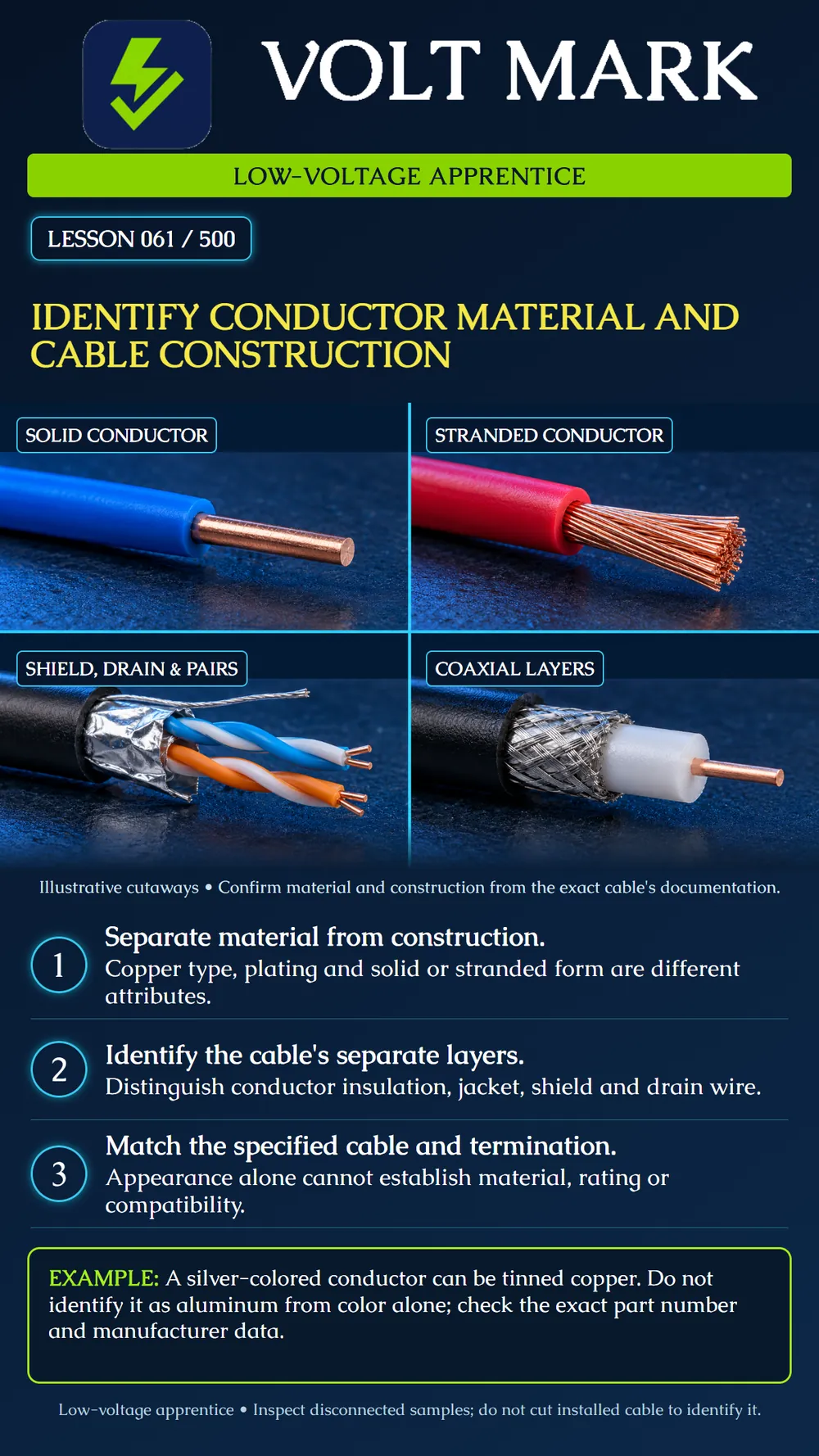
Distinguish conductor material from conductor construction and identify common cable layers using documented disconnected samples.
Find the cable manufacturer, part number, jacket markings, packaging identification, and applicable data sheet. Match the documentation to the actual sample. Appearance can help locate features, but it cannot establish every material, listing, electrical property, or permitted use.
For this exercise, use instructor-provided disconnected offcuts. Do not cut or strip installed cable merely to identify it. Unknown service status and missing identification need an authorized investigation.
A material description identifies what a conductor is made from, including any plating or composite construction. A construction description identifies its form. Solid means one metal wire forms the conductor; stranded means multiple smaller wires form it.
Copper may be bare or plated, such as tinned copper. A silver-looking surface therefore does not establish aluminum. A copper-colored surface does not by itself prove that the entire conductor is copper. Verify the documented material rather than substituting based on color.
Solid and stranded conductors of a nominal size can have different handling and termination requirements. Stranding does not automatically mean a cable is rated for continuous flexing, and a connector is not automatically compatible with both forms. Follow the cable and connector specifications.
Conductor insulation surrounds an individual conductor. The jacket is the outer covering of the cable assembly. A shield can be foil, braid, or another documented construction. A drain wire can provide a connection to a foil shield in a particular cable design.
Do not treat a drain wire as a spare signal conductor or assume it is a protective-earth conductor. Its termination belongs to the system design and manufacturer instructions. This lesson does not prescribe a universal one-end or both-end shield-bonding rule.
Twisted pairs group two insulated conductors together. A cable can have several pairs, individual pair shields, an overall shield, or combinations. Count and identify the elements from the actual construction and documentation; do not rely only on the outside jacket color.
The coaxial example shows a center conductor, surrounding dielectric, metallic shield, and outer jacket. These layers have different functions and are not interchangeable. Center-conductor material and shield construction vary by product. A generic cutaway does not establish impedance, connector compatibility, or suitability for a particular application.
Fiber cables use optical fibers and may include buffers, tubes, strength members, armor, or other layers. They are not simply copper cable with a different colored center. The dedicated fiber sequence addresses those constructions in detail. Here the focus is identifying the material and layers of the shown copper examples.
Sample A's documentation says solid tinned copper. Sample B says stranded tinned copper. Both can have silver-colored exposed surfaces, but their conductor forms differ. Select a compatible termination only after checking the exact requirements.
Sample C has a foil layer, a small bare drain wire, and insulated pairs. A learner calls every exposed metal part a signal conductor. Correct that record by distinguishing the conductors, shield, and drain. Confirm the actual cable construction in the data sheet rather than inferring the electrical function of each part from appearance.
Record manufacturer and part number, conductor material, solid or stranded form, documented size, conductor or pair count, insulation, shield construction, drain wire where present, and jacket description. Mark any unidentified attribute as unresolved. Preserve the source reference used for each conclusion.
Compare labeled offcuts with their manufacturer data. Point to each visible layer and explain what the documentation establishes. Identify one property that cannot be proved visually, such as a listing or an electrical performance value.
Belden 9802, solid tinned copper construction: https://www.belden.com/products/cable/electronic-wire-cable/multi-conductor-cable/9802 Belden 9402, stranded tinned copper, shielded pairs and drain wire: https://www.belden.com/products/cable/electronic-wire-cable/multi-conductor-cable/9402 Sources reviewed September 30, 2026. Artwork is illustrative and is not a verified photograph of either referenced product.
Free study material for low-voltage apprentices. This is a national foundation course: requirements differ by state and by local jurisdiction, and a practice that is common in one place is not a rule everywhere. Nothing here is a licence, a certification, or authority to work unsupervised, and completing it does not count as apprenticeship hours or continuing-education credit. Check the codes adopted where you are working, the licensing authority for that work, and your employer's safety programme. VoltMark is not affiliated with, endorsed by, or sponsored by NFPA, OSHA, NICET, BICSI, FOA, or any state or local licensing authority.

Electrician licensing exam prep: practice questions, timed exam simulations, and step-by-step help finding every answer in the NEC.