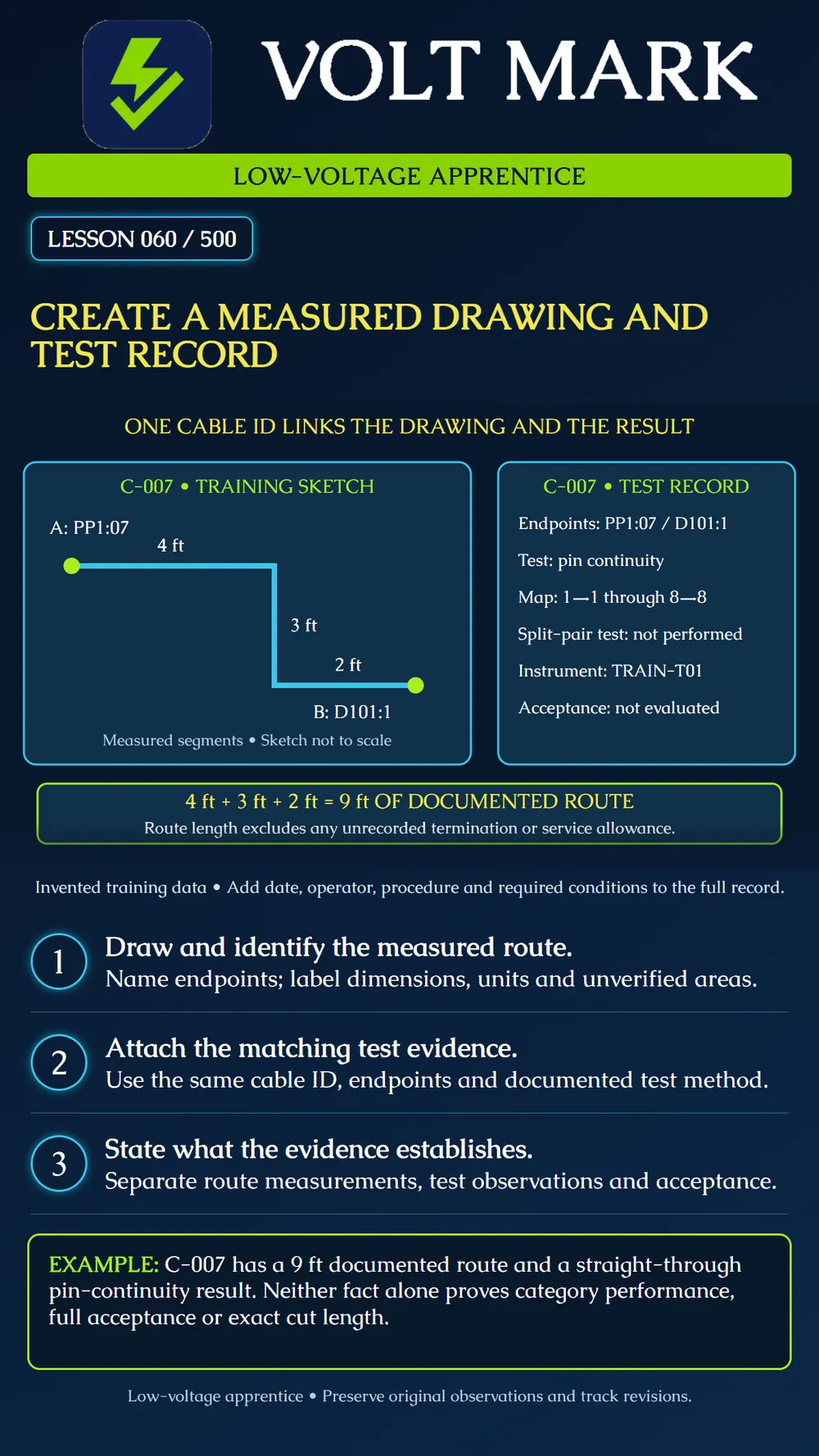
Produce a measured route sketch and a linked test record for one training cable, clearly separating observed dimensions, test results, and acceptance.
Assign or confirm the cable identifier under the project convention. Record both endpoints, including relevant rack, panel, outlet, or terminal identifiers. Use the same cable ID on the drawing, test record, and any permitted physical labels. Similar cable colors do not establish identity.
This exercise uses disconnected instructor-approved training cabling. Follow the test equipment instructions and the employer's procedure. Do not disconnect an operating system or enter an inaccessible area merely to complete the worksheet.
Show enough surrounding information to locate the endpoints and route. Include orientation or a reference feature when needed. Label each measured segment with a value and unit. Distinguish horizontal segments, rises, drops, and any separately measured service loops.
A clear sketch can be marked not to scale while still carrying measured dimensions. That label does not turn guessed values into measurements. Mark inaccessible or unverified segments as such. Do not draw an assumed route as though you observed it.
State the basis of measurements and the relevant date and revision. If using a reproduced plan, follow its measurement permissions and calibration requirements. If making a field sketch, use the approved measuring method and record its limitations.
Cable C-007 connects endpoint A, PP1:07, to endpoint B, D101:1. Three documented training-route segments measure 4 ft, 3 ft, and 2 ft. Their sum is 9 ft.
That sum is the documented route length in this example. It excludes any unrecorded termination or service allowance. It is not automatically the cable cut length or the result of a cable tester's length measurement. Keep these different quantities separately identified.
Use C-007 and the same two endpoints in the test record. Identify the test method and instrument, date, operator, setup, conditions, and required references. Save original instrument output where the procedure requires it and link it to the drawing rather than relying on an unrelated screenshot filename.
The fictional poster record reports pin continuity from 1 to 1 through 8 to 8. It explicitly states that a split-pair test was not performed and that acceptance was not evaluated. This avoids turning a limited observation into a broader claim.
A test result applies to the tested setup and cable at the recorded time. If the termination or cable changes afterward, determine the required retest through the project procedure. Preserve the previous result and the reason for the change.
Can another technician find the cable, follow the documented route, identify the tested endpoints, and understand the test's limitations? If not, identify the missing information. A route sketch without an ID and a test file without endpoint references may be difficult to connect reliably.
For fiber work, later lessons add fiber identifiers, wavelengths, directions, references, methods, and optical results as appropriate. The same basic principle applies: the drawing and test evidence must identify the same installed item.
One worksheet labels the sketch C-007 but attaches a result for C-070. The values may look plausible, but the evidence is not linked correctly. Investigate the identity mismatch rather than renaming the result without proof.
A second worksheet reports the 9 ft route as a certified cable length and marks PASS. The route measurement and limited continuity observation do not support those claims. Correct the description and perform any required additional work through the authorized process.
Measure an instructor-provided route, draw it clearly, and label its endpoints and segments. Complete the approved test, preserve the observed result, and link it with the cable identifier. Have another learner trace the documentation. Record what remains unverified.
FOA, Users Guide to Fiber Optic System Design and Installation, documentation: https://www.thefoa.org/user/ FOA, Fiber Optic Network Design, test-plan documentation: https://thefoa.org/tech/ref/basic/design.html Sources reviewed September 30, 2026. Their documentation principles inform this original copper training exercise; no historical standard edition is prescribed here.
Free study material for low-voltage apprentices. This is a national foundation course: requirements differ by state and by local jurisdiction, and a practice that is common in one place is not a rule everywhere. Nothing here is a licence, a certification, or authority to work unsupervised, and completing it does not count as apprenticeship hours or continuing-education credit. Check the codes adopted where you are working, the licensing authority for that work, and your employer's safety programme. VoltMark is not affiliated with, endorsed by, or sponsored by NFPA, OSHA, NICET, BICSI, FOA, or any state or local licensing authority.
Electrician licensing exam prep: practice questions, timed exam simulations, and step-by-step help finding every answer in the NEC.