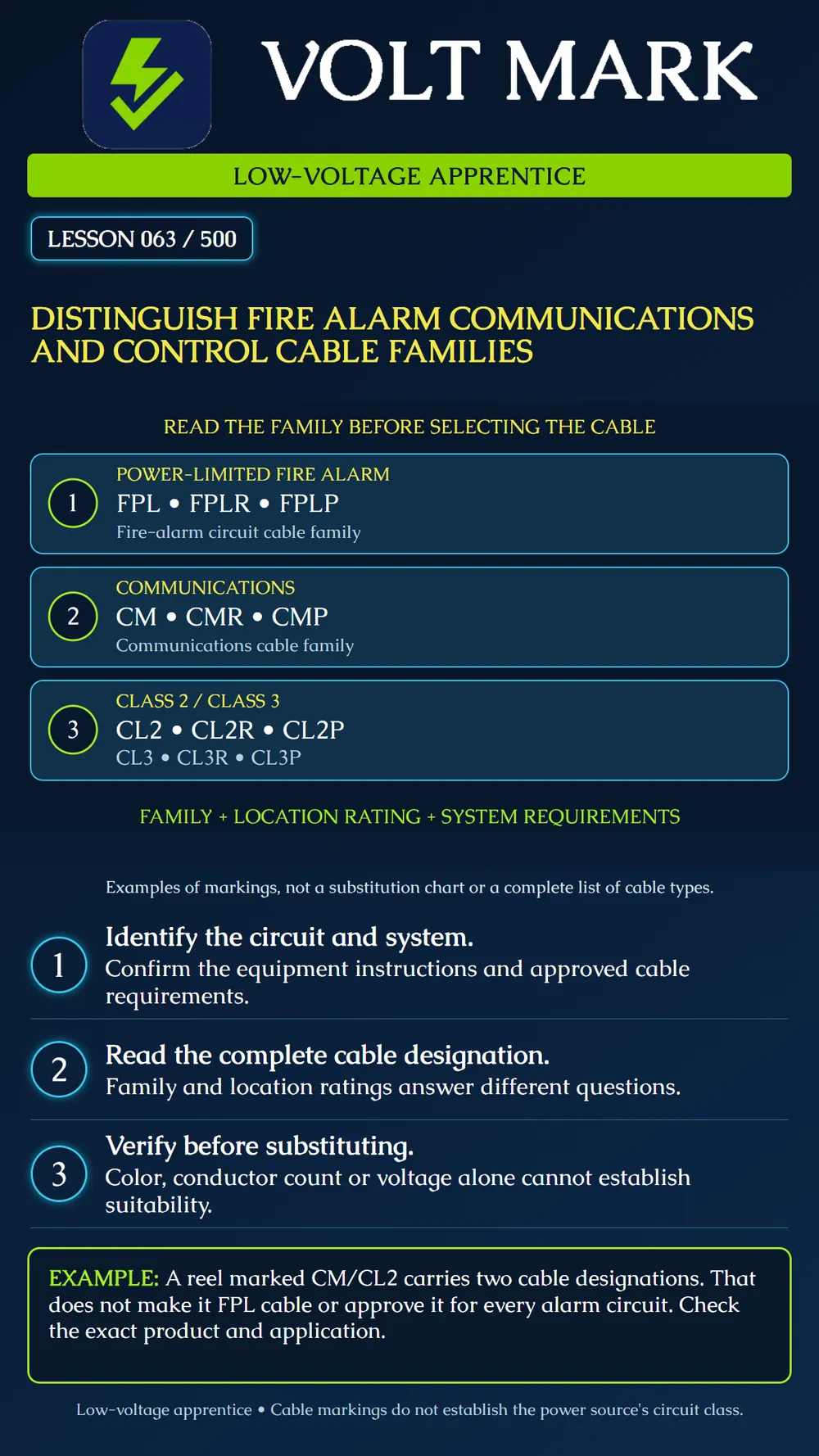
Recognize three common cable families and explain why selecting cable requires more than matching jacket color or conductor count.
A cable-family designation tells you something about the evaluated use of the cable. It is only one part of a selection decision. Begin with the circuit, equipment instructions, approved design and installation environment. Then match the actual product's documented properties to those requirements.
Power-limited fire alarm cable commonly uses FPL designations, including FPLR and FPLP variants. The words power-limited matter: this family should not be treated as a label covering every fire alarm circuit. A fire alarm system can have different circuit requirements at different terminals. Do not choose the wiring method merely because the enclosure says fire alarm.
Communications cable commonly uses CM designations. CMR identifies a communications riser type; CMP identifies a communications plenum type. These markings address a different question from transmission categories such as Category 6. A performance category is not a substitute for the required installation rating. Fiber cable has its own designations, addressed in later lessons.
CL2 and CL3 identify power-limited circuit cable types associated with Class 2 and Class 3 circuits. Riser and plenum variants include CL2R/CL3R and CL2P/CL3P. Control and signaling work can involve these families, but not every control circuit is Class 2 or Class 3. Installing CL2 cable does not convert a power supply or its output into a Class 2 source.
Location suffixes are explored in Lesson 064. Do not infer wet-location, sunlight or direct-burial suitability merely from a plenum or riser marking. This lesson deliberately does not give a universal substitution ladder. Apply the locally adopted requirements and approved design with the responsible supervisor or designer.
Southwire lists a burglar alarm product with CM/CL2 markings. Belden lists product 5300U2 with CL3, FPL and PLTC designations and specific environmental applications. These examples demonstrate that a product can have more than one evaluated use. They do not mean that every communications cable is fire alarm cable or that all products in a family share that product's environmental ratings. Confirm the exact part number, packaging and supporting documentation.
A trainee receives two reels with the same conductor count. The first has a documented CM/CL2 designation. The second has a documented FPLR designation. A work order merely says "alarm." The trainee has insufficient information to release either reel for installation. Obtain the actual system, circuit identification, cable schedule, equipment requirements and route conditions. Record the selected part number and the basis for selection. If documents disagree, escalate the discrepancy before the pull.
Free study material for low-voltage apprentices. This is a national foundation course: requirements differ by state and by local jurisdiction, and a practice that is common in one place is not a rule everywhere. Nothing here is a licence, a certification, or authority to work unsupervised, and completing it does not count as apprenticeship hours or continuing-education credit. Check the codes adopted where you are working, the licensing authority for that work, and your employer's safety programme. VoltMark is not affiliated with, endorsed by, or sponsored by NFPA, OSHA, NICET, BICSI, FOA, or any state or local licensing authority.

Electrician licensing exam prep: practice questions, timed exam simulations, and step-by-step help finding every answer in the NEC.