Distinguish common installation-location categories and identify what must be confirmed before choosing a cable or wiring method.
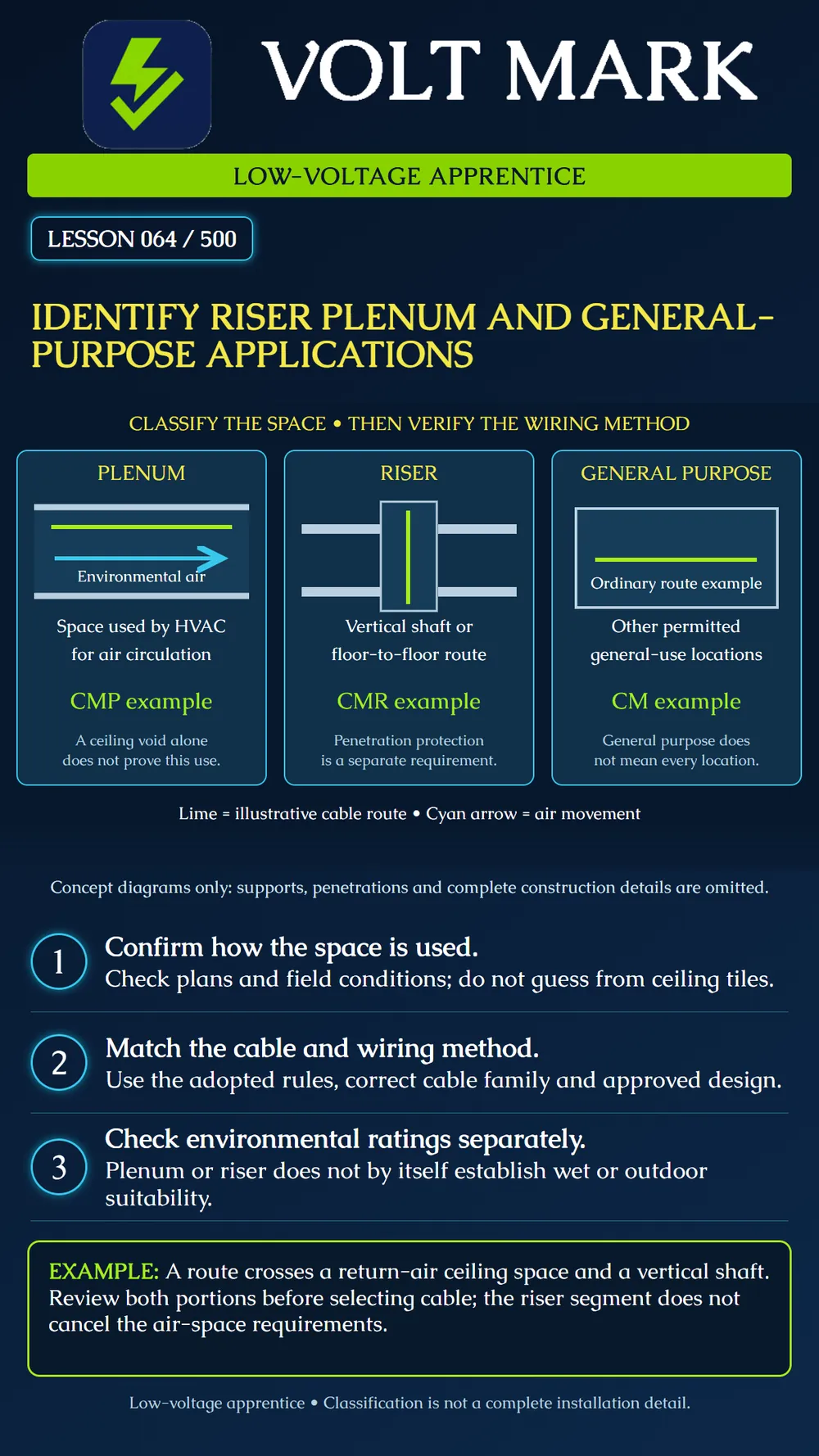
A plenum is associated with the building's environmental-air system. An above-ceiling or raised-floor space may be used for air circulation. Its actual function matters. Ceiling tiles alone do not tell you whether the surrounding void transports environmental air. Read the mechanical design and have the responsible project personnel confirm the space classification.
Riser applications involve vertical shafts or floor-to-floor routes. They present a different fire-propagation concern from an ordinary same-floor run. A riser cable designation is not a statement that the cable is suitable for every other space along its route.
General-purpose cable is intended for permitted general-use applications. General purpose does not mean unrestricted use. The cable family, installation method, location and applicable requirements still govern selection.
The poster uses the communications designations CMP, CMR and CM to illustrate plenum, riser and general-purpose types. Other families use different markings. Do not put communications markings on fiber cable in your records merely because both cables serve a network. Fiber designations and conductive versus nonconductive constructions are addressed later in this course.
The three drawings are concepts, not approved construction details. Lime shows an illustrative cable route; the cyan arrow shows air movement. Cable supports, firestopping assemblies and complete building construction are intentionally omitted. A line passing through a floor in a teaching sketch never authorizes an unprotected opening in the field.
Walk the complete proposed path and compare it with current plans. Record where it enters a shaft, environmental-air space, exterior section or potentially wet location. Confirm uncertain transitions before pulling. The first room does not determine the requirements for the rest of the run.
Plenum does not mean weatherproof. Manufacturers offer specific products combining indoor and outdoor capabilities; those additional capabilities must be documented for the actual product. Likewise, riser does not automatically mean direct burial. Check the exact product's environmental ratings and conditions of use rather than relying on one familiar suffix.
A camera cable runs from a telecommunications room into a corridor ceiling, then through a floor-to-floor shaft. The drawing identifies the corridor void as an environmental-air return space. A reel is marked CMR. A trainee says, "Most of the run is vertical, so this is the correct reel."
The trainee has skipped part of the route. Record both conditions and refer the cable selection to the approved design and applicable installation rules. Do not invent a percentage-of-length exception. Do not assume enclosing a short portion in any convenient tube automatically resolves the issue. Any permitted alternative wiring method must be verified for the actual application.
A second corridor has fully ducted return air, but the trainee has not confirmed the design or field conditions. The correct next step is to verify those facts. This lesson does not declare the second corridor a plenum or approve a particular cable from a verbal description.
UL Solutions — Telecommunications Cable Testing: communications location categories and associated evaluations. https://www.ul.com/services/telecommunications-cable-testing Belden — Fiber Cable Ratings: Selecting Riser vs. Plenum: environmental-air spaces and fiber location ratings. https://www.belden.com/blog/smart-building/fiber-cable-ratings-selecting-riser-vs-plenum Belden — Going Beyond Boundaries: Plenum Cables You Can Install Outdoors: separate indoor/outdoor product capabilities. https://www.belden.com/blog/going-beyond-boundaries-plenum-cables-you-can-install-outdoors UL Solutions — Wire and Cable Application Guide: cable suitability and application categories. https://www.ul.com/thecodeauthority/knowledge/wire-cable-guide
Apply locally adopted requirements and approved project documents.
Free study material for low-voltage apprentices. This is a national foundation course: requirements differ by state and by local jurisdiction, and a practice that is common in one place is not a rule everywhere. Nothing here is a licence, a certification, or authority to work unsupervised, and completing it does not count as apprenticeship hours or continuing-education credit. Check the codes adopted where you are working, the licensing authority for that work, and your employer's safety programme. VoltMark is not affiliated with, endorsed by, or sponsored by NFPA, OSHA, NICET, BICSI, FOA, or any state or local licensing authority.
Electrician licensing exam prep: practice questions, timed exam simulations, and step-by-step help finding every answer in the NEC.