Arrange planned cable slack so future service is possible without compromising the cable or its terminations.
A service loop is reserved cable length for a defined maintenance, termination or relocation need. Its amount and location come from the project and equipment requirements. Do not add an arbitrary length to every cable or leave excess wherever space happens to be available.
Plan where the slack will be stored and how a future technician can reach it. The storage arrangement should protect the cable without blocking equipment, covers, identification or necessary access. Available space alone does not establish that a location is suitable.
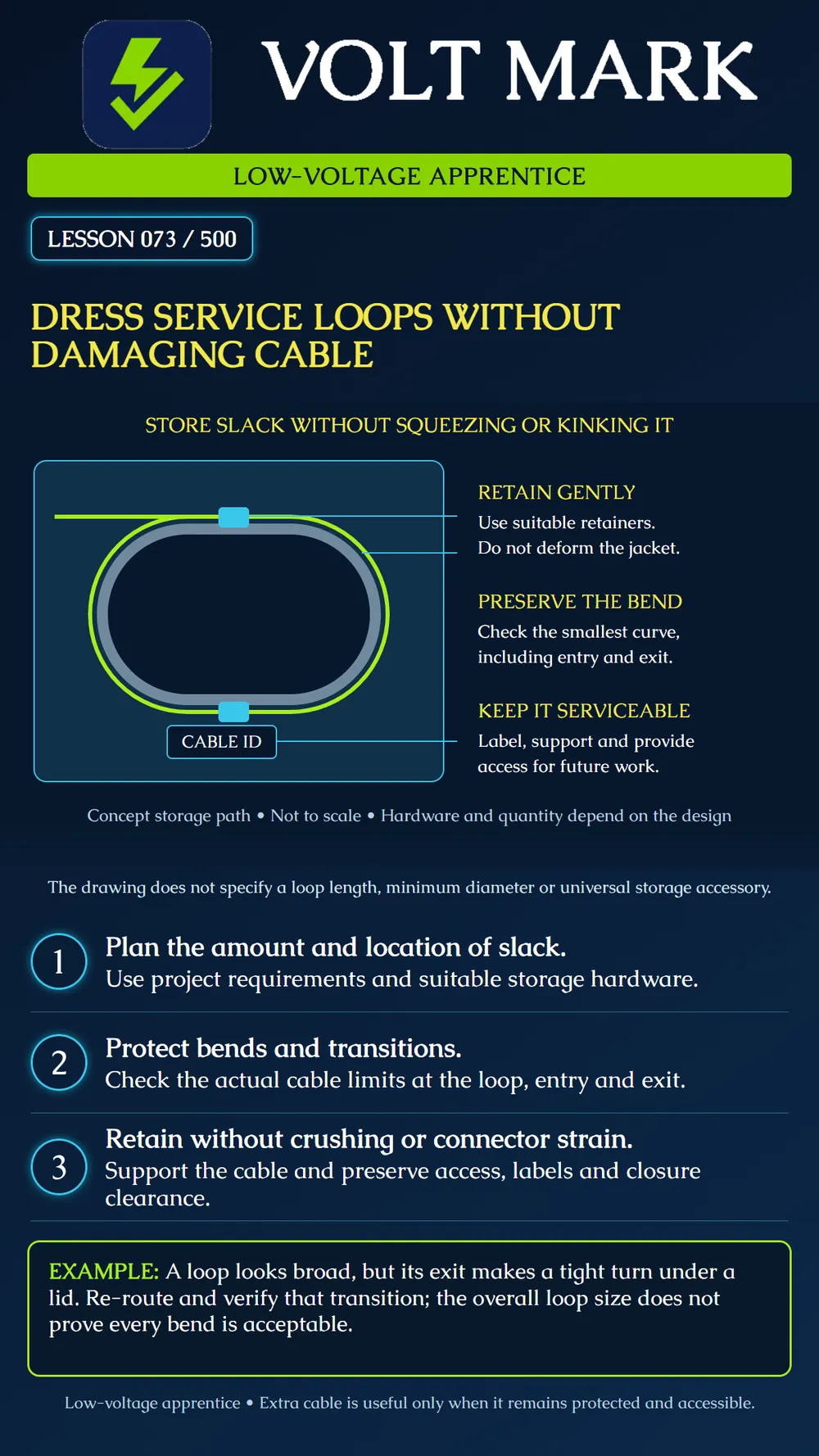
The lime line is a conceptual slack-storage path around a rounded gray support. Cyan blocks represent suitable retainers; the tag represents identification. The drawing shows principles rather than an actual manufacturer's product or a specified number of turns. Its dimensions are not a bend template.
Use the exact cable's bend requirements for the relevant handling or installed condition. Distinguish radius from diameter, as covered in Lesson 069. Check turns at the entry, exit and transition to equipment, not only the broad main loop.
A large-looking loop can still contain a kink or a small-radius corner. Closing a door or lid can create another problem after the cable has been arranged. Check clearances through the intended operation of the enclosure without forcing the cable into position.
Manufacturers offer slack managers and routing accessories with defined applications and geometry. Panduit's FiberRunner resources illustrate purpose-built management with smooth cable surfaces and bend control. This does not mean every accessory fits every fiber or copper cable. Compare the accessory with the actual cable and enclosure requirements.
FOA emphasizes product-specific bend limits and appropriate support of stored cable. A generic diameter from a training illustration should not replace the cable documentation. Fiber, coaxial and balanced copper cable can have different construction and handling limits.
Use the specified retention method and avoid squeezing the jacket or changing the shape of the cable. Retainers organize the slack; they do not justify overfilling or force a cable to conform to inadequate space. Hook-and-loop products can be useful for reopening a bundle, but their presence alone does not prove correct pressure or routing.
Support the stored cable so its weight or movement is not carried unintentionally by a connector. Provide the required strain relief independently where specified. Do not assume a neat coil automatically protects the termination.
An apprentice stores slack in a cabinet and closes the cover. The loop itself remains broad, but the exit passes through a narrow corner beneath the cover. The correct response is to revise that transition and verify clearance and bend geometry before accepting the arrangement. Do not push harder on the cover or tighten a retainer to make it fit.
If a kink, scrape or deformation is found, follow the cable manufacturer's assessment and project disposition process. Straightening a visible kink does not establish that the cable was undamaged. Complete the required inspection and testing after the final arrangement.
Cable identifier and location: Required slack amount and purpose: Storage accessory and instructions: Applicable bend requirements: Entry, exit and cover-clearance checks: Retention and termination support: Inspection and test disposition:
FOA — Fiber Optic Cables: product-specific bending limits and service-loop sizing. https://www.thefoa.org/tech/ref/basic/cable.html FOA — Installing Fiber Optic Cable: support and avoiding compression. https://www.thefoa.org/tech/ref/install/installcbl.html Panduit — FiberRunner Cable Routing System: smooth carrying surfaces and bend-control accessories. https://www.panduit.com/en/products/featured-products/fiberrunner-cable-routing-system.html Panduit — FiberRunner Slack Management Spool, FRSSM2: example of purpose-built slack management, not a universal product selection. https://www.panduit.com/en/products/wire-routing-management-protection/fiber-routing-systems/fiber-optic-routing-hardware-accessories/p201249.html
No universal loop size, slack allowance or hardware installation is specified.
Free study material for low-voltage apprentices. This is a national foundation course: requirements differ by state and by local jurisdiction, and a practice that is common in one place is not a rule everywhere. Nothing here is a licence, a certification, or authority to work unsupervised, and completing it does not count as apprenticeship hours or continuing-education credit. Check the codes adopted where you are working, the licensing authority for that work, and your employer's safety programme. VoltMark is not affiliated with, endorsed by, or sponsored by NFPA, OSHA, NICET, BICSI, FOA, or any state or local licensing authority.

Electrician licensing exam prep: practice questions, timed exam simulations, and step-by-step help finding every answer in the NEC.