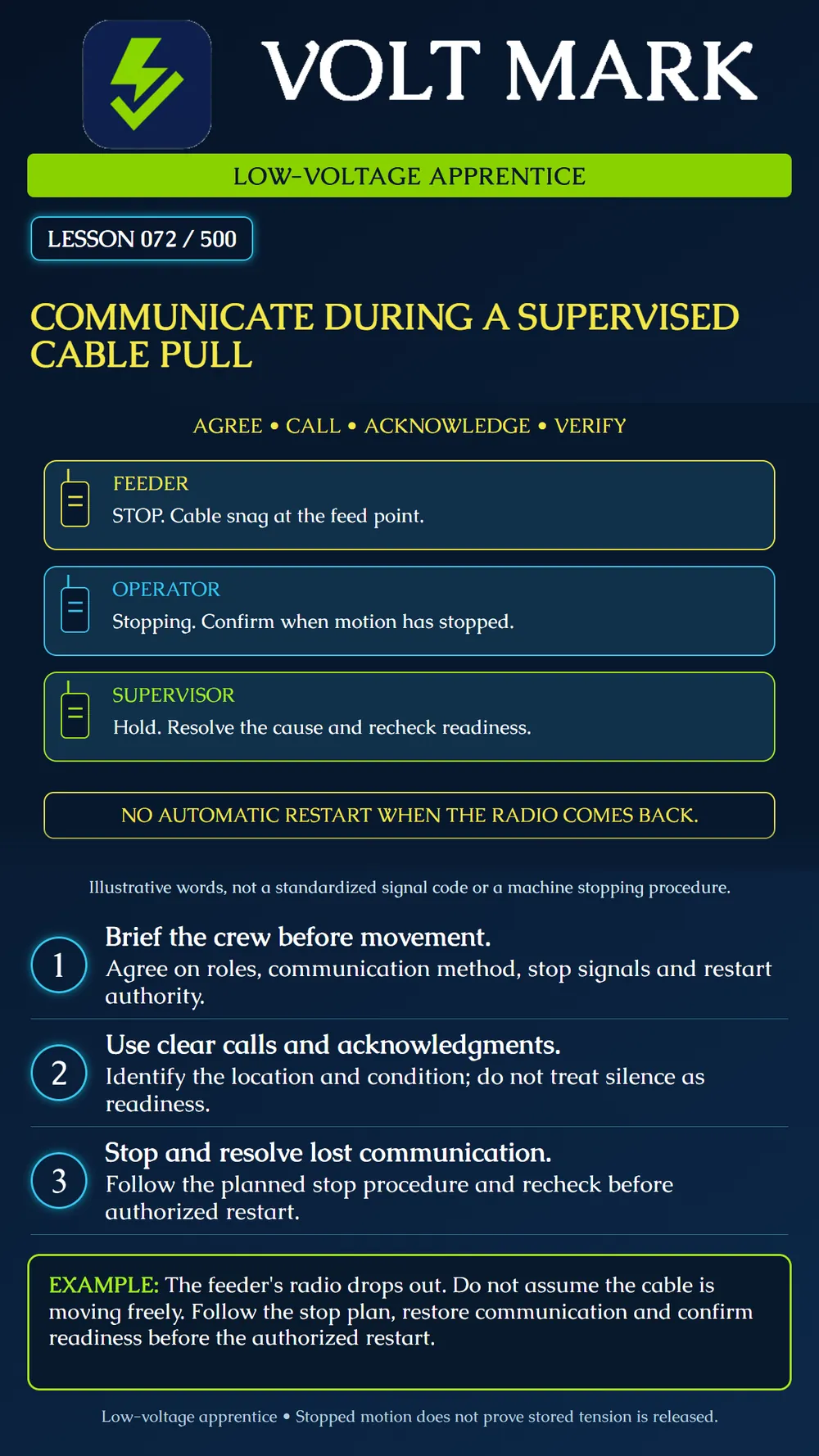
Use an agreed communication process to coordinate a supervised cable pull, report a problem and prevent an uncontrolled restart.
A crew needs a shared plan before cable or pulling equipment moves. Identify the person supervising the pull, the equipment operator, the feeder and any intermediate observers. Confirm who gives routine movement directions and who authorizes restart after a problem. Make sure every participant knows how to call for an immediate stop under the site procedure.
Test the chosen communication method from the actual working positions. A radio that works beside the truck may not work at the far end of a route or behind building construction. Confirm the channel, location names and agreed words. If a backup method is required, establish it before work rather than improvising after contact is lost.
A useful call identifies the action or condition and its location. "Stop, snag at the feed point" is more informative than "something is wrong." The receiver should acknowledge the message so the sender knows it was heard. Keep messages short enough to be understood amid equipment noise.
The poster gives an illustrative exchange. It is not an industry-standard command vocabulary or a substitute for equipment instructions. A stopping acknowledgment is not proof that all motion has ceased; verify the actual condition. Likewise, stopped motion does not prove that the rope or cable is free of stored tension.
Greenlee's Pull Assist instructions emphasize maintaining operator communication and warn that loss of communication increases injury and equipment-damage risk. That manual also illustrates that tension can remain after equipment stops. Those principles support this lesson; its specific machine procedures must not be transferred to other equipment.
FOA's installation guidance emphasizes trained personnel, planning and cable mechanical limits. Crew communication supports those controls by allowing the feeder or an intermediate observer to report a snag, an unexpected bend condition or abnormal movement before the operator can see it.
Use the preplanned stopping procedure when required communication is lost or a message is unclear. Do not interpret silence as permission to continue. Do not walk into a tensioned line or reach into moving equipment while trying to restore contact. Follow the equipment and site controls for making the work area safe.
Restoring a radio link does not itself authorize restart. The supervisor and operator must resolve the reported condition, confirm readiness at the required positions and use the agreed restart process. A casual "okay" may refer to the radio test rather than the cable condition, so be explicit about what is being confirmed.
A feeder notices a snag and transmits the stop call. The operator acknowledges and uses the specified stopping procedure. The supervisor keeps the pull on hold while the cause is evaluated. The crew checks the affected cable and setup as required. Only after the problem and readiness checks are resolved does the authorized person direct restart.
If the feeder cannot hear the acknowledgment, the feeder must not assume the operator received the call. Use the agreed backup or emergency communication process while keeping clear of the operating equipment. This lesson cannot define the emergency controls of an unspecified puller.
No to all four. Use the agreed plan, acknowledgments, verified conditions and equipment-specific procedures.
Pull identifier and route: Supervisor and assigned crew positions: Routine direction and restart authority: Primary communication method and test: Stop call and backup method: Loss-of-contact response: Monitoring and readiness checks: Issues and corrective actions:
Greenlee — Pull Assist instruction manual, 52093315 Rev 0 (2021): operator communication and residual tension warnings. Referenced for principles, not as instructions for another machine. https://cdn.greenlee.com/resources/media?key=cf97dd64-5c06-4117-aa11-9989e495daa3&languageCode=en&type=document FOA — Fiber Optic Installation: trained personnel, planning and mechanical limits. https://www.thefoa.org/tech/ref/OSP/install.html FOA — Fiber Optic Network Design: project responsibility and authority to stop work or require corrections. https://thefoa.org/tech/ref/basic/design.html
This overview does not replace site procedures, equipment training or a machine-specific emergency-stop plan.
Free study material for low-voltage apprentices. This is a national foundation course: requirements differ by state and by local jurisdiction, and a practice that is common in one place is not a rule everywhere. Nothing here is a licence, a certification, or authority to work unsupervised, and completing it does not count as apprenticeship hours or continuing-education credit. Check the codes adopted where you are working, the licensing authority for that work, and your employer's safety programme. VoltMark is not affiliated with, endorsed by, or sponsored by NFPA, OSHA, NICET, BICSI, FOA, or any state or local licensing authority.
Electrician licensing exam prep: practice questions, timed exam simulations, and step-by-step help finding every answer in the NEC.