Recognize the evidence needed for a shared enclosure and identify why a divider alone does not establish an acceptable installation.
Identify the enclosure, installed equipment and each circuit. Check the applicable adopted requirements and manufacturer instructions for the specific combination. Do not begin by choosing a spare box and assuming a divider will make any mix of circuits acceptable.
An enclosure-specific arrangement can depend on circuit classifications, the equipment served, cable types and the treatment of conductors beyond their jackets. Rules for one arrangement must not be transferred to another without checking the conditions.
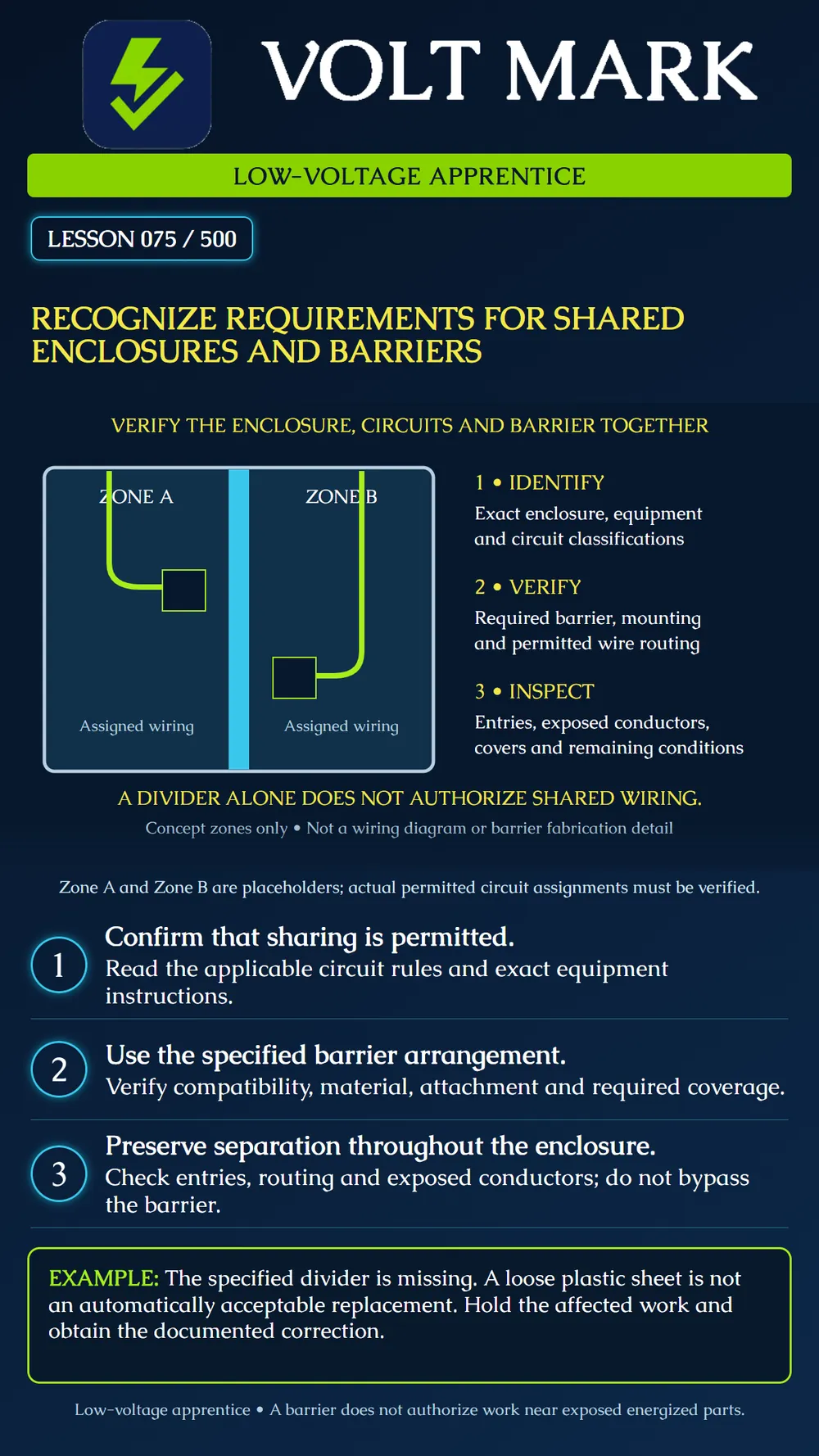
Zone A and Zone B are placeholders for circuit assignments established by the approved design. The cyan divider represents a barrier whose suitability must be verified. Lime lines illustrate routing within the assigned areas. The drawing is not a wiring diagram, fabrication detail or approval for a particular mixture of power and low-voltage circuits.
The simplified terminals and entries show where inspection attention belongs. Actual terminal locations, entry fittings, bonding, conductor clearances and cover construction come from the real equipment documentation. They are not specified by this teaching sketch.
Lutron Application Note 670 discusses low-voltage and line-voltage wiring for specific DIN power modules and panels. Its discussion ties cable types and exposed-conductor treatment to that application. It demonstrates why equipment details and installation conditions matter. It is not a blanket permission for unrelated enclosures.
Legrand also supplies product-specific instructions for boxes, dividers and control enclosures. A divider is selected and installed as part of the documented arrangement. The existence of such products does not establish that an arbitrary piece of sheet material is equivalent.
Check the specified part or permitted construction, material, mounting method and coverage. Confirm it is installed and retained as instructed. Where the approved arrangement requires a fixed barrier, a loose sheet that can shift does not demonstrate compliance.
Inspect how cables enter and reach their terminals. Look for routing that bypasses the intended separation, exposed conductors extending into another zone, missing parts or alterations. Do not drill, trim or remove a barrier merely to make routing easier. Obtain direction through the project's authorized process if the planned arrangement cannot be achieved.
UL explains that modified equipment may need evaluation to determine whether it meets applicable safety requirements. This does not mean every field adjustment automatically voids a certification or always requires the same service. It means an apprentice should not assume a change is covered by the existing product approval. Resolve the proposed modification with the responsible parties and applicable authority.
Review labels, drawings and accessible information within your training and authorization. A barrier is not permission to reach into equipment with exposed energized parts. Follow the site's electrical safety and access procedures. A low-voltage task can still place a worker near power hazards.
A crew receives a cabinet whose drawing calls for a specific divider. That component is missing. Someone suggests taping a scrap plastic sheet inside until the work is inspected.
Record the missing part and hold the affected installation. Obtain the specified component or a documented acceptable revision. Do not treat an improvised temporary separator as the approved final barrier, and do not route conductors in a way that makes proper correction harder.
No to all four. Verify the complete arrangement and preserve its documented conditions.
Enclosure and equipment model: Circuit classifications and assignments: Governing requirements and instructions: Barrier part or approved detail: Attachment and coverage: Entries and conductor routing: Missing components or modifications: Required correction and disposition:
Lutron — Application Note 670, Wiring Low-Voltage and Line-Voltage Using DIN Power Modules and Panels. https://support.lutron.com/us/en/product/homeworks/article/panels-and-modules/app-note-670-wiring-low-voltage-and-line-voltage-using-din-power-modules-and-panels Legrand — Plastic Boxes Installation Instructions, IS340702: product-specific divider context. Manufacturer search result reviewed; full document not retrieved in this run. No dimensions or detailed installation procedure taken from it. https://www.legrand.us/resources UL Solutions — Field Evaluation Services: assessment of modified equipment. https://www.ul.com/services/field-evaluations UL Solutions — FAQs About Safety Certification for Reconditioned Equipment: limits of assumptions after modification. https://www.ul.com/resources/faqs-about-safety-certification-reconditioned-equipment
Lutron's manufacturer search excerpts were available; a direct page fetch failed in this run. No numerical separation allowance is reproduced. Confirm the full applicable instructions during qualified publication review.
No shared-enclosure arrangement or barrier construction is approved by this lesson.
Free study material for low-voltage apprentices. This is a national foundation course: requirements differ by state and by local jurisdiction, and a practice that is common in one place is not a rule everywhere. Nothing here is a licence, a certification, or authority to work unsupervised, and completing it does not count as apprenticeship hours or continuing-education credit. Check the codes adopted where you are working, the licensing authority for that work, and your employer's safety programme. VoltMark is not affiliated with, endorsed by, or sponsored by NFPA, OSHA, NICET, BICSI, FOA, or any state or local licensing authority.

Electrician licensing exam prep: practice questions, timed exam simulations, and step-by-step help finding every answer in the NEC.