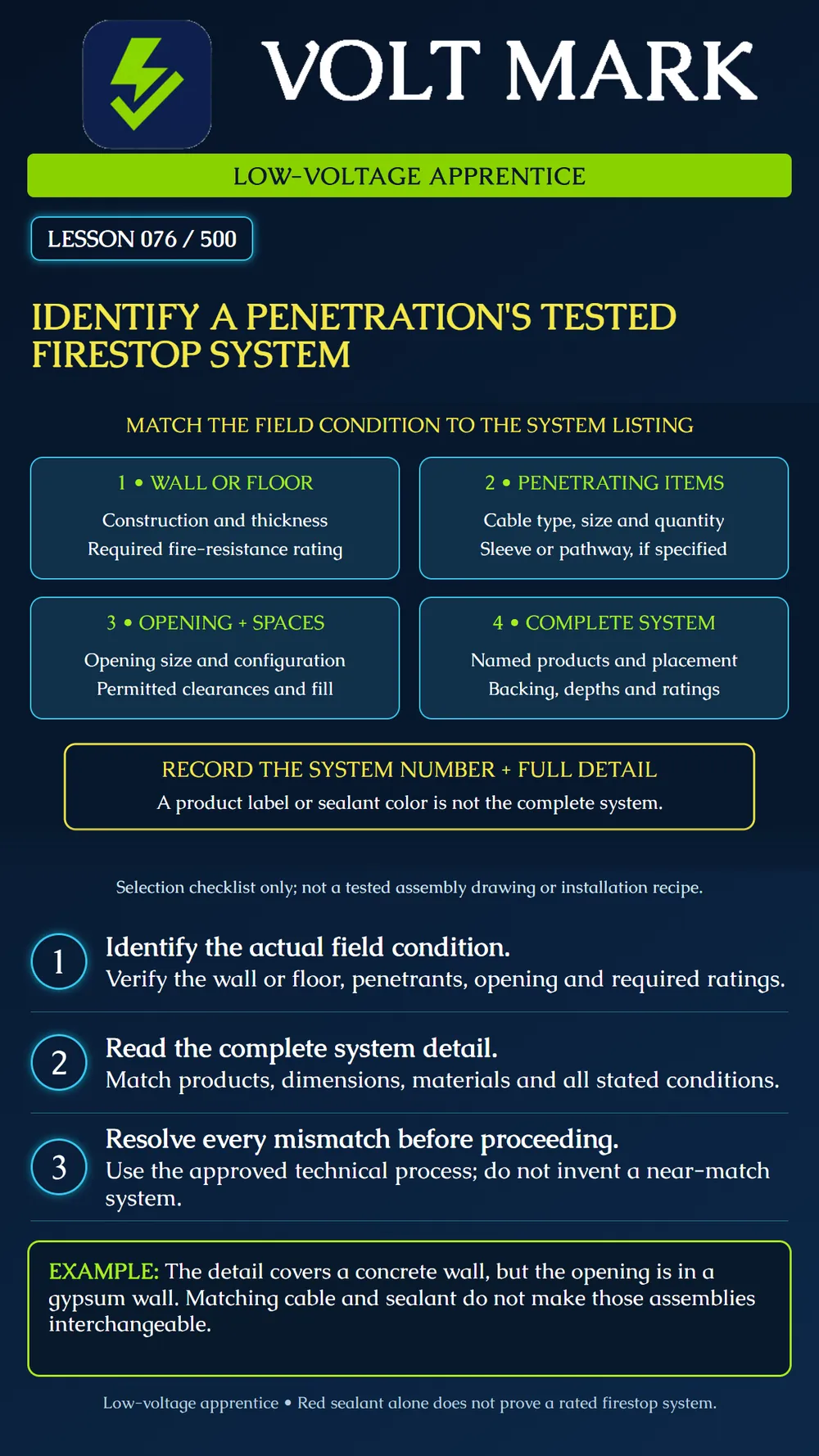
Identify the complete system documentation needed to evaluate a cable penetration in a rated assembly.
Determine what wall or floor is being penetrated and its required rating. Confirm its construction and thickness through approved documents and field verification. A concrete floor, concrete wall and framed gypsum wall are not interchangeable merely because each has an opening for cable.
Identify whether the situation is a through-penetration, a membrane penetration or another condition. Select documentation for the actual condition. Do not use a through-penetration detail as a general answer for every opening in a rated assembly.
Record cable types, dimensions and quantity or bundle configuration. Identify sleeves, conduits, cable trays or devices if present. A listed system may restrict those items or permit defined variations. Verify rather than assuming that additional cables fit simply because physical space remains.
Record the opening dimensions and configuration. Annular-space requirements address the permitted gaps around penetrating items and, where applicable, between them. STI explains these as minimum-to-maximum separations within the specified arrangement. Do not assume the cable bundle must be centered or may touch the edge unless the detail permits that condition.
The opening's size and the amount of cable are separate facts. A system's allowed cable fill or bundle dimensions do not automatically authorize a larger hole. Check each stated condition in the full listing.
Obtain the system identifier and complete current detail, including notes and referenced instructions. Match the named products, required backing or packing where specified, material depths, placement on the required sides and any sleeve or support provisions. Some systems use devices instead of a simple sealant-and-backing arrangement; the selected detail governs.
Verify the required ratings against the project's requirements. Do not treat every rating shown on a system sheet as interchangeable. This lesson introduces identification, not a detailed interpretation of all firestop ratings.
A sealant tube is a product. The rated performance belongs to the described system and its conditions. Color alone cannot identify either the exact product or the complete assembly. Do not combine the backing from one detail, sealant from another and dimensions from a third.
STI's system-search guidance describes filtering tested designs by field criteria and retrieving the listing by its system number. Use such tools to locate candidates, then read the actual detail. A search result thumbnail or a familiar identifier is not the completed check.
If no listed system matches, document the actual condition and use the approved technical process. UL discusses changes in penetrants, annular space and penetration angle as potential deviations from tested conditions. An engineering judgment is a separate technical document requiring appropriate acceptance; it must not be represented as the original tested listing.
The submitted detail describes a concrete wall. The field opening is in a framed gypsum wall. The cable and sealant product appear to match, but the assembly does not. Record the mismatch and obtain a suitable approved resolution before installation. Do not cover the opening with an assumed equivalent arrangement.
Penetration location and unique ID: Assembly construction and required rating: Penetrants and dimensions: Opening, sleeve and annular spaces: System number and detail revision/date: Specified materials and installation conditions: Rating comparison: Mismatches and disposition:
STI — How do I find systems when using System Search & Submittal Builder? https://knowhow.stifirestop.com/digital/how-do-i-find-systems-when-using-system-search-submittal-builder STI — How does FCM determine Annular Space when placing markers and object files? https://knowhow.stifirestop.com/digital/how-does-fcm-determine-annular-space-when-placing-markers-and-object-files UL Solutions — Beyond Installation: Challenges in Passive Fire Protection Compliance. https://www.ul.com/thecodeauthority/knowledgecenter/beyond-installation-challenges-passive-fire-protection-compliance UL Solutions — Numbering Systems for Penetration Firestop Systems and Joint Systems. https://www.ul.com/thecodeauthority/knowledge/ul-solutions-numbering-systems
No actual system number or fabricated tested assembly is supplied. This checklist does not authorize installation of a particular firestop.
Free study material for low-voltage apprentices. This is a national foundation course: requirements differ by state and by local jurisdiction, and a practice that is common in one place is not a rule everywhere. Nothing here is a licence, a certification, or authority to work unsupervised, and completing it does not count as apprenticeship hours or continuing-education credit. Check the codes adopted where you are working, the licensing authority for that work, and your employer's safety programme. VoltMark is not affiliated with, endorsed by, or sponsored by NFPA, OSHA, NICET, BICSI, FOA, or any state or local licensing authority.

Electrician licensing exam prep: practice questions, timed exam simulations, and step-by-step help finding every answer in the NEC.