Inspect a supervised training installation against defined criteria and create an accurate record of findings, corrections and outstanding evidence.
Use a disconnected training sample or a work area released for the assigned inspection. Confirm access and supervision. Inspection does not authorize opening energized equipment, entering a restricted space or disconnecting an operating service.
Obtain the current drawing, cable schedule, relevant product instructions, inspection criteria and required test plan. Determine which adopted requirements apply to the actual system and location. A generic checklist helps organize work but does not supply every acceptance criterion.
Start with the cable identifier and endpoints. Compare the installed cable and route with the approved documents. Review accessible jacket condition, supports, bends, edge protection, service-loop arrangement and endpoint labeling. Evaluate separation, shared enclosures and penetrations against their actual applicable requirements. Record inaccessible or concealed portions as limitations rather than assuming they pass.
Do not guess a universal support interval, bend radius or allowable fill. Cite the applicable product or project criterion. A photograph can document a visible condition; it cannot establish an unmeasured dimension or reveal concealed construction.
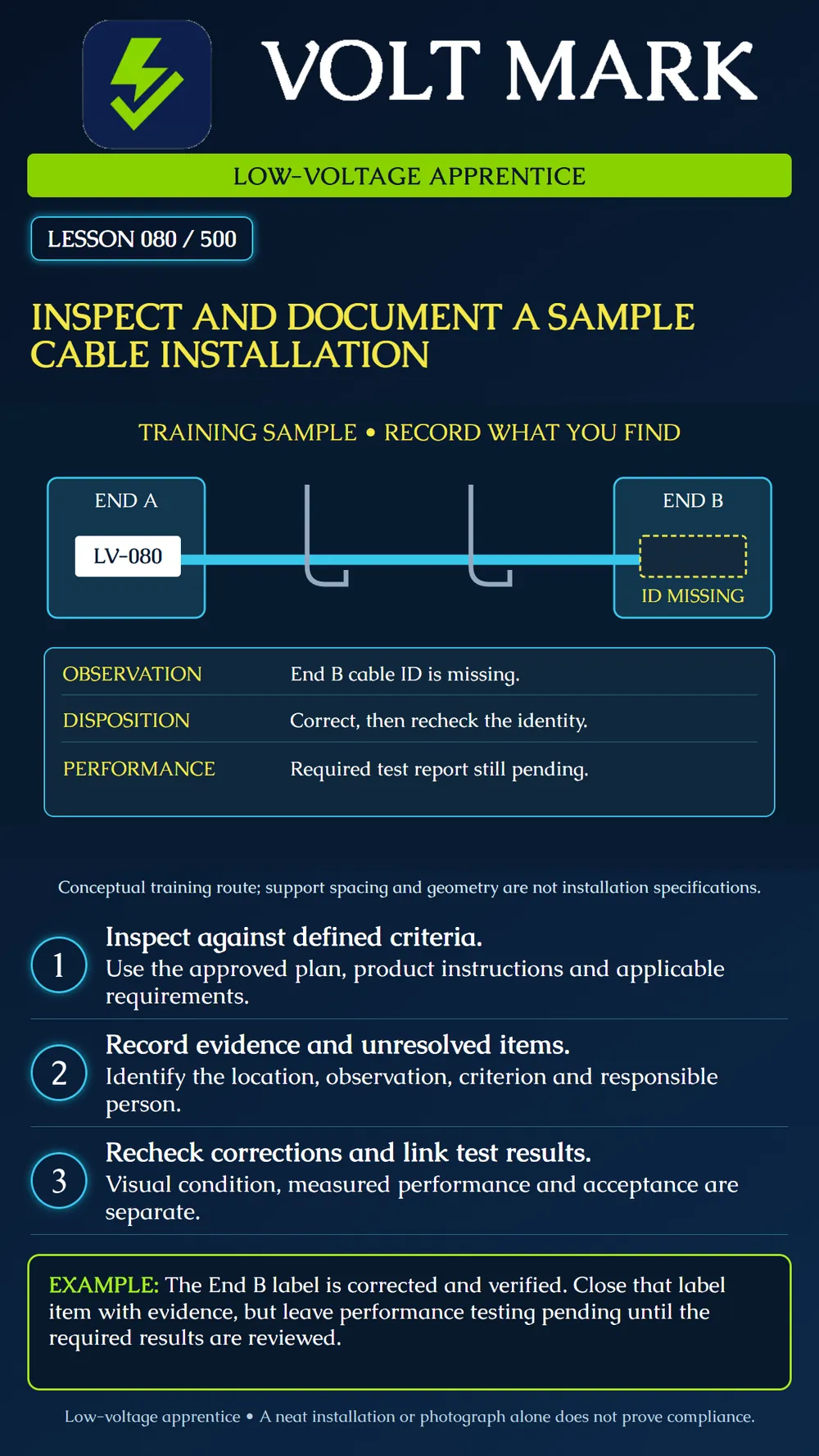
Write what was actually observed, where it was observed and what criterion was used. "Bad cable work" is not actionable. "End B cable identifier missing; training schedule R2 requires a matching identifier at both ends" identifies a location, a condition and a reference.
Separate an observed discrepancy from a question needing clarification. If the required criterion or evidence is unavailable, record that limitation and ask the designated reviewer to resolve it. Do not silently mark it acceptable.
FOA treats workmanship inspection, test-data review and completed documentation as distinct installation activities. Link the required results to the actual cable or fiber identifiers. For copper communications cabling, Fluke distinguishes basic verification, application qualification and standards-based certification. A continuity result is not automatically a certification result. Use the test method, limit and configuration required for the actual job.
This lesson does not prescribe one test instrument for all low-voltage systems. A fiber loss report, copper certification report and a fire-alarm functional test address different requirements. Review the appropriate evidence through the assigned process.
Training cable LV-080 has a readable End A label and no End B label. The drawing shows one continuous cable. Its required performance-test report is not yet available.
Create two separate entries:
Project/sample and cable ID: Drawing and revision: Location and accessible inspection scope: Criterion reference: Observed condition: Photo or measurement reference: Status and unresolved limitation: Assigned correction and responsible person: Correction evidence: Recheck date and verifier: Required test-report reference and review status: Acceptance authority and disposition, if applicable:
FOA - Outside Plant Fiber Optic Cable Plant Installation; Installation Checklist, During the Installation, Testing and Documentation sections. https://www.thefoa.org/tech/ref/OSP/install.html Fluke Networks - Verification Qualification and Certification; distinctions between test purposes. https://www.flukenetworks.com/knowledge-base/cableiq/verification-qualification-and-certification
LV-080, schedule R2 and the inspection entries are fictional teaching examples, not records of an inspected real installation.
Free study material for low-voltage apprentices. This is a national foundation course: requirements differ by state and by local jurisdiction, and a practice that is common in one place is not a rule everywhere. Nothing here is a licence, a certification, or authority to work unsupervised, and completing it does not count as apprenticeship hours or continuing-education credit. Check the codes adopted where you are working, the licensing authority for that work, and your employer's safety programme. VoltMark is not affiliated with, endorsed by, or sponsored by NFPA, OSHA, NICET, BICSI, FOA, or any state or local licensing authority.
Electrician licensing exam prep: practice questions, timed exam simulations, and step-by-step help finding every answer in the NEC.