Apply a consistent cable identity to both ends and designated intermediate access locations, then reconcile that identity with project records.
Get the project's labeling schedule before printing. Confirm the required identifiers, label locations and record format. Telecommunications, fire alarm, security and controls projects may use different conventions. Do not invent a nationwide naming rule or treat the sample below as a prescribed TIA format. If an administration standard is specified, use its specified edition and project requirements.
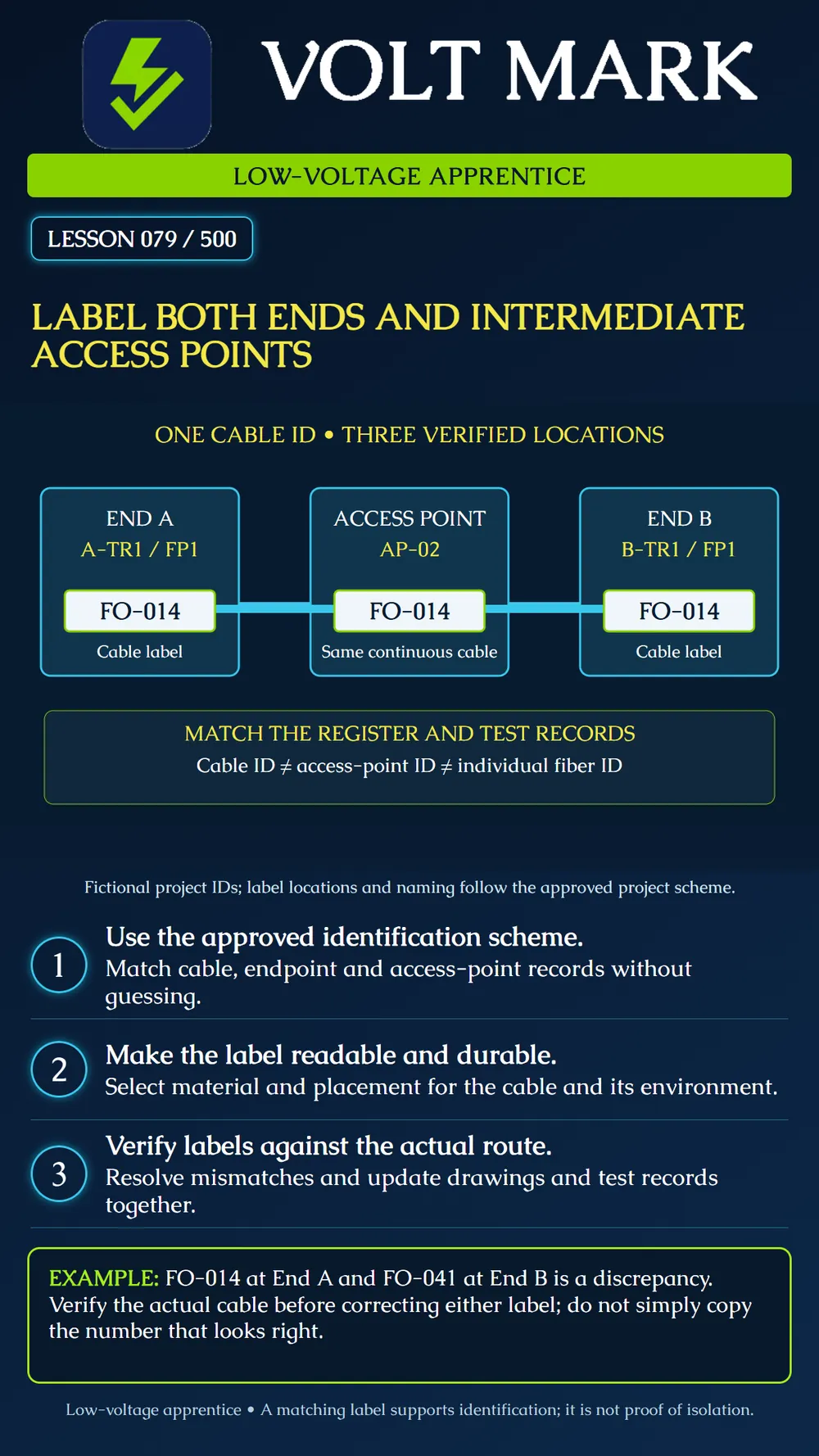
The illustration shows one continuous fictional fiber cable, FO-014, between A-TR1/FP1 and B-TR1/FP1. It passes through access point AP-02 without a splice. The cable ID remains FO-014 at all three locations. AP-02 identifies the access location, not the cable.
A multi-fiber cable also needs records for its individual fibers and their terminations. A cable label alone cannot identify every optical path. If the route contains splices or multiple cable segments, record those relationships using the approved scheme; do not assume a logical link and a physical cable are the same object.
Brady distinguishes marker types and environmental suitability. Select material, adhesive, print system and size for the actual cable and exposure. Self-laminating labels protect printed legends with a clear overwrap; they are not automatically suitable for every wet, outdoor, hot or chemical environment. Some sleeve types must be fitted before termination. Consult the actual product instructions.
Place labels where they can be read during authorized access. Avoid a placement that requires pulling on a connector or sharply bending the cable to read it. Do not cover information that must remain visible. A tag attachment must not crush the cable or obstruct required enclosure closure.
FOA links termination identification with test results and future changes, and calls for records that follow the fiber path through intermediate connections. Compare the physical labels with the cable register, termination schedule and test record IDs. Correct confirmed errors through the project process and preserve the change history. Reprinting a label without updating the records leaves a second version of the truth.
A label is useful evidence, not independent proof that a cable is safe to disconnect. Follow the system's authorization and verification process before disturbing it.
Use a disconnected training cable and three tabletop location cards. Assign the fictional ID FO-014 to the cable and AP-02 to the intermediate location. Print and place the sample labels. Have a second learner match them to a register without relying on memory. This exercise does not require entering a real vault or opening an operating system enclosure.
End A reads FO-014; End B reads FO-041. Record the mismatch. Verify the actual route and cable identity using the approved process before deciding which record or label is incorrect. Do not alter both to match merely for appearance.
Cable ID: End A location and termination: End B location and termination: Intermediate locations: Individual conductor/fiber mapping reference: Label material and placement: Discrepancies and disposition: Drawing and test-record references: Verifier and date:
FOA - Outside Plant Fiber Optic Cable Plant Installation; Labeling and Documentation and Administration sections. https://www.thefoa.org/tech/ref/OSP/install.html Brady - Selecting Wire Markers: material, environment, application timing and marker construction. https://www.bradyid.com/resources/guides/how-to-select-a-wire-marker Brady - Wire and Cable Self-laminating Labels: material/environment options. https://www.bradyid.com/labels/self-laminating
Educational draft.All illustrated identifiers and training scenarios are fictional.
Free study material for low-voltage apprentices. This is a national foundation course: requirements differ by state and by local jurisdiction, and a practice that is common in one place is not a rule everywhere. Nothing here is a licence, a certification, or authority to work unsupervised, and completing it does not count as apprenticeship hours or continuing-education credit. Check the codes adopted where you are working, the licensing authority for that work, and your employer's safety programme. VoltMark is not affiliated with, endorsed by, or sponsored by NFPA, OSHA, NICET, BICSI, FOA, or any state or local licensing authority.

Electrician licensing exam prep: practice questions, timed exam simulations, and step-by-step help finding every answer in the NEC.