Identify which loads share protection and distinguish branch ratings from total available supply capacity.
An output terminal is a connection point. Its label alone does not establish whether it has an individual fuse, shares protection with another terminal or uses electronic protection. Use the exact equipment diagram and instructions.
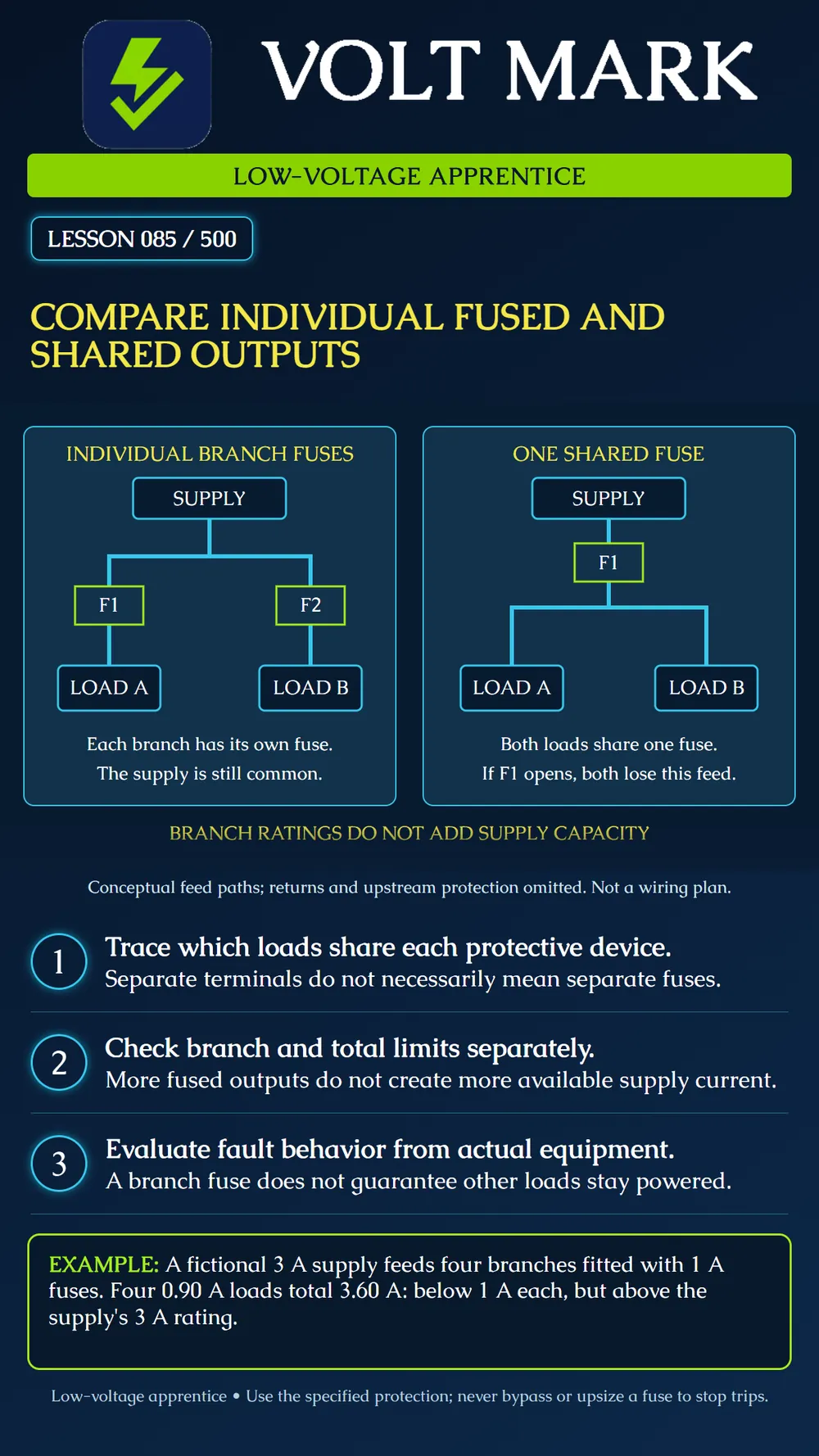
The left teaching diagram shows two feed branches with separate fuses F1 and F2. Both originate at one common source. The right diagram places one fuse F1 ahead of the split to both loads. Return conductors, upstream protection and switching details are omitted so the protection relationship is visible. Neither diagram specifies an installable assembly.
A separate branch fuse provides protection in that branch's feed path. If that fuse opens, the affected branch loses that feed. Other branches are not disconnected by that fuse itself, but they can still be affected by the fault or source response. The shared source may current-limit or shut down; upstream protection may operate.
Do not promise that a short on one individually fused branch can never interrupt the others. Selective operation depends on the actual source, available fault current, protective-device characteristics and circuit arrangement. Separate fuses also do not establish galvanic isolation or independent standby power.
When both loads are downstream of the same fuse, opening that fuse removes this feed from both. A fault or excessive combined demand on the shared circuit may affect the whole group. Identify that group in the documentation so a technician understands the possible service impact before authorized work.
This describes the shown single-source paths. Additional sources or backfeeds must be evaluated separately; a fuse opening is not proof that every part of a real system is de-energized.
Altronix's PD4 is a real example of one input distributed to individually fused outputs. Its documentation gives an input limit and fuse ratings. Those are different limits, not numbers that can be added together to manufacture additional capacity.
Altronix's AL600ULACM likewise publishes a total supply rating along with output and fuse information. This lesson does not apply either product's ratings to the fictional diagrams. Use the exact configuration's specifications, including any shared terminal groups.
Supply continuous rating: 3.00 A. Four branches, each fitted with a specified 1 A fuse. Evaluated demand per branch: 0.90 A. Total demand: 4 x 0.90 = 3.60 A.
The total exceeds the supply rating by 0.60 A. Being below each fuse's marked current does not resolve the source overload. This arithmetic does not predict exactly when a fuse operates; a fuse's rating is not an instantaneous current clamp. Startup, temperature, time-current characteristics and equipment limits still require evaluation.
Never bypass a fuse or substitute a larger rating to prevent repeated operation. Identify the cause and follow the manufacturer's specified replacement and service process. Matching current alone may be insufficient; voltage rating, interrupting capacity, speed/type and approved construction can matter.
A resettable PTC or an electronically protected channel is not automatically equivalent to a replaceable fuse. Its behavior and recovery process come from the actual documentation. Do not infer Class 2 status or power limitation merely from the presence of a fuse.
Use a supplied equipment schematic, without opening an operating enclosure. Highlight each protective device and list the downstream loads. Mark shared source dependencies. Compare the total evaluated demand with source and distribution limits, and record unanswered questions for the designated reviewer.
Supply and distribution model/configuration: Protective device ID/type/rating: Loads downstream of each device: Shared input or output groups: Normal/peak branch demands: Total demand and applicable limits: Expected fault behavior evidence: Unresolved questions and review disposition:
Altronix - PD4: individual fused outputs, input limit and fuse ratings. https://www.altronix.com/products/PD4 Altronix - AL600ULACM: total supply current, output arrangements, fuse ratings and source protection. https://www.altronix.com/products/AL600ULACM
The diagrams and arithmetic example are fictional and do not approve an installation or protective-device selection.
Free study material for low-voltage apprentices. This is a national foundation course: requirements differ by state and by local jurisdiction, and a practice that is common in one place is not a rule everywhere. Nothing here is a licence, a certification, or authority to work unsupervised, and completing it does not count as apprenticeship hours or continuing-education credit. Check the codes adopted where you are working, the licensing authority for that work, and your employer's safety programme. VoltMark is not affiliated with, endorsed by, or sponsored by NFPA, OSHA, NICET, BICSI, FOA, or any state or local licensing authority.

Electrician licensing exam prep: practice questions, timed exam simulations, and step-by-step help finding every answer in the NEC.