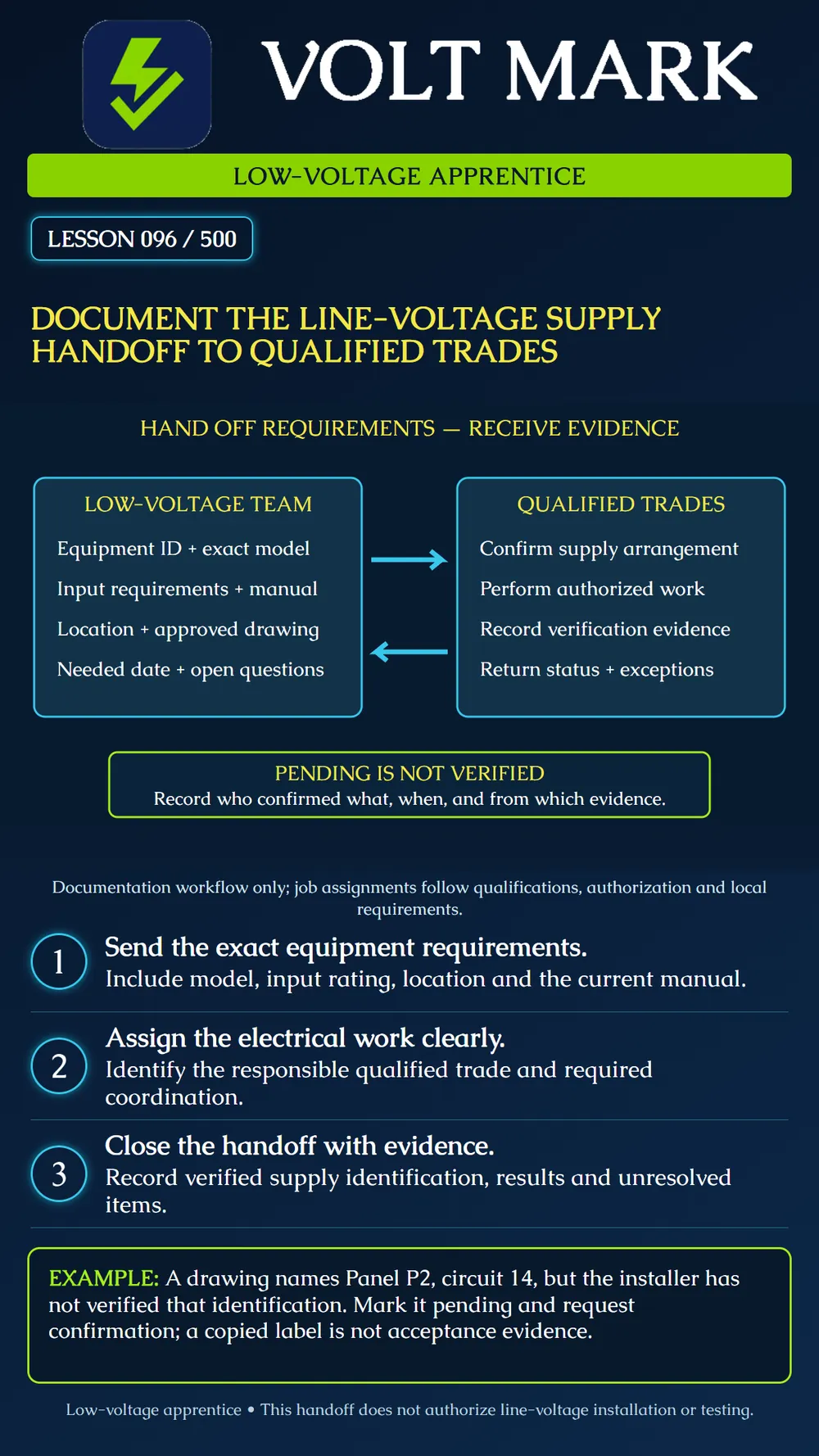
Prepare and track a supply handoff so the responsible electrical trade receives the right equipment information and the low-voltage team receives a clear, evidence-based completion status.
Low-voltage equipment may depend on a line-voltage input. The output voltage does not describe every hazard inside the enclosure. Treat supply coordination as a defined task with an owner. An apprentice can help assemble documentation within assigned duties; this lesson does not teach line-voltage connections, testing or energized work.
Start with identification. Record the equipment asset, exact manufacturer/model, drawing reference and installation location. Attach the relevant current manual and identify its revision. Copy input requirements from that equipment documentation, not from a similar-looking unit. Separate input specifications from low-voltage output ratings.
Altronix identifies the AL600ULX input as 115VAC, 60Hz, 3.5A, while its selectable output is 12VDC or 24VDC. The installation guide specifies an unswitched AC supply and refers installation and servicing to qualified service personnel. These are model-specific facts for a documentation exercise. The 3.5A input specification is not an instruction to select a 3.5A breaker, and the DC output rating is not the branch-circuit rating. The responsible designer and electrical trade determine the actual supply installation under applicable requirements.
State the requested location, equipment requirement, drawing reference and date needed. Identify missing information explicitly. Where the design calls for a dedicated supply or particular supervision, quote the applicable project requirement and its source; do not invent a universal dedicated-circuit rule for all low-voltage equipment. Identify who will resolve discrepancies and who can authorize energization and commissioning.
OSHA's general-industry electrical work-practice standard addresses de-energization and qualified-person verification; its energized-work provisions restrict such work to qualified persons. Construction work has its own applicable electrical requirements, including protection against contact with energized circuits under 1926.416. The employer must apply the rules for the actual task and workplace. A course completion record, tool ownership or a handoff form does not establish electrical qualification, licensing or authorization. Do not remove covers or take measurements to fill in this form unless that task is separately assigned and safely within your qualifications.
Request the installed supply identification and the responsible person's verification record. Distinguish planned identifiers from verified identifiers. Record outstanding items and whether the supply is ready for the next authorized activity. A historical acceptance record is not proof that equipment is safe to touch now; isolation and verification belong to the actual work procedure.
The design drawing lists Panel P2, circuit 14 for supply PS-096. The label has been copied into the handoff but no verification record is available. Write “planned identification; verification pending.” Ask the responsible electrical trade to confirm and return its record. Do not mark the circuit accepted or probe it yourself to complete the paperwork.
Equipment asset / exact model: Location / approved drawing revision: Manual revision / input requirement: Project-specific supply requirement and source: Requested completion date: Responsible trade and contact: Planned circuit identification: Verified circuit identification and evidence: Verification performed by / date: Outstanding discrepancy / owner: Status and authorized next activity:
Fill the form from a supplied manual and fictional drawing. Use pending for unknowns. Have your supervisor review the handoff before it is issued.
Altronix AL600ULX product specifications: https://altronix.com/products/AL600ULX Altronix AL600ULX Series Installation Guide, DIP version: https://altronix.com/library/pdf/installation_instructions/AL600ULXseries_DIP.pdf OSHA 29 CFR 1910.333, general-industry electrical work practices: https://www.osha.gov/laws-regs/regulations/standardnumber/1910/1910.333 OSHA 29 CFR 1926.416, construction electrical general requirements: https://www.osha.gov/laws-regs/regulations/standardnumber/1926/1926.416
Scope: National coordination fundamentals. State-plan requirements, local licensing, adopted codes, approved design and employer procedures must be checked for the actual project. No actual installation has been accepted.
Free study material for low-voltage apprentices. This is a national foundation course: requirements differ by state and by local jurisdiction, and a practice that is common in one place is not a rule everywhere. Nothing here is a licence, a certification, or authority to work unsupervised, and completing it does not count as apprenticeship hours or continuing-education credit. Check the codes adopted where you are working, the licensing authority for that work, and your employer's safety programme. VoltMark is not affiliated with, endorsed by, or sponsored by NFPA, OSHA, NICET, BICSI, FOA, or any state or local licensing authority.

Electrician licensing exam prep: practice questions, timed exam simulations, and step-by-step help finding every answer in the NEC.