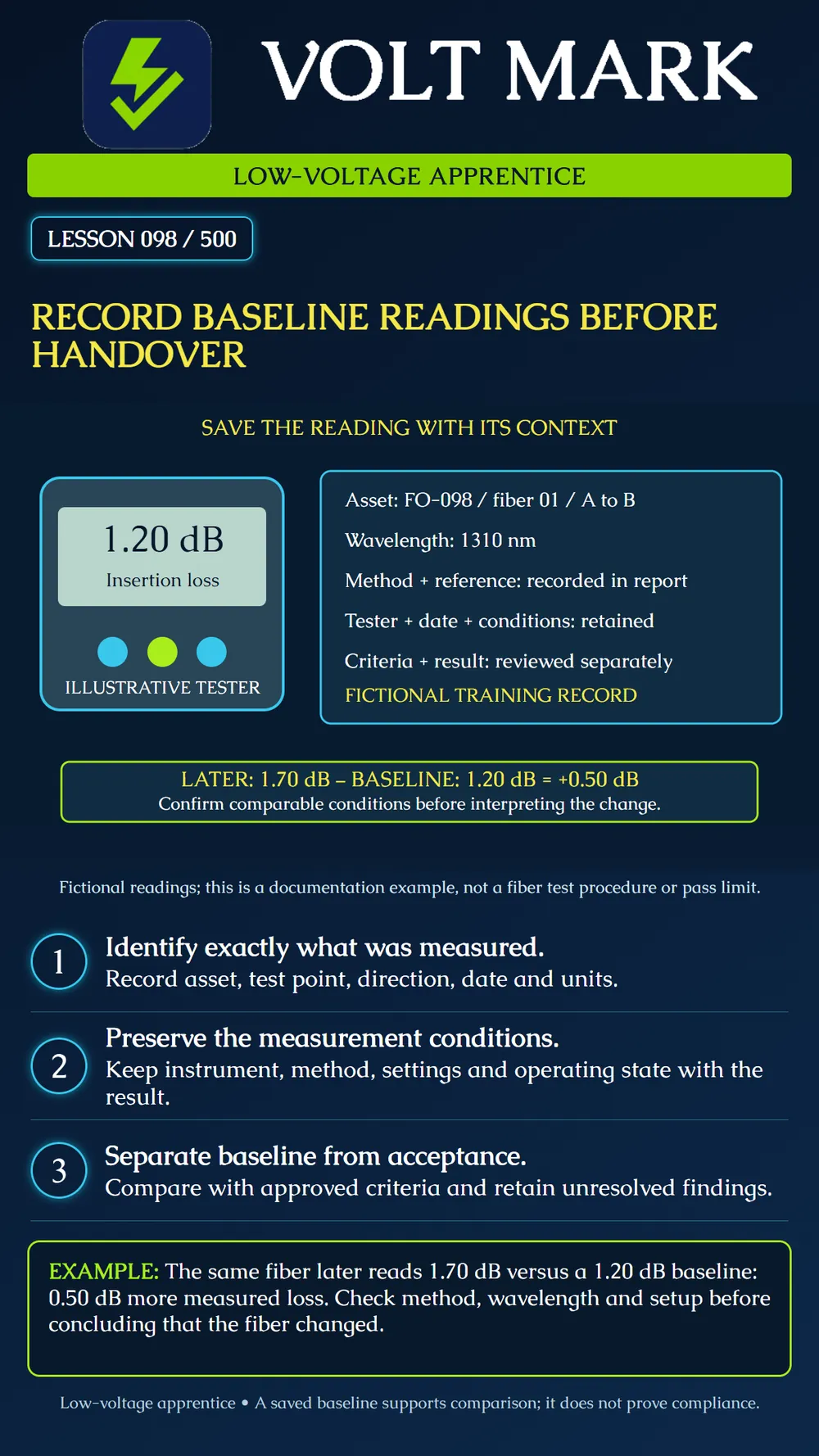
Save measurements with enough context for another technician to understand and compare them, while keeping baseline documentation separate from acceptance.
A baseline is a retained reference condition. A number without its asset, units and circumstances is difficult to use. Establish the baseline at the documented stage of commissioning, preserve the source record and identify unresolved work. Do not label a defective installation “normal” just because its first reading was saved.
Choose the record fields to match the system. For a low-voltage supply, the relevant context may include the measurement point and operating load. For a fiber result, it includes the fiber identity, wavelength, direction and test configuration. FOA's documentation guidance calls for the test date, cable/fiber identification, operator, equipment, reference method, wavelength and measured loss. These fields explain what the result represents. Follow the project's actual test plan for additional information and required tests.
Keep the original report or instrument export when available, with a readable summary. Use stable asset IDs that match labels and drawings. Record the instrument identification and calibration information required by the procedure. Retain method and reference details rather than relying only on a photograph of a display. Mark the report revision, and preserve earlier records when a correction is made.
Asset: FO-098, fiber 01, measured A to B. Test wavelength: 1310 nm. Baseline insertion loss: 1.20 dB. Later insertion loss: 1.70 dB. Arithmetic difference: 1.70 - 1.20 = +0.50 dB.
This means the later reported loss is 0.50 dB greater. It does not, by itself, prove a cable fault or determine pass/fail. Confirm that the two results use comparable methods, reference arrangements and test boundaries, and evaluate measurement uncertainty under the procedure. Fluke Networks discusses how setup, connector condition and measurement technique affect fiber troubleshooting. Investigate those factors before assigning a cause.
The poster is a summary, not a complete test record. Its references to the method and conditions mean that the real values must be retained in the linked report. Do not literally write “recorded” without an accessible record. The drawing is not a connection diagram, does not specify a reference method and does not authorize testing a live fiber.
The approved limits and required test scope determine acceptance. A baseline may be within a limit, outside it or not yet evaluated. Keep that status explicit. If a baseline is replaced after corrective work, record why and link the new results to the correction; do not silently overwrite the history.
Asset / location / drawing reference: Measurement point or fiber / direction: Date / time / operator: System operating state and relevant environment: Instrument / configuration / calibration information: Method / reference details / wavelength where relevant: Reading and units: Approved criterion and source: Result / exception / responsible reviewer: Native report or evidence file: Revision / correction / later comparison:
Given two fictional reports, first confirm their identity and test configuration. Calculate a numerical difference only after confirming that the quantities and units match. Explain why that difference alone cannot identify the fault or certify acceptance.
FOA Quickstart Guide: Fiber Optic Testing, documentation fields: https://thefoa.org/tech/ref/quickstart/test.html Fluke Networks, White Paper: Troubleshooting Fiber, measurement and troubleshooting context: https://www.flukenetworks.com/edocs/white-paper-troubleshooting-fiber
Scope: National apprentice documentation fundamentals. Fictional data, no universal loss limit and no actual acceptance decision.
Free study material for low-voltage apprentices. This is a national foundation course: requirements differ by state and by local jurisdiction, and a practice that is common in one place is not a rule everywhere. Nothing here is a licence, a certification, or authority to work unsupervised, and completing it does not count as apprenticeship hours or continuing-education credit. Check the codes adopted where you are working, the licensing authority for that work, and your employer's safety programme. VoltMark is not affiliated with, endorsed by, or sponsored by NFPA, OSHA, NICET, BICSI, FOA, or any state or local licensing authority.
Electrician licensing exam prep: practice questions, timed exam simulations, and step-by-step help finding every answer in the NEC.