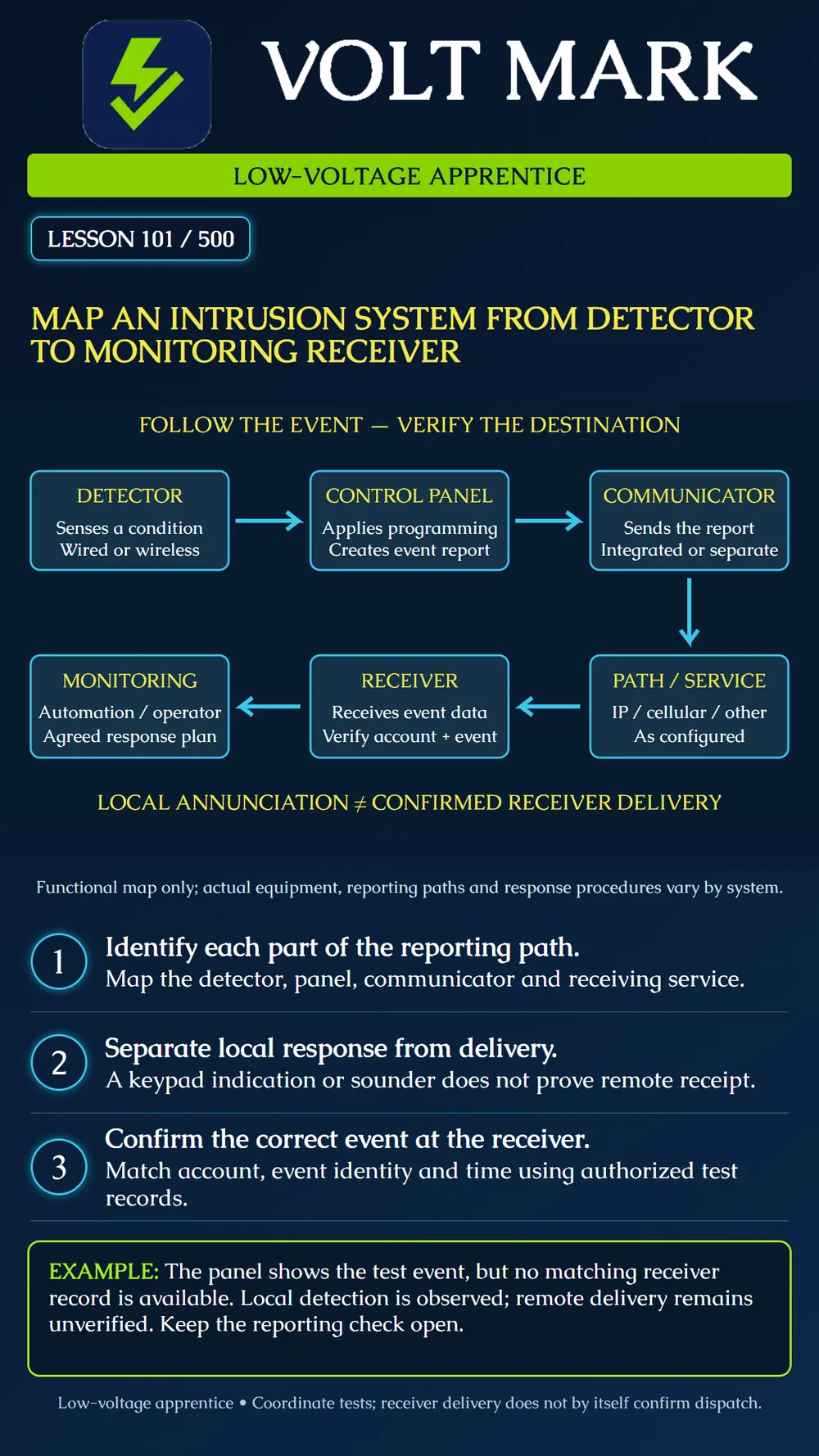
Draw the functional path of an intrusion event and distinguish detection, local indication, remote receipt and the monitoring response.
Start with a detector, such as a door contact or motion detector. Its information reaches the control panel through the installed wired or wireless interface. The panel evaluates that information according to its configuration and operating state. A sensor change does not automatically mean an alarm report: the programmed point function, arming state and other system rules matter.
The panel may produce a local indication, operate a sounder or create a report. These are distinct outcomes. Local annunciation can be silent or audible as configured. A local display by itself cannot establish that a report reached a remote receiver.
Next identify the communicator. It may be integrated with the panel or installed as a separate compatible component. Document the actual path or paths and the associated service. IP, cellular and other technologies depend on the installed equipment and configuration. The poster groups transport and any service intermediary into one block; it does not imply every system uses the same route.
Resideo describes AlarmNet communicators sending signals through its Network Control Center for routing to the appropriate central station. DMP describes its SCS-1R receiver accepting alarm, trouble, user and system reports, with output to host automation. These are examples of different architectural details, not a claim that the two product families interoperate.
At the receiving end, event data is interpreted by the receiving system and monitoring process. Receiver delivery is distinct from operator review, verification calls, dispatch requests and actual responder arrival. Obtain the service's response procedure and applicable local requirements rather than promising a universal dispatch sequence.
Use approved drawings and product documentation. Identify the detector or point, control panel, communicator, transport/service and monitoring destination. Show local annunciation as a separate branch if it is part of the installed design. Include primary and alternate reporting paths only when they actually exist, and label unknown information for resolution.
The poster arrows show the forward event-report path for learning. They omit acknowledgments, supervision exchanges, power and detailed wiring. They are not installation or programming instructions.
The approved test calls for an intrusion event from training point Z-101 on a designated test account. The panel history contains the event, but no matching receiving record has been returned. Record local detection as observed and remote delivery as unverified. Do not infer delivery from a sounder or an unrelated app notification. During an authorized coordinated test, compare the account, event/point identity where reported, time and available receiving evidence with the test plan. Resolve any mismatch before closing the item.
Draw the six functional blocks shown on the poster. Add a local annunciation branch from the panel and label it separately from reporting. Use supplied fictional documents to identify the components. Do not trigger a live alarm, alter routing or contact a monitoring station as part of this paper exercise.
Site and system: Detector / point identity: Control panel / relevant configuration: Communicator model and service: Actual reporting path or paths: Receiver / account reference: Local annunciation: Test authorization and coordination: Panel observation: Matching receiving evidence: Response procedure reference: Unresolved item / owner:
Resideo Security Alarm Communicators, AlarmNet routing overview: https://www.resideo.com/us/en/pro/products/security/communicators/ DMP SCS-1R Network Enabled Receiver specification, LT-0012/25: https://assets.dmp.com/assets/LT-0012.pdf DMP SCS-1R product description: https://buy.dmp.com/dmp/Shop?DSP=30100&IID=SCS-1R&PCR=1:100:10002:10017 Research limitation: DMP LT-1037 installation guide returned 403; no unverified detailed programming procedure is used.
Scope: National intrusion fundamentals. Reporting, supervision, verification and response requirements depend on the actual system, service and jurisdiction.
Free study material for low-voltage apprentices. This is a national foundation course: requirements differ by state and by local jurisdiction, and a practice that is common in one place is not a rule everywhere. Nothing here is a licence, a certification, or authority to work unsupervised, and completing it does not count as apprenticeship hours or continuing-education credit. Check the codes adopted where you are working, the licensing authority for that work, and your employer's safety programme. VoltMark is not affiliated with, endorsed by, or sponsored by NFPA, OSHA, NICET, BICSI, FOA, or any state or local licensing authority.

Electrician licensing exam prep: practice questions, timed exam simulations, and step-by-step help finding every answer in the NEC.