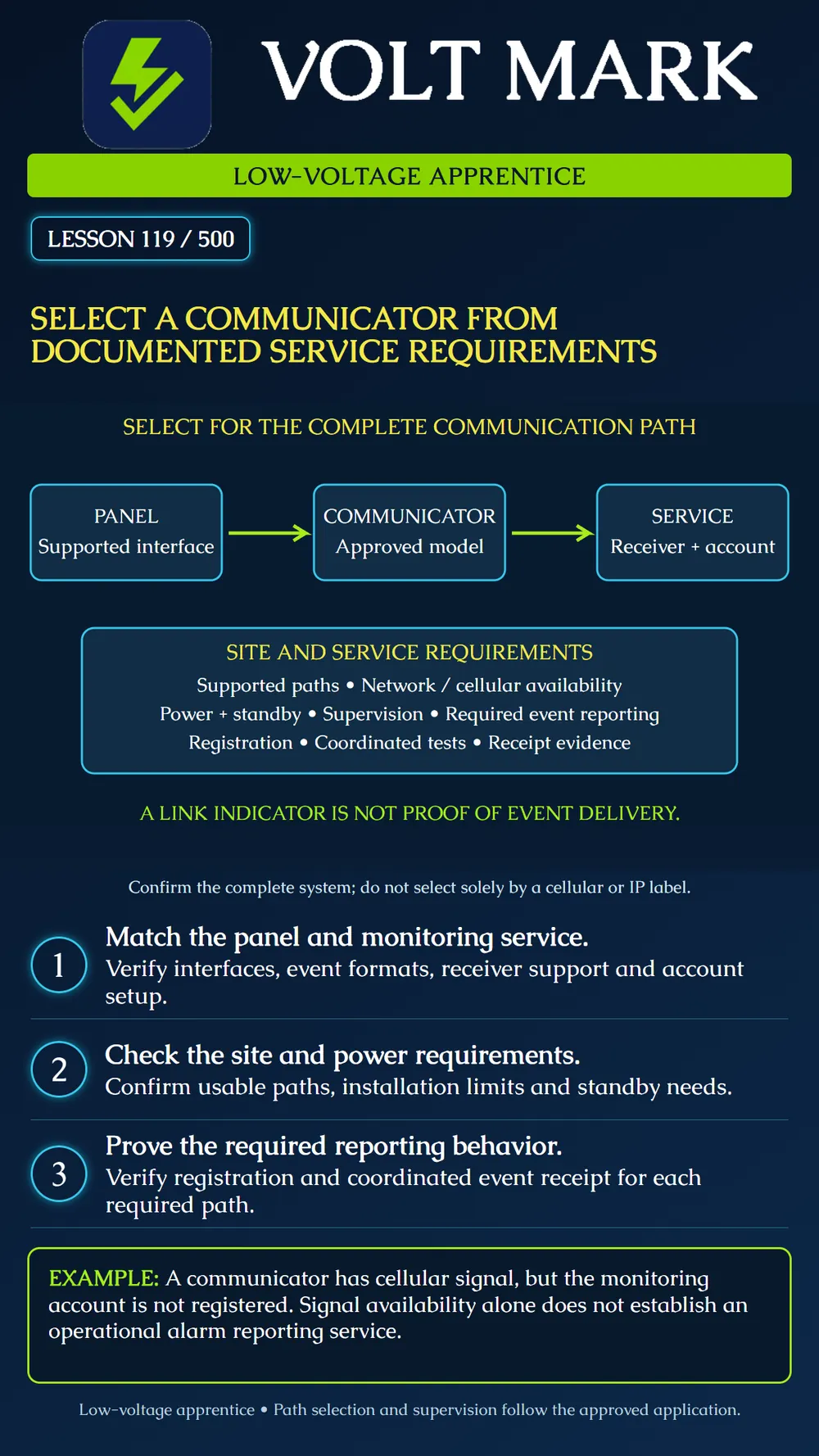
Compare a proposed alarm communicator with the documented panel, monitoring service, site and power requirements before selecting it.
A communicator is part of a complete reporting path. Its radio or network label does not establish compatibility with a panel, supported event information or acceptance by a monitoring service. Begin with the required service and approved system design, then identify equipment that satisfies them.
Resideo's LTEM-P product information describes panel compatibility and optional connection modules. Its LTEM-PA page specifies that Ethernet and optional Wi-Fi are alternative Internet connections, not simultaneous Internet methods on that product. This illustrates why feature names must be read carefully. Do not count two connectors or two advertised options as two independent reporting paths without documentation.
DMP's Com Series specification distinguishes network, Wi-Fi and cellular variants, supported receiver arrangements and different power demands. Those distinctions belong to the exact model. The lesson does not recommend a carrier, claim coverage at a site or establish current availability for every variant.
Write down the required panel interface, event reporting and destination service. Determine whether the proposed arrangement conveys the needed event type, point or zone identity and restoration information. A generic alarm output may not carry the same detail as a supported panel interface. Have the responsible designer and monitoring provider confirm the intended information.
Site constraints include approved mounting, environmental limits, available network services and usable cellular signal at the intended location. Power and standby calculations must include the communicator's documented operating demands and other shared loads. Remote network equipment may have its own power dependencies. Do not treat the communicator's backup battery as proof that every part of an IP path remains operational.
Compare two hypothetical candidates using a requirements sheet. Candidate A has a suitable connection interface but lacks documented service compatibility. Candidate B supports the service but still needs a site signal assessment. Neither is ready to be called approved from the information available. Mark the missing evidence and assign it for resolution rather than guessing a preferred technology.
Obtain the panel model, firmware where relevant, current communicator instructions and the monitoring provider's documented requirements. Record the intended application and who approves the selection. Do not apply intrusion assumptions to fire signaling or another regulated service without its separate requirements.
Create one row for each selection criterion. Include interface compatibility, supported messages, receiver or service support, registration, required communication paths, supervision, power, standby and environmental conditions. Use PASS, DOES NOT MEET or UNRESOLVED with supporting evidence. A marketing feature list is not evidence for a missing site measurement or service approval.
Have the responsible person arrange any required network and cellular checks. Record how the site evidence was obtained and the specific proposed mounting location. Do not infer indoor reception from a coverage map or assume a phone's signal proves that the chosen communicator will meet its requirements.
After approved installation and enrollment, follow the coordinated test plan. Confirm registration and account identity. Compare generated test events with receiver records, including the required location and event details. Where multiple paths or failover behavior are required, verify them through the authorized procedure. Do not disconnect production services as an improvised demonstration.
Retain discrepancies and retest after approved corrections. Record the final normal-service state and responsible person's closeout. A link LED, successful registration or one received event is useful evidence, but each proves only its own part of the required verification.
The communicator indicates cellular signal, yet the account has not been registered. The trainee marks signal availability observed and service activation unresolved. The reporting service is not called operational until the required configuration and receipt checks succeed. No real account was created or signal transmitted for this lesson.
Panel / firmware / interface: Communicator exact model / manual revision: Application and approving parties: Monitoring service / receiver / supported event detail: Required paths and supervision: Site network and cellular evidence: Power / standby / environmental check: Registration and identity confirmation: Required event and path test evidence: Open items / owner / retest / restoration:
Answer: No.
Answer: No. Read the model's supported operation.
Answer: No. Test the approved requirements individually.
Researched 2026-09-30, primary manufacturer material: Resideo LTEM-PA: https://www.resideo.com/us/en/pro/products/security/communicators/ltem-pa-advanced-modular-communicator-att-ltem-pa/ Resideo LTEM-P product family and compatibility resources: https://www.resideo.com/us/en/pro/solutions/security/ltem-p-communicator/ DMP Com Series specification LT-2428: https://production-dmp.sfo3.cdn.digitaloceanspaces.com/assets/LT-2428.pdf Original conceptual diagram, exercise, scenario and record. No universal path mandate, supervision interval, carrier coverage or approval claim.
Free study material for low-voltage apprentices. This is a national foundation course: requirements differ by state and by local jurisdiction, and a practice that is common in one place is not a rule everywhere. Nothing here is a licence, a certification, or authority to work unsupervised, and completing it does not count as apprenticeship hours or continuing-education credit. Check the codes adopted where you are working, the licensing authority for that work, and your employer's safety programme. VoltMark is not affiliated with, endorsed by, or sponsored by NFPA, OSHA, NICET, BICSI, FOA, or any state or local licensing authority.
Electrician licensing exam prep: practice questions, timed exam simulations, and step-by-step help finding every answer in the NEC.