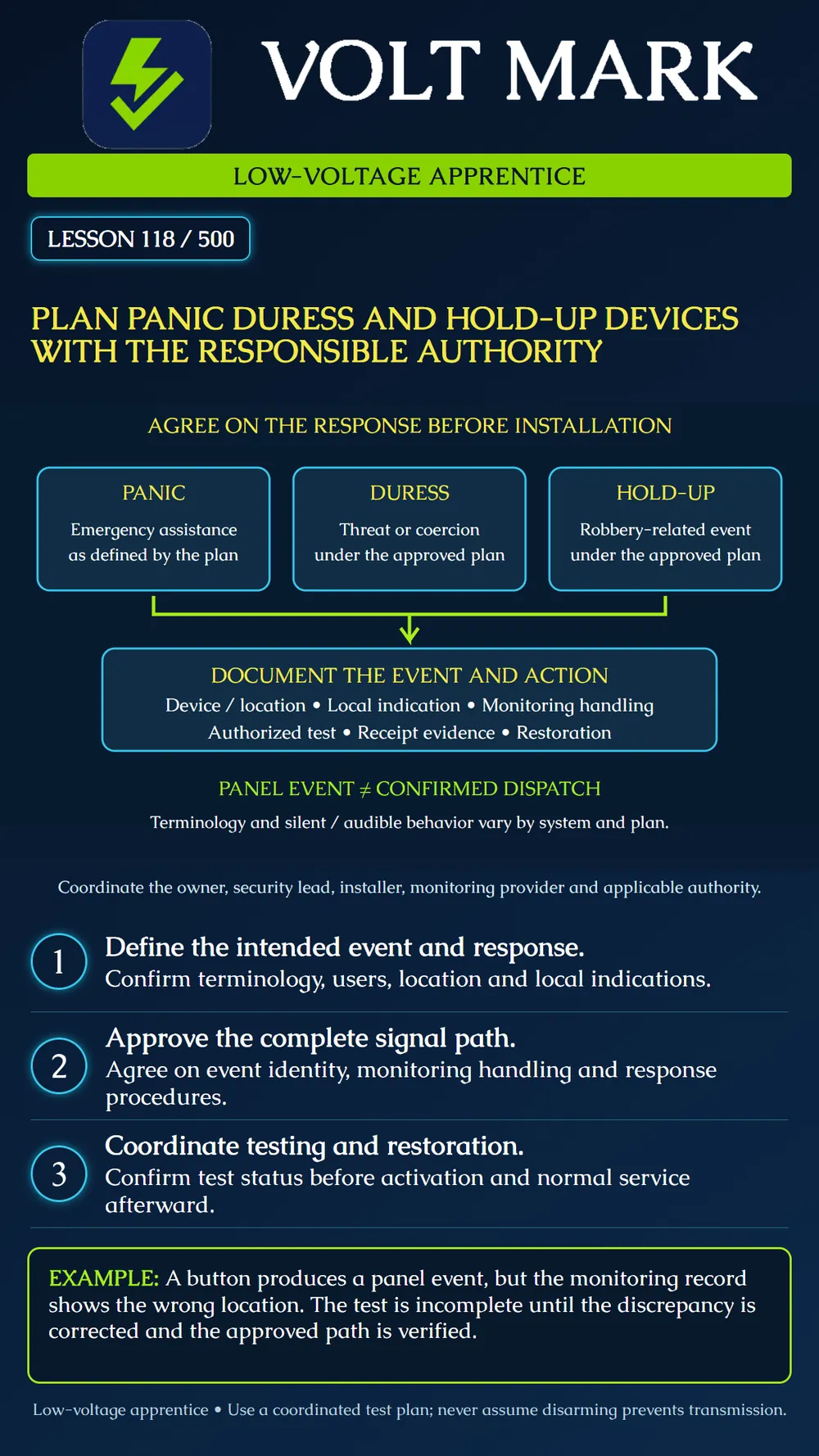
Prepare a reviewable plan for emergency signaling devices and their intended response without assuming the device label defines the entire system behavior.
Panic commonly describes a request for emergency assistance. Duress involves threat or coercion, and hold-up commonly identifies a robbery-related event. Terminology can overlap across products and organizations. The approved site plan must define the event classification, user action and intended response for the actual system.
A duress function may be associated with a credential or code rather than a separate button. DSC user documentation describes a duress code that performs permitted user functions while transmitting a duress report. This is a bounded example; never infer a code from another code, create a universal activation rule or assume the same function exists on every panel.
Manufacturer documentation also distinguishes panic, duress and hold-up event categories. Silent and audible behavior must be verified from the actual configuration and approved response plan. A generic button shape, zone name or illuminated indicator does not establish whether sound occurs locally, which message is transmitted or what response follows.
The responsible authority in this lesson means the people empowered to approve the installation and its response arrangements. Identify the owner or designated security lead, qualified installer or designer, monitoring provider and any applicable local authority or responder coordination. Their roles vary by location and application. This course does not assign one nationwide approval process.
Start with the intended use. Record who is expected to operate the device, in what context, and how its location supports authorized use. Review accessibility, accidental-operation risks and any environmental or mounting requirements with the responsible people. Do not choose a concealment, audible response or activation method independently.
Create an event-to-action record. Include the device identifier, approved location description, panel event classification, local indications and intended monitoring handling. Keep sensitive credentials out of the public lesson and general installation record. Reference the controlled procedure instead.
Agree on what constitutes successful verification. A local panel event, successful transmission, receiver receipt and responder dispatch are separate stages. This lesson does not promise that pressing a device causes immediate dispatch, or that a receiver event proves anyone was dispatched.
Plan maintenance, authorized training and restoration as part of the installation. The users need the approved operating instructions, while technicians need the product-specific test and service procedures. Record who owns changes to event descriptions, contacts and response arrangements.
Use an isolated demonstration system or a specifically coordinated test. Before activation, the responsible person must confirm the exact account, devices, event types, test window and agreed handling with the monitoring provider where applicable. Do not assume a general burglary test state covers every emergency event. Disarming alone is not evidence that reporting is disabled.
Follow the approved test method under supervision. Record the initiated event and observed local response. Obtain the required receipt evidence through the authorized process and compare account, device, event type and location. Do not ask a trainee to experiment with live panic or duress functions.
Afterward, restore the equipment and normal service through the agreed process. Confirm the final status with the responsible person. Preserve unresolved items and retest after approved corrections. Do not mark the system complete because only one part of the signal path worked.
A training button produces the expected panel event, but the received location description is incorrect. The physical input test succeeded; the complete verification did not. The record stays open until the authorized correction and retest establish the intended identity and handling. No actual signal was sent in this lesson.
Approving people and responsibilities: Intended event and authorized users: Device/model/location/environment: Panel classification and local indications: Monitoring event identity and agreed handling: Controlled operating procedure reference: Test authorization/window/handling confirmation: Local result and receiver evidence: Discrepancies/correction/retest: Restoration and normal-service confirmation:
Answer: No. These are separate stages.
Answer: No. Verify the actual configuration and plan.
Answer: No. Use the coordinated authorized test procedure.
Researched 2026-09-30: DSC user access-code documentation, bounded duress example: https://docs.johnsoncontrols.com/dsc/api/khub/documents/IULpWl8GFJMuLZe3fv0lrA/content DSC PowerSeries Pro alternate communicator event categories: https://docs.johnsoncontrols.com/dsc/r/DSC/en-US/PowerSeries-Pro-Reference-Manual/1.3.1/Programming/Programming-descriptions/009-PGM-Types/149-Alternate-Communicator The diagram, planning workflow, scenario and record are original educational material. No universal legal requirement, dispatch guarantee or activation credential is supplied.
Free study material for low-voltage apprentices. This is a national foundation course: requirements differ by state and by local jurisdiction, and a practice that is common in one place is not a rule everywhere. Nothing here is a licence, a certification, or authority to work unsupervised, and completing it does not count as apprenticeship hours or continuing-education credit. Check the codes adopted where you are working, the licensing authority for that work, and your employer's safety programme. VoltMark is not affiliated with, endorsed by, or sponsored by NFPA, OSHA, NICET, BICSI, FOA, or any state or local licensing authority.
Electrician licensing exam prep: practice questions, timed exam simulations, and step-by-step help finding every answer in the NEC.