Collect a useful, traceable record of site conditions within the access and activities authorized for an intrusion-system survey.
A site survey gives the design team evidence about the place being protected and how people use it. Start by confirming the site contact, purpose, accessible areas and permitted activities. Agree on photographs and how the resulting records will be stored. Permission to walk through a building does not by itself authorize opening equipment, changing programming or triggering alarms. Arrange any testing separately through the responsible parties.
Ask the responsible site representative about operating hours, staff entrances, visitors, deliveries and areas requiring different access. Identify what the project is intended to protect. Record who supplied an answer and when; a reported condition is different from something you personally observed. Keep sensitive site plans and security details within the approved project records.
Use the current drawing if available. Walk the authorized areas with the required escort. Mark openings, rooms, mounting surfaces and possible cable routes. Record dimensions with their units and explain whether they were measured or estimated. A drawing can be outdated. Note differences between the drawing and what you can actually see.
Intrusion detection must suit site conditions. As one manufacturer example, OPTEX describes adjusting its WXI detection areas to the site while avoiding unwanted areas such as roads, nearby properties and moving vegetation. That illustrates the value of recording surroundings before selection. It does not establish a universal detector range, an approved American installation or compatibility with any particular alarm system.
Look for obstructions and changing conditions that the designer should evaluate. Shelving, stored goods and expected layout changes may matter. Record relevant environmental observations without diagnosing performance from appearance alone. Device-specific placement, environmental limits and verification come from the selected equipment documentation and approved design.
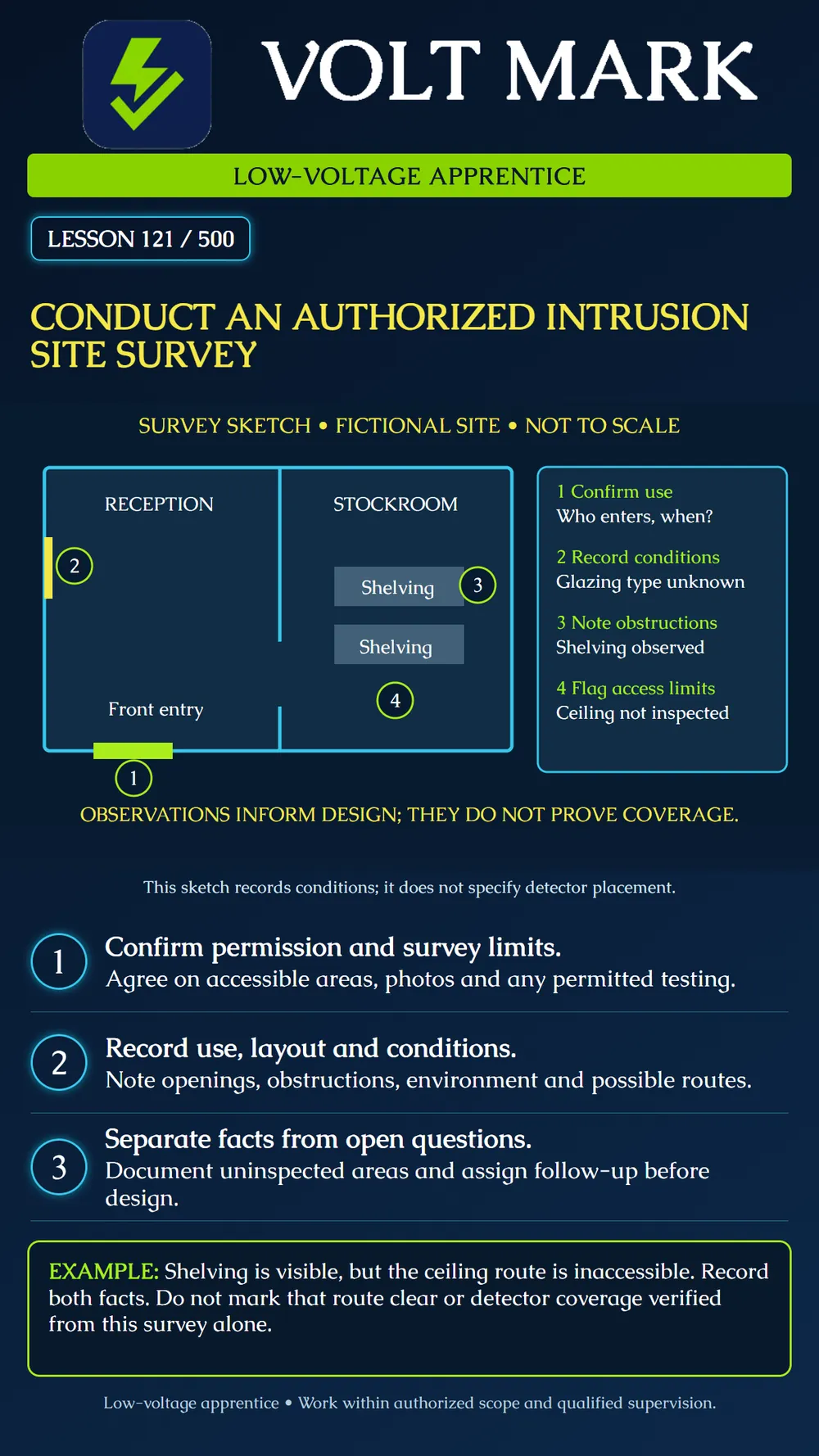
The poster shows a reception area and a stockroom, not to scale. Its numbered notes are survey observations and questions, not zone numbers.
The room plan is an original teaching sketch. Its proportions do not establish distance, mounting height, cable length or the number of required detectors. The green entry marker identifies an opening, not an installed contact.
A useful finding says what is known, how it is known and what is needed next. For example: "Stockroom shelving observed during escorted walk-through; dimensions not measured; supervisor to determine the measurements needed for design." That is more useful than "coverage okay."
Log inaccessible rooms or pathways with a reason and an owner for follow-up. Do not silently omit them from the report. Identify changes that would require revisiting the design, such as a proposed storage layout. A survey is a dated snapshot, not a guarantee of future site conditions.
Use an authorized training room or supervisor-provided plan. Create four numbered observations linked to a sketch. Include one directly observed condition, one reported operating requirement, one measurement and one unresolved item. Have a partner locate every observation from the sketch. Revise any vague location descriptions. Do not activate live alarm devices as part of this exercise.
Survey date and revision; authorization/contact; permitted areas and activities; room/location; drawing or photo reference; observation; evidence type (observed, measured, reported); units and method where relevant; uninspected area; open question; follow-up owner; resolution and date. Keep configuration credentials out of the ordinary survey report.
Primary manufacturer reference checked September 30, 2026: OPTEX Europe, WXI-RAM, flexible detection area and site-layout discussion: https://www.optex-europe.com/products/intrusion-detection/wxi-ram Used only for the bounded example of adapting detection areas to surroundings. No numeric product limits or universal approval claims are imported. A Bosch PDF search result was also investigated but its direct link returned 404; no claims in this lesson depend on that unavailable document. The site sketch, authorization workflow, evidence categories and exercise are original general instructional guidance, not a jurisdiction-specific legal checklist.
Free study material for low-voltage apprentices. This is a national foundation course: requirements differ by state and by local jurisdiction, and a practice that is common in one place is not a rule everywhere. Nothing here is a licence, a certification, or authority to work unsupervised, and completing it does not count as apprenticeship hours or continuing-education credit. Check the codes adopted where you are working, the licensing authority for that work, and your employer's safety programme. VoltMark is not affiliated with, endorsed by, or sponsored by NFPA, OSHA, NICET, BICSI, FOA, or any state or local licensing authority.

Electrician licensing exam prep: practice questions, timed exam simulations, and step-by-step help finding every answer in the NEC.