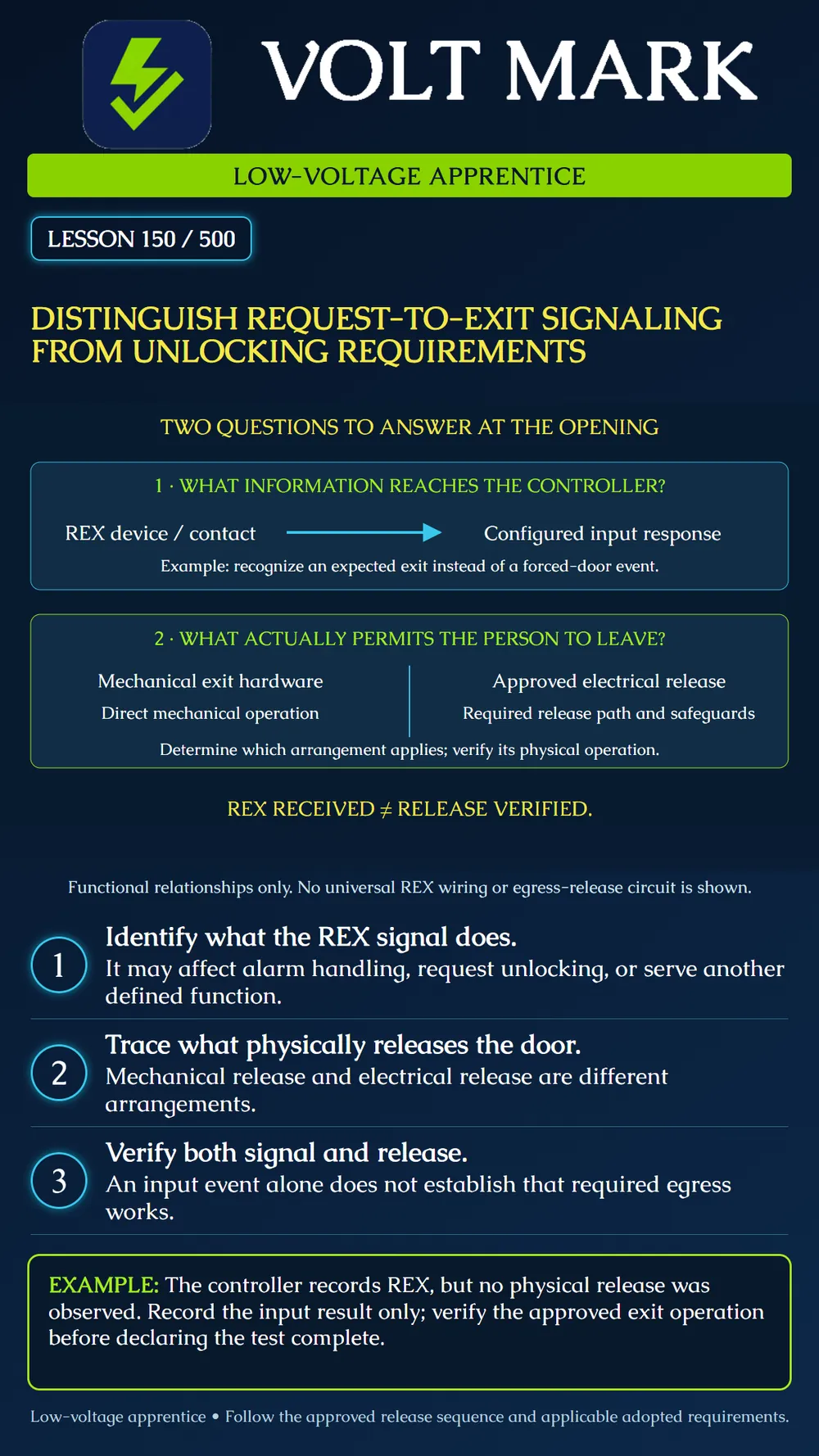
Identify the documented purpose of a request-to-exit signal and separately establish what permits physical egress at the opening.
Request-to-exit, often abbreviated REX or RX, names a signal or device function. The label alone does not describe the entire release arrangement. Ask two questions: what information reaches the controller, and what physically permits the person to leave?
On a conventional mechanically free-egress opening, an inside lever or exit device can release the door mechanically. A REX signal may tell the access system to recognize the resulting opening as an expected exit instead of a forced-door event. It need not be the mechanism that unlocks the door.
Other configurations use a REX input to request an unlock action. Still other approved electrical-release arrangements have specific requirements for the release path and its independence from control electronics. Do not substitute an ordinary software input for a required release circuit. Identify the actual arrangement, adopted requirements and approved sequence.
Axis A1001 documentation includes an option for a REX signal that does not unlock the door, with examples involving mechanical handles or push bars. It describes how that configuration affects forced-open alarm handling within the configured access period. This is a bounded product example, not a universal timer or instruction to change an installed system.
Allegion's guidance distinguishes sensors used only to notify the security system of an exit from devices that release electrical locking. It also distinguishes mechanical free-egress arrangements from special electrical-release arrangements. Device appearance and the term REX do not establish which category applies.
The lesson diagram is a functional comparison. Its upper arrow carries information to the controller. The lower area asks which actual release arrangement applies. These are not conductor routes or a complete emergency-release circuit.
An instructor activates a trainer's REX contact. The controller records the input. The worksheet contains no observation of the physical hardware, yet a trainee marks "exit release passed."
Correct the record to show only the demonstrated input response. The missing evidence is the actual release operation required by the approved training sequence. Obtain that sequence before deciding what test remains. An input record and a physical release observation answer different questions.
In a second fictional example, mechanical exit hardware allows departure while the configured REX input prevents an expected opening from being classified as forced. If the input fails, the resulting nuisance event does not automatically mean the mechanical exit path failed. Evaluate and document each function. Conversely, a clean event log does not establish that occupants can exit.
Identify the opening and exact hardware set. Identify each relevant device, contact and controller input. State whether the REX function requests unlocking, changes alarm interpretation or performs another documented role. Trace the actual physical release mechanism. Identify required independent release functions and interfaces from the approved design. Match each test to the function it proves.
Do not assume a door-mounted switch always has one purpose or a motion sensor always has another. A physical device may provide multiple contacts with separate functions. The model instructions, wiring documentation and approved sequence establish their use.
Use a tabletop trainer or an explicitly authorized demonstration opening. Make a two-column worksheet labeled signal evidence and release evidence. Before the demonstration, predict each documented response.
Record the input indication, event reference and timing where relevant. Separately record the physical operation actually observed under the supervisor's procedure. Mark untested conditions clearly. Do not disable a release, alter alarm behavior or interrupt an occupied exit's power to create a classroom example.
For a discrepancy, describe the observation rather than guessing the cause. "REX input event recorded; release operation not observed" is traceable. "REX works" is too broad unless the record defines exactly which function was tested.
Opening / approved sequence revision: Device / contact / controller input: Documented signaling purpose: Actual mechanical or electrical release arrangement: Required independent release references: Signal observation and event reference: Physical release observation: Untested conditions / discrepancy: Responsible reviewer and follow-up:
Does REX always mean the controller must unlock the door? No. Does a recorded input prove physical release? No. Can mechanical egress operate separately from an alarm-handling signal? Yes, in the appropriate arrangement. Can a software setting replace a required independent release? No. What determines the required sequence? The approved design, applicable adopted requirements and product instructions.
Primary sources checked September30,2026: Axis, AXIS A1001 and AXIS Entry Manager, reader and REX device options: https://help.axis.com/en-us/axis-a1001 Allegion / Lori Greene, Electrified Hardware and Special Locking Arrangements: https://idighardware.com/sla/ Original diagram, trainer scenarios and worksheet; no actual opening tested or approved. This lesson does not prescribe a universal release circuit, code edition or timer.
Free study material for low-voltage apprentices. This is a national foundation course: requirements differ by state and by local jurisdiction, and a practice that is common in one place is not a rule everywhere. Nothing here is a licence, a certification, or authority to work unsupervised, and completing it does not count as apprenticeship hours or continuing-education credit. Check the codes adopted where you are working, the licensing authority for that work, and your employer's safety programme. VoltMark is not affiliated with, endorsed by, or sponsored by NFPA, OSHA, NICET, BICSI, FOA, or any state or local licensing authority.

Electrician licensing exam prep: practice questions, timed exam simulations, and step-by-step help finding every answer in the NEC.