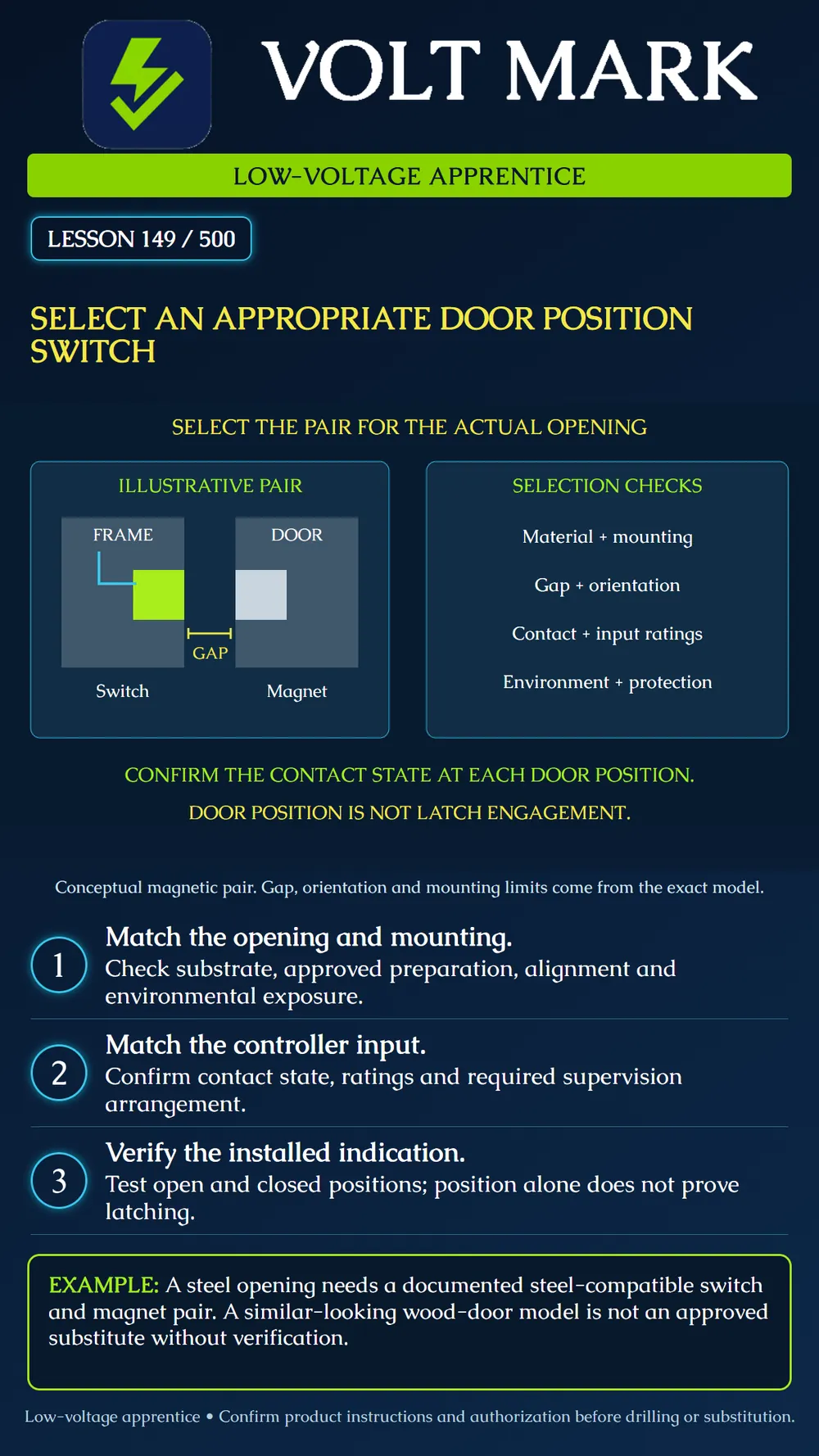
Select a documented door-position sensing arrangement that fits the opening and controller input, and distinguish its indication from lock engagement.
A door position switch supplies information about the position it is designed and installed to sense. A common arrangement uses a magnetic switch and a matched magnet. The poster illustrates that pair across an opening gap; it does not prescribe a model, orientation, mounting dimension or wiring circuit.
Begin with the actual opening. Identify door and frame construction, permitted preparation and available mounting space. Determine whether the approved design calls for recessed or surface-mounted equipment. Inspect the relevant product instructions before selecting hardware. A contact that fits visually may not suit the substrate or intended sensing distance.
Manufacturer examples make this distinction concrete. Securitron lists DPS-M and DPS-W variants for metal and wood applications and describes a larger magnet to address steel's shielding effect. GRI offers multiple recessed, surface and application-specific switch families. These examples support matching a product to its conditions; they do not make every device within a family interchangeable.
Use the exact paired components and documented sensing geometry. Confirm the permissible gap, orientation, offset and mounting conditions. A catalog gap value is not an installation target that overrides the door assembly's own requirements. Do not enlarge a door gap to fit a sensor, or substitute a random stronger magnet when the installed indication is unreliable.
Identify the controller input and how the switch is expected to behave at each door position. Check the model's contact form and ratings against the documented input circuit. Do not connect a signaling contact directly to a lock load simply because both involve low voltage.
Interpret labels such as normally open and normally closed using the manufacturer's stated reference condition and the system's wiring diagram. Write down the actual expected electrical state with the door open and closed. If supervision is required, use the specified circuit and components for that input; there is no universal resistor value supplied by this lesson.
Environment and cable protection also affect selection. Confirm documented suitability for exposure, temperature and physical conditions. A recessed indoor component is not automatically appropriate for an exposed industrial opening. Protect conductors using the approved installation method and preserve required opening labels and construction.
A fictional steel training opening requires a recessed magnetic pair. Candidate A is documented for the specified steel application; Candidate B is a similar-looking product described for a wood application. The trainee selects A for further verification rather than substituting B by appearance.
Selection is not complete yet. The supervisor provides the exact data sheets, permitted preparation, expected gap, controller-input documentation and environmental conditions. The trainee compares each requirement and records unresolved items. If A fails another requirement, its steel compatibility alone does not make it acceptable.
In a second fictional observation, a correctly selected pair reports closed even though the latch has not seated. That is a reminder about scope: position sensing is not latch monitoring. Evaluate mechanical engagement separately rather than renaming the closed indication secure.
Use an approved trainer and its supplied matched components. Identify the switch and magnet, compare the arrangement with the model instructions, and record expected states before observing the demonstration. Check both opening and closing movement using the authorized method. Record actual results and any intermittent change.
If the indication is inconsistent, document alignment, mounting material and the observed position where it changes. Do not publish an unmeasured distance. Have the supervisor determine whether the cause is selection, mounting, wiring, configuration or another condition before proposing a correction.
Opening identifier: Door and frame construction: Switch model and matched magnet: Surface or recessed mounting / approved preparation: Documented gap and orientation conditions: Contact form and electrical ratings: Controller input and supervision reference: Environmental suitability: Expected open / closed electrical states: Observed indication / unresolved question: Reviewer and approved disposition:
Does matching physical size establish compatibility? No. Why identify steel construction? It can affect magnetic operation and product selection. Can a generic gap replace the model instructions? No. Does a closed indication prove the door is locked? No. Should supervision components be chosen from habit? No; follow the input's specified arrangement.
Primary manufacturer sources checked September 30, 2026: Securitron, DPS Door Position Switches, catalog page updated January6,2026: https://www.securitron.com/content/dam/assa-abloy/americas/ems/securitron/document/AADSS1204550.pdf GRI, Recessed Magnetic Contacts: https://www.grisk.com/products/magnetic-reed-switches/recessed-magnetic-switches/ GRI, Magnetic Reed Switches: https://www.grisk.com/products/magnetic-reed-switches/ Numerical catalog gap conversions were not reproduced; use the model's controlling documentation for actual installation. The graphic and exercises are original teaching material, not a product approval or installation template.
Free study material for low-voltage apprentices. This is a national foundation course: requirements differ by state and by local jurisdiction, and a practice that is common in one place is not a rule everywhere. Nothing here is a licence, a certification, or authority to work unsupervised, and completing it does not count as apprenticeship hours or continuing-education credit. Check the codes adopted where you are working, the licensing authority for that work, and your employer's safety programme. VoltMark is not affiliated with, endorsed by, or sponsored by NFPA, OSHA, NICET, BICSI, FOA, or any state or local licensing authority.

Electrician licensing exam prep: practice questions, timed exam simulations, and step-by-step help finding every answer in the NEC.