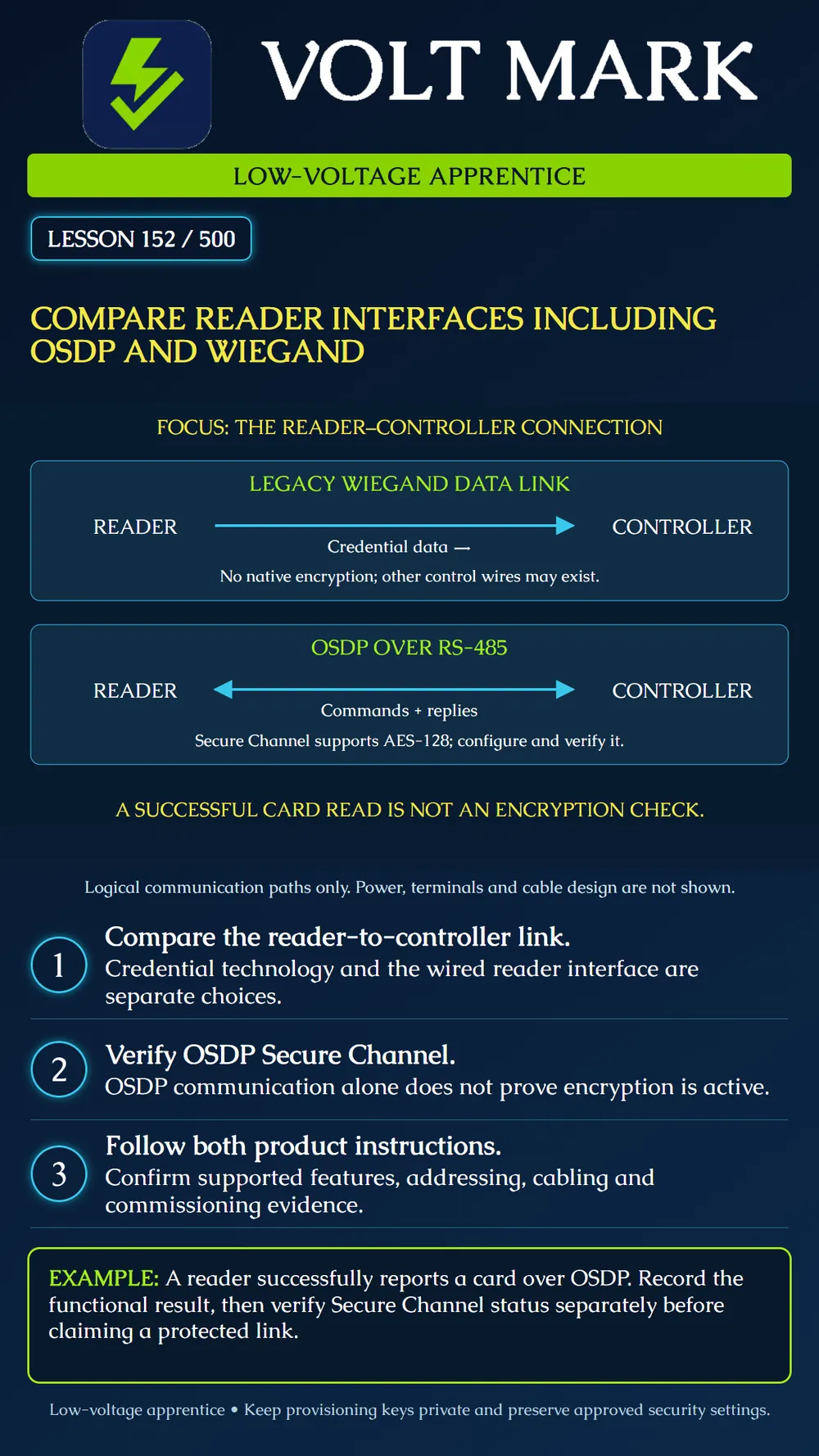
Distinguish common reader-controller communication arrangements and separate functional communication from verified Secure Channel operation.
The credential technology is the method by which a card, token or supported mobile credential communicates with a reader. The reader-controller interface is another part of the system. Changing the wired interface does not automatically change which credential applications the reader supports.
Legacy Wiegand sends credential data from the reader toward the controller. Its data link does not provide native encryption or the command-and-reply supervision offered by OSDP. Separate conductors may control reader indicators or provide other signals, so saying the credential data is one-way does not mean every conductor at a Wiegand reader carries information in only that direction.
OSDP, the Open Supervised Device Protocol, supports bidirectional reader-controller communication over RS-485. The controller can send commands and receive replies. Product support and configuration determine the available functions. Confirm the selected reader and controller together; the protocol name is not proof that every feature in one product exists in the other.
SIA's OSDP guidance identifies Secure Channel as supporting AES-128 protection. Secure Channel must be correctly provisioned and its operation verified. A reader that transmits a card successfully is not, by that observation alone, proven to have an active protected link.
The poster compares logical communication paths. Its arrows are not a terminal map. It omits reader power, grounding or reference requirements, auxiliary controls and cable details. Do not wire from the graphic.
Identify the reader model, controller model, supported firmware and configured interface. For an OSDP installation, confirm the manufacturer-prescribed addressing and communication settings. Follow the documented cable, topology, termination and power requirements. Do not assume every existing Wiegand cable is suitable simply because it has enough conductors.
Where Secure Channel is required, use the authorized provisioning procedure and verify the operating status using supported product evidence. Do not copy encryption keys into a classroom worksheet or general handover file. Do not leave a reduced-security setup in place merely because it makes an initial communication test pass.
SIA's deployment checklist recommends a bench test that includes basic reader functions and successful Secure Channel configuration and negotiation. This is useful preparation for a supported installation. It does not replace the project's full commissioning and acceptance process.
A fictional trainer reads Card T-152 over OSDP. The event log identifies the card, but no Secure Channel status is included in the record. The trainee marks "encrypted."
Correct the record to distinguish the demonstrated card transaction from the unverified security state. Obtain the supported status or diagnostic evidence under supervision. The missing check is specific; there is no need to guess that encryption is either on or off.
In a second example, a reader and controller communicate but a particular indicator command does not work. Compare the documented capabilities and configuration of the selected products before declaring the entire protocol incompatible. Keep the observed failure narrower than the conclusion.
For a Wiegand link, record the supported data format and the actual controller interpretation. For OSDP, record the supported communication settings, device identification and relevant function checks. In either case, the access rules still determine whether a recognized credential is permitted to enter.
Do not confuse a readable credential, a working interface and an authorized entry. They are three separate observations. A credential can be read through a functioning interface and still be denied by the correct access rule.
This introductory comparison does not prescribe a maximum distance, a universal cable type or a single termination layout. Those choices depend on the applicable interface requirements and selected products. Document the approved design instead of importing a value from an unrelated installation.
Use a non-production trainer and authorized test credentials. Draw the credential-reader relationship separately from the reader-controller link. Identify which link is being evaluated in each test.
Record a functional credential transaction and a supported indicator or keypad check where applicable. For the OSDP trainer, separately record Secure Channel evidence and the prescribed supervision check, if performed. Mark unperformed checks not tested. Never invent status from the presence of an OSDP menu item.
Reader / controller / firmware references: Credential technology: Reader-controller interface and approved settings: Cable and topology document reference: Functional observations: Secure Channel status and evidence, where applicable: Supervision test and evidence, if performed: Unsupported features / unresolved items: Authorized reviewer and final configuration:
Does OSDP identify the card's radio technology? No. Does a successful OSDP read prove Secure Channel is active? No. Can legacy Wiegand have separate indicator-control wires? Yes. Should provisioning secrets be stored in a general lesson worksheet? No. Does a recognized credential always receive access? No.
Primary standards-organization sources checked September30,2026: SIA, Don't Be Intimidated by OSDP: https://www.securityindustry.org/2022/10/06/dont-be-intimidated-by-osdp/ SIA, Implementing OSDP Access Control? Follow This Simple Checklist: https://www.securityindustry.org/2026/02/10/implementing-osdp-access-control-follow-this-simple-checklist/ SIA, Open Supervised Device Protocol: https://www.securityindustry.org/industry-standards/open-supervised-device-protocol/ The diagram, scenarios and record are original teaching material. No live configuration, security audit or compatibility certification is claimed.
Free study material for low-voltage apprentices. This is a national foundation course: requirements differ by state and by local jurisdiction, and a practice that is common in one place is not a rule everywhere. Nothing here is a licence, a certification, or authority to work unsupervised, and completing it does not count as apprenticeship hours or continuing-education credit. Check the codes adopted where you are working, the licensing authority for that work, and your employer's safety programme. VoltMark is not affiliated with, endorsed by, or sponsored by NFPA, OSHA, NICET, BICSI, FOA, or any state or local licensing authority.

Electrician licensing exam prep: practice questions, timed exam simulations, and step-by-step help finding every answer in the NEC.