Build a resource ledger from the correct product documentation and identify limits that cannot be established by counting terminals.
A controller or expansion board has several capacities. Door count, supported readers, monitoring inputs, relay outputs, downstream devices and electrical output limits answer different questions. Do not reduce them to a single number such as a four-reader board without examining what that means for the opening design.
Read the exact model, hardware revision and applicable firmware or software documentation. Identify which functions reside on the controller and which require a supported expansion module. An expansion board is not necessarily an independent controller. Confirm the supported host, connection method and system limits.
Primary examples illustrate the distinction. Axis describes the A1610 as controlling two doors with four reader connections. Mercury describes MR52 reader-interface resources separately, including reader connections, monitoring inputs and control relays. Those are manufacturer examples, not the specifications of the fictional ledger on this poster.
Assign resources from the approved opening sequence. A door can use more than one reader or several monitoring points. Additional relays may serve auxiliary functions rather than additional doors. Count the actual assignments instead of assuming that every spare terminal creates another supported opening.
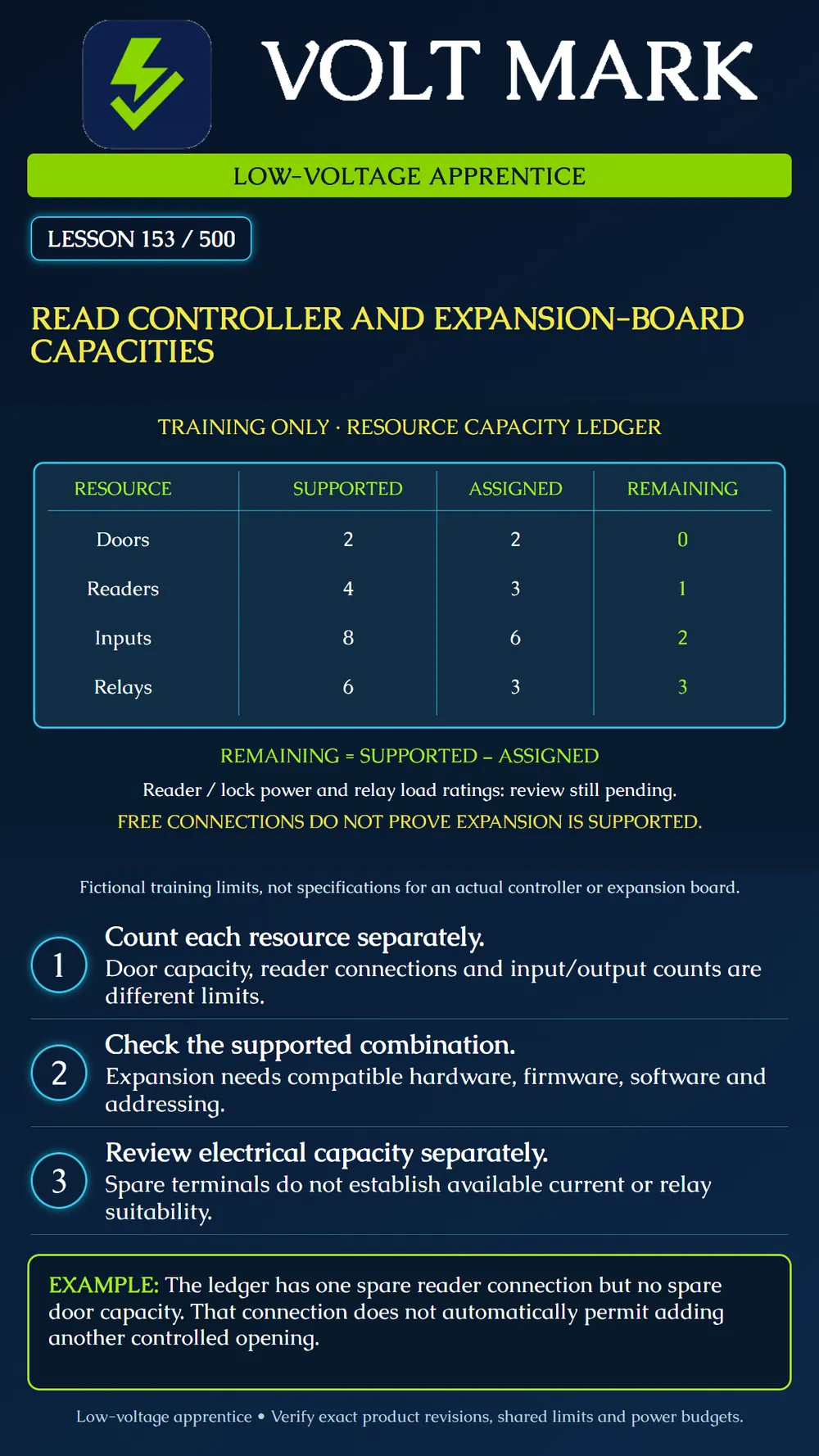
The instructor supplies these fictional supported limits for one configured training system: Doors: supported2, assigned2, remaining0. Readers: supported4, assigned3, remaining1. Inputs: supported8, assigned6, remaining2. Relays: supported6, assigned3, remaining3.
The arithmetic is subtraction within each resource type. Do not add one reader connection and two input points to claim three spare doors. These are different resources with different roles.
The exercise does not identify a real product. It also does not prove that any electrical load can be added. Power and relay-load reviews remain pending. The row counts are only one part of the design assessment.
For proposed expansion, identify the supported module and its connection to the controller. Check addressing or device-count constraints and software or licensing conditions where applicable. Confirm whether capacities are per port, per board, per controller or per system.
Some limits are shared. Axis's A1610 manual, for example, describes a reader-power allowance shared across reader ports. A per-system allowance cannot be multiplied by the number of terminals. Read the conditions associated with each rating, including the supply method. Use the applicable product revision for an actual design.
Separate relay contact capability from the power available to supply a load. A contact's switching rating does not create that current at the terminals. Confirm whether an output provides power or switches an external circuit, and follow the specified load and protection requirements.
Reader and lock electrical budgets need their own review. Include the documented operating conditions and relevant peak loads. Spare logical capacity is insufficient if power, wiring, protection, enclosure or supported topology is inadequate.
The fictional system already controls its two supported doors. A trainee proposes adding a third because one reader connection is unassigned.
Explain the error: the spare reader does not remove the two-door limit. The responsible designer must determine whether a supported expansion arrangement exists and whether the rest of the system can support it. Do not parallel readers, reassign inputs or bypass software limits to make the proposal appear feasible.
In a second exercise, the trainee finds an output rating and treats it as a supply rating. Ask them to locate the actual power-output specification and source architecture. Mark the electrical capacity unresolved until the appropriate evidence is available.
Use approved sample documentation and an opening schedule. Prepare a row for every relevant resource and show supported, assigned and remaining counts. Beside each supported value, record the document and scope of the limit.
Have a second trainee trace one assigned reader, input and relay back to the opening sequence. Then identify which electrical and system-level questions remain unanswered. This practice is a documentation exercise, not permission to connect loads or reconfigure the controller.
Controller / board / revision: Firmware and host software: Resource / documented limit / scope: Assigned functions and opening references: Remaining arithmetic: Expansion compatibility and addressing: Shared power and per-output ratings: Supply conditions and unreviewed loads: Unresolved item / reviewer / disposition:
Does four readers necessarily mean four doors? No. Can a spare relay establish a spare supported door? No. Is a relay switching rating a power-supply output rating? No. How many inputs remain in the fictional ledger? Two. Does the ledger approve adding a load? No; other limits remain to be checked.
Primary manufacturer sources checked September30,2026: Axis, A1610 Network Door Controller: https://www.axis.com/products/axis-a1610 Axis, A1610 User Manual, shared reader-power information: https://help.axis.com/en-us/axis-a1610 Mercury, MR52 Dual Card Reader Interface Panel: https://www.mercury-security.com/products/mr52/ The numerical ledger is explicitly fictional; it does not combine these products into a certified design. Diagram, scenarios and worksheet are original teaching material.
Free study material for low-voltage apprentices. This is a national foundation course: requirements differ by state and by local jurisdiction, and a practice that is common in one place is not a rule everywhere. Nothing here is a licence, a certification, or authority to work unsupervised, and completing it does not count as apprenticeship hours or continuing-education credit. Check the codes adopted where you are working, the licensing authority for that work, and your employer's safety programme. VoltMark is not affiliated with, endorsed by, or sponsored by NFPA, OSHA, NICET, BICSI, FOA, or any state or local licensing authority.

Electrician licensing exam prep: practice questions, timed exam simulations, and step-by-step help finding every answer in the NEC.